
In the opening piece in this series, we looked at the Philadelphia Phillies, a team almost certain to be a major player in this winter’s free agent market. In addition to being a fun look at a key market participant, that piece also sets forth some key assumptions to be used in this series regarding financial information available to the public.
With Philadelphia in our rear view mirror, we turn our attention to the biggest spender in recent years: the Los Angeles Dodgers.
Team Leadership
Despite being a marquee franchise, the Dodgers found themselves embroiled in a quagmire during much of the last decade, with Frank McCourt’s tumultuous ownership ending with a bankruptcy sale to Guggenheim Partners in 2012. Guggenheim — consisting of Mark Walter, Magic Johnson, Stan Kasten, Peter Guber, Bobby Patton, and Todd Boehly — added Billie Jean King and Ilana Kloss as minority owners in 2018, comprising the current group. As is well known, they have spent aggressively throughout their ownership, fueled in large part by an $8.3 billion, 25-year television rights deal with Time Warner.
After directing a run of success in Tampa Bay, Andrew Friedman joined the Dodgers as President of Baseball Operations on a lucrative five-year, $35 million deal after the 2014 season. Despite that massive contract, this is actually a time of some uncertainty with the front office. Friedman named Farhan Zaidi his general manager shortly after taking over in 2014, but Zaidi left to run the rival Giants earlier this month. It is also worth noting that the Dodgers have yet to guarantee an outside free agent even $50 million during Friedman’s tenure.
Historical Payrolls
Before hitting the numbers, please recall that we use data from Cot’s Baseball Contracts, we’ll use average annual value (“AAV”) on historical deals but actual cash for 2019 and beyond, and deferrals will be reflected where appropriate. And, of course, the value of examining historical payrolls is twofold: they show us either what type of payroll a team’s market can support or how significantly a given ownership group is willing to spend. In the most useful cases, they show us both.
As with the Phillies, we’ll focus on a 15-year span for the Dodgers, covering 2005-18 for historical data as a means to understanding year 15: 2019. We’ll also use Opening Day payrolls as those better approximate expected spending by ownership. With the Dodgers, this captures nearly the entirety of the McCourt years and all of Guggenheim’s free spending ways. Here is what the Dodgers have spent in the prior 14 seasons:
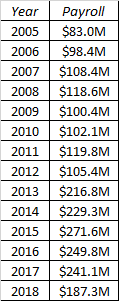
The Dodgers payroll story tracks the story of their ownership changes remarkably well. In the mid-2000s, McCourt increased spending to build a winner before corralling expenditures as his divorce from ex-wife Jamie and the effects of purchasing the team with so much debt caught up with him. Then the Guggenheim folks showed up and blew the top off of what most of us thought was the ceiling for spending outside of the Bronx. Importantly, the figures above do not include luxury tax payments, meaning that Dodgers spending was actually notably higher over that span thanks to the taxes that accompanied their lavish spending.
Unlike Philadelphia, the Dodgers were substantial players in the Latin American amateur market before Major League Baseball imposed significant spending restrictions, handing out substantial deals to the likes of Yadier Alvarez, Yusniel Diaz, Omar Estevez, and Erisbel Arruebarrena. In the end, as gaudy as the Major League spending figures were, amateur spending added a significant amount to overall expenditures reflected above, at least during the Guggenheim period of ownership.
Future Liabilities
For a team known for its massive spending habits, the Dodgers have surprisingly little in the way of long-term guarantees, especially when compared to other big spenders in major markets competing for the World Series each year.
Here is a look at their future guarantees with the powder blue highlight indicative of a player option — in the case of Kenley Jansen, this is an opt-out prior to the 2020 season. As mentioned above, note that the numbers shown on here are cash payments by year, not the salary plus the prorated amount of any bonus. The AAV column captures the player’s luxury tax number.
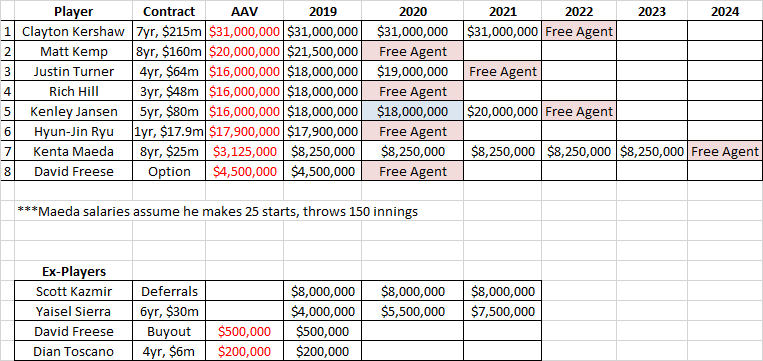
The Dodgers’ new deal with Clayton Kershaw gives them an ace on a reasonably short-term deal. While the annual financial commitment is high, the Dodgers must have been pleased to keep the term so modest.
Beyond Hill, their salary sheet is loaded with short-term commitments until we hit Maeda. Maeda’s contract is heavily incentive driven. Maeda receives $3 million annually, then receives the following incentives:
- $0.15 million for making Opening Day roster
- $1 million for each of 15 and 20 starts, then $1.5 million for each of 25, 30, and 32 starts
- $0.25 million for each of 90, 100, 110, 120, 130, 140, 150, 160, 170, 180, and 190 innings pitched, then $0.75 million for 200 innings pitched
It is an extraordinarily team-friendly pact, one that has played out handsomely for Los Angeles. From a budgetary standpoint, however, it does present plenty of uncertainty.
At the bottom of the chart, we see two lines with hefty numbers but no tax component. First, we see the remaining half of the $48 million owed to Scott Kazmir from his three-year deal covering the 2016-18 seasons. Instead of receiving $16 million per year or something close to it, Kazmir received $8 million annually for six years. As such, he will receive his $8 million annual payouts in 2019-21, but those cash receipts won’t count against the Dodgers’ luxury tax figure. Cuban pitcher Yaisel Sierra obtained a substantial guarantee from the Dodgers, but he is yet to pass Double-A and didn’t record an inning in affiliated ball in 2018. Because L.A. removed him from their 40-man roster (under a rule that has now been amended), his significant cash guarantees do not count against the luxury tax figure for the Dodgers either.
Moving to arbitration, the Dodgers feature a pair of massive paydays for pending free agents in Yasiel Puig and Alex Wood. On the other hand, they appear to have “lucked” into artificially deflated arbitration pay rates for shortstop Corey Seager due to a poorly timed injury in his platform year. Here are the arbitration statuses (salary projections by MLBTR and Matt Swartz):
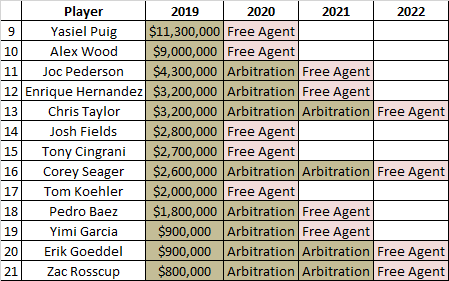
The Dodgers have a number of key contributions controlled via arbitration, but as is the case with most teams, there are some players here who stand a good chance of being non-tendered. From this viewpoint, it looks like Koehler, Garcia, and Rosscup will likely get the boot. Regardless of what happens with that trio, only a couple of million dollars in savings are there to be found.
What Does Team Leadership Have to Say?
This is where things get interesting. Really interesting. Last week, the Bill Shaikin of the Los Angeles Times got hold of a document prepared by the Dodgers before the 2017 postseason for potential investors indicating that the club intended to stay below the luxury tax threshold each year from 2019-22. This would be a striking shift from the free-spending club. The document pegged future payrolls roughly $5 million south of the luxury tax threshold in each season once player benefits are factored in, as they are for luxury tax purposes, projecting payroll at $185 million in 2019 and 2020, $191 million in 2021, and $196 million in 2022.
Will such a spending restriction come to fruition? Your guess is as good as mine. It’s worth stressing that the document was prepared before the 2017 postseason and that Shaikin cited a team official as saying that he would be “shocked” if the payroll stayed below $200 million in 2019. The team’s plans might have changed in the last 13 months, especially after back-to-back World Series losses. But one significant data point out there regarding Dodgers spending in 2019 suggests that the 2018 payroll will be far more predictive of spending in 2019 and beyond than were the payrolls from 2013-17.
Are the Dodgers a Player for Bryce Harper or Manny Machado?
Simply put, this depends on how you feel about the two preceding paragraphs. If the Dodgers haven’t altered their plans since that document was prepared, it’s difficult to see them making a serious push for either player. If the Dodgers were merely posturing with the leaked document or setting forth an aspirational threshold that they don’t actually expect to hit, Harper or Machado is surely in play as the franchise continues to be flush with cash as they chase a World Series title that has proved elusive. (Those same leaked projections also predicted significant revenue increases.)
What Will the 2019 Payroll Be?
The standard disclaimer: ownership and management knows the actual budget whereas we’re focusing on historical data and other relevant factors to project future spending in the immediate and more distant years to come.
Whereas the Phillies will clearly spend and spend big, the Dodgers enter this offseason as a wild card. They have enough talent on the Major League roster and in the upper levels on the farm to expect another excellent season in 2019 without marquee additions this winter. They lack an obvious hole — provided, at least, that the Dodgers believe in Matt Kemp’s 2018 resurgence. Of course, even if they don’t buy into Kemp repeating his surprising success, Alex Verdugo is likely ready to jump to the big club to take his job.
If the Dodgers are serious about capping their spending south of the tax line, they won’t make a big move. Even removing Koehler, Garcia, and Rosscup, the Dodgers are projected to spend $196.5 million including the hits for Kazmir, Sierra, and Toscano. Removing that trio, they are still at $184.3 million. There just isn’t enough payroll space to make a splash. If, on the other hand, the Dodgers get serious about Harper, they could create enough financial wiggle room to sign him by upping payroll by a few million dollars, shipping out Puig, and trading one of their lefty starters: Wood, Rich Hill, or Hyun-Jin Ryu. Friedman would likely be able to find a market for his moderate-sized contracts should he elect to go that route, though Ryu would have to approve any deal before June 15th of 2019 since he accepted a qualifying offer and is therefore treated like a signing free agent.
While it seems crazy to think that they’ll actually hold tight to their purse strings, the presence of impact talent on the farm and a strong Major League roster lends credence to the idea that L.A. could roll into 2019 with their core largely intact from 2018, allowing Machado to leave in free agency after a mercenary visit while passing on the chance to bring Harper back to the Southwest. Crazier things have happened.
We’ll find out if I’m a chump for believing this in the coming weeks.
Projected 2019 Payroll: $195 million
Projected 2019 Payroll Space: -$1.5 million
Just jumping up the list of my favorite authors.
Question. Mccourt owns joint venture “rights” to develop the parking lots. When he dies, (not hoping for it) do the Dodgers get the economic interest of parking lots back? I want them to own 100% of the team, stadium, and parking lots.
Dodgers owners still pay McCourt $14M per annum year to rent the parking lots in a 99 year lease
lol, you read that and posted within 2 mins. You are amazing.
He’s an MLBTR icon.
He’s a baseball cyborg
That makes ey an MLBTR Terminator!!!
She’s the Borg
No I just wanted to be first. 🙁
The parking lots were the reason Torre group backed off the bidding for the Dodgers, paved the way for Guggenheim’s $2B bid.
McCourt doesn’t get a cent of revenue from gate receipts, 100% of parking revenue goes to the LAD, he just has 50% economic interest only IF parking lots gets developed, but Dodger owners keep 100% of parking lot ticket gate receipt sales. make sense?
just want them to get those parking lots’ rights back. Guessing that 99 year lease is legally binding
If dont develop it, that joint venture means nothing
No one ever knows the answer.. searched many times. was hoping Rob would know.
Was wondering what it would take for Dodger ownership to buy out McCourt, or if they still have to pay 99 year lease, if McCourt’s died?
Thank you for your time, this guy is really financially savvy, thought it was worth more ridicule. Here’s to Guggenheim buying out the last of McCourt
Forgot “/s” next to “want to be first.” Nooo!! 🙁
Can’t give more trolls material. Worth the triple post. Dodgers aren’t my team,
They just own a lot of assets, and like their arch-nemesis, SFG, they own their Stadium. Sucks McCourt remains involved by a thread,
Wondering what it would take to take back the 50%. Paying the lease for 99 years, or if he dies before? Not like LAD owners needs more money, but deserve it over McCourt, respect spend more than McCourt Wilpon-clone
The LAD BK. A topic worthy of a book longer than a Russian novel. However, the author would have to navigate through more disgusting waste than Andy, when he escaped Shawshank. The key points were:
1. The LAD never were bankrupt, only the McCourts personally;
2. McCourt had a deal with Fox sports for billions less than the true value of the TV rights but MLB would not approve it so McCourt — with Fox Sports backing and legal help — filed a BK thinking he could make the deal and keep the Dodgers. (Like Mo Greene , he didn’t understand who he was dealing with.)
3. Once Time Warner and a number of Billionaire investors learned that the BK Court had control of the LAD franchise NOT MLB and the other owners it was TEGWAR. (see “Bang the Drum Slowly”)
4. With a clueless BK judge in charge — the lawyers for the big money guys cut everything up leaving a truly weird result not only with the parking but also the TV rights. There still is no TV for many LAD fans unless they have Time Warner.
5. All of the true details were worked out in a back room — no cigar smoke, it was LA, but just as shady as anything Boss Tweed could have dreamt up.
If any of the above resembles real people or events it was not intended.. After all I do not want to be sued for libel even if truth is an absolute defense.
*Spectrum.
Time Warner Cable basically went bankrupt thanks in part to overpaying for Dodgers & Lakers rights. Charter bought out TWC and rebranded as Spectrum. And yes, the majority of Dodger fans still cannot watch the games (legally).
Now you want to talk about shady backroom deals, let’s talk about how broke grifter McCourt was allowed to purchase the Dodgers from FOX in the first place with basically zero $$ down, after being denied in his attempt to purchase the Red Sox in the same manor.
Good summary. I remember following DodgerDivorce.com regularly during the height of the drama. One thing that interested me was the McCourt’s willingness to set fire to everything on the way out and how hard MLB (and owners) had to work to keep their books from going public. Not sure how it would’ve affected the fans or the success of the sport, but we’re probably better off.
It’s highly unlikely that McCourt’s share of the development rights to the stadium parking lots are expressed in some sort of life estate terms. What it would take to buy them out is an appraisal of the development rights McCourt owns and the Dodgers paying him that much.
If I remember correctly from when this deal went down, McCourt can sell his share of the development rights, but the Dodgers have first rights of refusal. I don’t see that happening any time soon since developing the parking lots would be as much about local politics as anything else and except for brief rumors of a companion football stadium, no plans for building anything on the parking lots has ever surfaced.
It’s worth mentioning that any construction on the parking lots at Dodger Stadium would require a massive reconfiguration of the parking for the stadium, more parking to serve whatever they were building, and an almost unimaginable amount of new transportation infrastructure improvements that nobody is really prepared to finance. We are talking probably billions.
Frank McCourt gets no sympathy from this Dodgers fan. He was a worse owner than Fox.
As for the Guggenheim opening up the checkbook, they pretty much picked up what the Red Sox had written up. And it was worth picking up Boston’s mistakes because it made the Dodgers much, much better than Frank would’ve generated through his DePo experiment.
McCourt only owns a portion of the parking lot.
He owns nothing. He owns 50% economic interest: If doesnt get developed, only gets 14M rent nothing else
He rocks. Read ’em and weep…..
Probably not. They may have first right of refusal for his stake but no way his estate gives it to them.
Just wondering: will there ever be an article about the Dodgers and the whole FBI situation? Read somewhere that the FO somehow violated RICO. It was a hot topic a month ago but there haven’t been any updates and it seems as if it’s just been brushed aside.
If there is ever any truth to it, you might find an article or two. But being a Hot Topic doesn’t really bode well for credibility.
As much of a Bryce fan that I am,
A Wood & player deal for Greinke and Goldschmidt would be enticing.
Az need to reduce the burden of financials in this trade.
Arizona would never trade them to the Dodgers. They own too much real estate in their owners head and pool
Yup, this right here. ^^^
AZ owner hates the Dodgers. lol
Bro I don’t even understand what you’re saying here. Alex wood and a player for Greinke and Goldschmidt??? I’d be pretty upset if I dealt my perennial MVP candidate for Alex Wood.
Maybe try Urias and Buehler
Is that player Kershaw? otherwise idk why Arizona is trading a top 3 1B in the league and reducing Greinke price just for Alex wood and some player not named Kershaw Bellinger Verdugo
Without a DH, I don’t think Goldschmidt fits comfortably on this roster. He would displace Muncy at 1B, a 5 WAR player last season. I get that Goldy would be a proven commodity, hedging against a fluke year from Muncy, but the acquisition cost would be high and might be better spent elsewhere. I would like to see Wood traded for a legit setup man with some control, even if we have to add.
I wonder did anyone else notice that who ever put this together has David Freeze as currently Dodger & an Ex Dodger now they can’t have it both ways. either he is on the team or he’s not
The Dodgers declined the $6 million 2019 team option and payed the $500,000 buyout instead. Then they re-signed him for $4.5 million, so whoever wrote this got it right
This series is interesting. Didn’t know about Kazmir and Maeda’s contracts. Also the signings of the international guys we can all forget. Happy Zaidi is with the Giants now. Sorry to Billie Jean King
Sorry, no fan of Huff. These articles he posts drag on way too long. There are people that enjoy listening to themselves speak… Huff seems to enjoy seeing very long winded analysis. I mean really, who cares about McCourt’s legal problems? Marital problems?
Yeah there are points where it’s like, wtf, should I read that over again lol. But it’s an in depth analysis. That’s what the series is about lol
It’s an in depth analysis of a teams financial obligations which has many moving parts from language in contracts as to how a player receives money- making roster, milestones- to deferred money to money owed in trades to arbittation projections etc. There’s ALOT to cover and idk if huff even coveted it all.
Every player has different contracts that make up the payroll. It’s lomg.cause there’s a lot to cover.
Thanks for your long-winded diatribe on why you dislike Huff.
I thought the article was very well-written. But to each their own.
@melchez no need to read the next ones pal. Heads up they’ll probably be similar.
I won’t bother.
Is every article going to ask… “Are the _____s a Player for Harper or Machado”? The answer is the same with every team… If they want to spend the money on one or two players, they can spend the money. Or, they could spread that money out and get more players. Or they can sit at home counting the money and run out AAAA players and laugh at the fans for spending their hard earned money to watch garbage.
“What Will the 2019 Payroll be” Hmmm, it depends… if they want to spend more money, they will sign some more players. If they want to cut payroll, they will trade some players…. hmmm… Genius.
He is
Im a dodger fan if they dont go out and spend some of that goldmine they are sitting on i am done with them they make it to back to back worl series and they lose both times why because of not enough pitching and need another big bat need machado or harper and frontline starter and rebuild bullpin
Rosanne Barr is a super model.
Thanks for the article I have a friend who’s a Dodgers fan who is trying convince me they only have 133 million in payroll for 2019 I couldn’t believe it without any proof and this article disproves his claimed payroll figure.
He’s actually not far off. According to spotrac the current active payroll is $131 mil and total payroll is at $145.
This article gets its number from assumptions regarding arbitration and other things. So technically your friend is a lot closer to being correct than this article currently is – but to be fair this article is billed as a “projection” so…
MLBTR’s arb projections have been incredibly accurate, and are used throughout the industry. Heck, Cot’s (now owned by Baseball Prospectus) uses them as well. These “assumptions” are pretty danged good.
Hey that’s great, I agree they do a great job here. But an accurate assumption is still, in fact, an assumption. So technically the OP’s friend is correct in current salary level, and we’ll see in February how accurate this projection is. I personally think the projection is pretty accurate.
Cool story, bro.
Kazmir was delt to braves for kemps contract. Think that needs to be corrected.
There were deferred payments to the tune of $8 mil,,that weren’t included in the Atlanta deal.
My grandson Clayton just texted me (I’m still trying to learn how to text) and told me that the dodgers plan to sign Harper. I’m so glad he keeps me in the loop
Where have you been? Harper already signed a 1 year deal with the Nationals. A royals fan said he knew for a fact.
If they sign Harper and trade Puig and Hill then Turner is their only source of RH power and he’s in the power declining years. All power comes from a potential Harper signing, Muncy, Bellinger, Seager, and Pederson. They do have Kike and Taylor though, but they’ve each supplied one 20 home run season in their careers.
“Importantly, the figures above do not include luxury tax payments, meaning that Dodgers spending was actually notably higher over that span thanks to the taxes that accompanied their lavish spending.”
So it actually cost more than 2 billion to build a team that gets absolutely demolished in the World Series.
Good business model Guggenheim Partners.
A Padres fan criticizing another team’s performance in the postseason!Oh…the irony!
No obvious holes for 2019? Uhh, how about catcher and second base? And then there is that going on three year problem of how to get the ball safely from the starter to the closer in the post season. I think that most Dodger fans would wish that memo about staying under the luxury tax cap is a “smokescreen” but long term fans have also watched the current FO place more emphasis on “competitiveness” than winning. Not that Harper or Machado guarantees a title (Machado especially not) but it gives us a wistful twinge to see the Philly owner say he wants to push his chips to the center of the table.
Testify, brother!
How’s about Puig for Weaver, Fowler, and cash.
DAryl
Anybody read how the Guggenheim owners put up $20B of their own money to back up the insurance companies they own? Or how they tried to leverage those same insurance companies to buy the Dodgers? I wouldn’t be surprised if the Dodgers are being used as collateral to back up the insurance companies. Or how they are now shopping Dodgers investment opportunities to Asian investors? If anybody thinks this ownership group is going to open up their pocketbooks to get the remaining pieces to win a World Series then I have some ocean front property in Florida to sell you.
The Dodgers are owned by an investment group, investment groups look to maximize on their investments and make a return.