
Nationals Notes: Soroka, Wood, Garcia
After moving to the bullpen with the White Sox down the stretch last year and finding great success with a 2.75 ERA and a 39% strikeout rate in 36 innings of work after converting to relief, right-hander Michael Soroka now figures to get another crack at starting in D.C. after signing a one-year deal worth $9MM. Soroka made his spring debut for his new club yesterday, posting three scoreless innings while walking one and striking out three.
Those strong results aren’t especially meaningful given the nature of Spring Training, but MASN’s Bobby Blanco noted yesterday that Soroka’s velocity was up substantially during the outing. Per Blanco, Soroka “nearly” averaged 95mph throughout the outing and topped out at 96.2mph. That’s a big step up from previous years of his career, where the right-hander has typically averaged around 93mph on his heater, with last year’s 93.5mph figure standing as his current regular season peak. One outing of just 39 pitches hardly guarantees that Soroka will be able to keep up mid-90s velocity throughout the regular season, but both Soroka himself and manager Dave Martinez appeared encouraged by the start, the latter of whom called it “very encouraging.”
“Yeah, absolutely. I think I knew I could,” Soroka said when asked about maintaining his velocity deeper into games, as relayed by Blanco. “In relief last year, for the most part, I was still throwing multiple innings. And to be honest with you, the feeling of where the fastball got to at the end of inning three was really exciting, because it feels like I can replicate it over and over again. It’s definitely the easiest I’ve ever thrown in the mid-90s… And yeah, I think after today, especially, I know I won’t have a problem, at least holding somewhere close to that.”
Soroka figures to be a fixture of the Nationals rotation this year if healthy, alongside southpaw MacKenzie Gore. Right-hander Jake Irvin, left-hander DJ Herz, lefty Mitchell Parker, veteran Trevor Williams, and NPB southpaw Shinnosuke Ogasawara are among the other candidates for the club’s Opening Day rotation as things stand. It’s a deep group of young and interesting arms, but none has posted a season that compares to Soroka at his best. A former first-round pick by Atlanta, the right-hander’s rookie campaign in 2019 was nothing short of dazzling as he posted a 2.68 ERA in 29 starts en route to a second place finish in NL Rookie of the Year voting. Soroka’s been derailed by injury woes in the years since then, but he’s still just 27 and is coming off a healthy 2024 campaign, lending optimism to the possibility he could return to form.
Elsewhere on the roster, young outfielder James Wood is still working his way back from a bout of quad tendinitis that slowed him in the early days of camp. The injury hasn’t impacted his swing, allowing him to continue to get reps as a DH, and Spencer Nausbaum of the Washington Post laid out the club’s plan for Wood to return to the field. Wood is expected to DH in today’s spring game, and with a team off-day on Monday the club plans to get Wood some outfield work on the backfields to test his ailing quad. If that goes well, it’s possible Wood could then return to the outfield in games. Wood, 22, figures to serve as the club’s everyday left fielder in 2025 after a strong debut season where he hit .264/.354/.427 across 79 games.
Elsewhere on the diamond, infielder Luis Garcia Jr. was a late scratch from yesterday’s spring lineup and was sent home from camp due to illness. As noted by Blanco, Martinez told reporters that he wasn’t yet sure when Garcia would return to action, as the Nats don’t want Garcia passing his fever around camp. Fortunately, it seems unlikely that the illness will have any serious impact on Garcia’s ability to ramp up for Opening Day later this month. The lefty enjoyed a strong season last year as he slashed .282/.318/.444 in 528 trips to the plate.
Nationals Designate Stone Garrett For Assignment
The Nationals announced Thursday that they’ve designated outfielder Stone Garrett for assignment. His roster spot goes to righty Kyle Finnegan, whose one-year deal to return to the Nationals is now official.
Garrett, 29, has appeared in parts of three big league seasons between the Nats and D-backs. He’s a lifetime .276/.341/.492 hitter in the majors, good for 25% better than average at the plate, by measure of wRC+. However, that production has been buoyed by a hefty .369 average on balls in play that’s not going to be sustained over a larger sample than Garrett’s 361 MLB plate appearances. He’s also fanned in 30.2% of his career plate appearances, leading to further questions about his ability to sustain his level of output.
Garrett also saw only six big league plate appearances in 2024, spending the rest of the season in Triple-A with a disappointing .249/.348/.333 slash. That lack of production is likely attributable — to at least some extent — to left ankle/leg surgery performed in Aug. 2023. Garrett sustained fractures in his fibula and ankle when chasing down a fly-ball and crashing into the wall at Yankee Stadium. He spent eight-plus months recovering from that gruesome injury.
The strikeout issues Garrett has faced have plagued him against righties and lefties alike. However, Garrett has shown considerably more power against southpaws. With a 30.8% strikeout rate and .362 BABIP against lefties, he’s not going to sustain his .279/.333/.541 output against them. That huge .262 ISO against southpaws should be enough to make him a viable platoon candidate, even if his average and OBP are ticketed for decline. The Nats already have a full outfield with James Wood, Jacob Young and Dylan Crews, though, and righty-swinging Alex Call is a similar platoon fourth outfielder with roughly half the strikeout rate and better defensive skills.
While Garrett has some notable red flags, he’s still an optionable corner outfielder with genuine power against lefties. That’s a skill set that could fit him into the bench mix for plenty of clubs. He’s coming off a down year, but teams might take an optimistic outlook now that he’s 18 months removed from that devastating injury. The Nats will have five days to trade Garrett, and if they don’t have a deal in place at that point he’ll be placed on outright waivers and learn whether he’s been claimed or cleared 48 hours later.
NL East Notes: Sale, Montas, Wood
Braves left-hander Chris Sale just had a tremendous bounceback season. He made 29 starts with a 2.38 earned run average, earning a National League Cy Young award. He was largely injured and/or ineffective from 2019 to 2023, which had him pondering retirement.
“I thought that it was gonna be my last year,” Sale said to the Baseball Isn’t Boring podcast about where he was at before getting traded to Atlanta. “So I went into that offseason on a mission like ‘one more year left.’… ’cause in my mind, I wasn’t walking away from baseball. I was walking away from getting hurt.”
The Red Sox traded Sale to Atlanta for Vaughn Grissom in December of 2023. At the time, as mentioned, he had been battling significant injuries for five years. Tommy John surgery in 2020 was the big one but Sale also had a stress reaction in his ribs, a fractured finger, a broken wrist suffered in a bicycle accident and a stress reaction in his shoulder blade over that span. He had a 4.16 ERA in 298 1/3 innings over those five seasons.
2024 was the final year of his extension with the Red Sox and the mounting injuries apparently had him looking towards hanging up his spikes. But he was traded to Atlanta, signed an extension that covered 2024 and 2025 with a club option for 2026, and then went on to have an excellent season in 2024. It makes for an interesting “what if” but Sale is clearly in a better spot now. The injury bug hasn’t left him entirely alone, however. He missed the final two weeks of 2024 due to back spasms and was also left off Atlanta’s postseason roster. 2024 was still a big improvement over prior years but time will tell if he can keep the good health going into his age-36 season.
Some more spring training tidbits from the NL East…
- It was reported earlier this week that Mets righty Frankie Montas has a lat strain and will be shut down for six to eight weeks. The righty is apparently a bit more optimistic than his club, however. He told members of the media today, including Anthony DiComo of MLB.com, that he’s already feeling better from his platelet-rich plasma injection and expects to be throwing again in four to six weeks. That’s still a notable period of time but it’s a bit less dire than the other timeline. He had a 4.84 ERA last year and then signed a two-year, $34MM deal with the Mets this winter. He will have the chance to opt out after the first year, though returning healthy and productive will be important if he is to consider that possibility. For now, the Mets’ rotation mix includes Sean Manaea, Kodai Senga, David Peterson, Clay Holmes, Paul Blackburn, Griffin Canning and Tylor Megill.
- Nationals outfielder James Wood has some quad tendinitis, per Andrew Golden of The Washington Post. It doesn’t bother him when he hits, so he’s been able to take batting practice but has skipped some defensive drills. Per Mark Zuckerman of MASNsports.com, Wood says he has “zero” concern but the club did send him for an MRI, which showed no structural damage. With still over a month before Opening Day, there’s plenty of time to get things in order, with Wood and the Nats both surely hoping for a clean bill of health by then. Now just 22 years old, Wood hit .264/.354/.427 in his major league debut last year and is slated to be a big part of the club’s future.
Nationals Sign Lucas Sims
2:05pm: The deal is for $3MM, per Andrew Golden of The Washington Post.
10:03am: The Nationals made a late addition to their bullpen Wednesday, announcing the signing of right-hander Lucas Sims to a one-year contract. Righty Mason Thompson, who had Tommy John surgery last March, was placed on the 60-day injured list to open a spot on the 40-man roster. Sims is represented by TWC Sports.
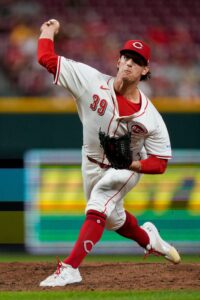
Sims, 31 in May, has spent most of his career with the Reds but was traded to the Red Sox at last year’s deadline. That deal didn’t work out especially well for Boston, as they gave up prospect Ovis Portes in exchange, while Sims then posted a 6.43 earned run average over 15 appearances around a three-week absence for a lat strain.
The Nats are surely looking beyond that unfortunate finish to his 2024 campaign. From 2019 to 2021, Sims tossed 115 2/3 innings for Cincinnati with a 4.05 ERA. He had a huge 35.2% strikeout rate over those seasons, though he undercut that somewhat with his 10.1% walk rate and some long balls.
He had a 50.6% fly ball rate in that stretch, with league average usually falling in the 35-40% range. For a guy who played his home games in homer-friendly Great American Ball Park, that wasn’t ideal and perhaps masked his true talents. He had a 3.69 FIP and 3.15 SIERA in that time. However, he strangely had a 3.75 ERA at home in those seasons but a 4.34 mark on the road.
Since then, his results have been a bit less impressive. His 2022 was largely wiped out by back issues, which culminated in surgery to repair a herniated disc. He only made six appearances that year. He returned to have a healthy 2023, tossing 61 innings with a 3.10 ERA, but his strikeout rate dropped to 27.9%. That was still above average but a notable drop from his previous work. His walk rate also ticked way up to 15.1%. A tiny .212 batting average on balls in play seemed to help him that year, which is why he had a 4.37 FIP and 4.58 SIERA.
He then posted a 3.57 ERA with the Reds last year, though with his strikeout rate falling again to 26%. His walk rate improved to 13%, a drop from the prior year but still a few ticks above average. As mentioned, he was then dealt to the Red Sox and finished the year on a down note.
Sims is a risky bet given that inconsistency but it will presumably be a fairly modest investment on the heels of his 2024 season. If he can engineer a bounceback this year, it would turn into a nice buy-low move for the Nats.
Some observers expected Washington to have an aggressive winter, but that hasn’t really come to pass. The rebuilding club has graduated a number of young players to the majors in recent years but that hasn’t pushed them to slam on the gas pedal. They have made a few additions but mostly of the short-term variety. Nathaniel Lowe was acquired to play first base and can be controlled through 2026, though he could also be traded or non-tendered depending on how things go this year. The Nats also signed Trevor Williams and Shinnosuke Ogasawara to relatively modest two-year deals and gave one-year pacts to Michael Soroka, Josh Bell, Amed Rosario, Jorge López and Paul DeJong.
In the bullpen, López and Derek Law figure to be the veteran anchors. Apart from that, it’s fairly wide open. Colin Poche is in camp as a non-roster invitee and could give them a bit more experience. Guys like Jose A. Ferrer, Eduardo Salazar, Zach Brzykcy, Evan Reifert and Orlando Ribalta are on the 40-man but no one in that group has more than 66 innings of big league experience. If the Nats and Sims get a deal done, he can join Law, López and Poche as the experienced arms in the group.
If the Nats aren’t in contention at the deadline, all of those veteran arms would be logical trade candidates. Both Law and López are slated for free agency at season’s end. Assuming Sims is only talking about a one-year deal, that would be true of him as well. Poche’s service time count is at five years and 114 days, meaning he’s just 58 shy of the six years needed for automatic free agency. If he’s on the roster before the deadline, then he would be on pace for free agency at season’s end as well.
MassLive.com’s Chris Cotillo first reported that the Nats and Sims were closing in on a deal. Mark Zuckerman of MASNsports.com reported that Sims had arrived at Nats camp and was signing a major league contract.
Lerner: Nationals Not Ready For Big Free Agent Spending
Coming into this offseason, some observers expected the Nationals to be a dark horse for the top free agents. That didn’t come to pass, which was addressed this week by owner Mark Lerner, who said that he and president of baseball operations Mike Rizzo agreed the timing wasn’t right.
“When Mike calls me in and says, ‘We really need to think about it,’ for next winter, we’ll talk about it,” Lerner said, per Barry Svrluga of The Washington Post. “Right now, he doesn’t think — and I agree with him: There’s no point in getting a superstar and paying him hundreds of millions of dollars to win two or three more games. You’ve got to wait until — like Jayson [Werth]. Jayson was right on the cusp of [the team] being really good, and it took us to the next level. That’s the ideal situation. It’s always on our mind.”
The Nationals have been firmly in rebuild mode for a while now. At the 2021 deadline, with their competitive window closing, they traded Max Scherzer, Trea Turner, Kyle Schwarber and others. The following summer, Juan Soto and Josh Bell were out the door. Though they won the World Series in 2019, they have finished well below .500 in the five seasons since then.
There have been some positive developments in that rebuild process lately. Young players like Dylan Crews, James Wood, CJ Abrams, MacKenzie Gore, Jake Irvin and others have had some big league success, to varying degrees, and are affordable as well as controllable for multiple years.
In addition to that emerging core, the club’s payroll situation looked to be in decent shape going into this winter. The six-year Patrick Corbin deal helped the Nats win a title in 2019 but his performance fell off for the final five years. That deal was backloaded, with a $12.5MM salary in the first year but a $35MM salary in the sixth. It was therefore taking up a big chunk of the payroll for a rebuilding club but finally came off the books a few months ago.
That left the Nats with few commitments going into the offseason. Catcher Keibert Ruiz is signed through 2030 but with his salary not reaching eight-figure territory unless the club picks up a 2031 option. Stephen Strasburg‘s deal is still technically on the books through 2026 at $35MM annually, though there were deferrals in there and he also agreed to some unspecified deferral package as part of a retirement settlement.
With the fairly light slate of investments and the talent percolating up from the minors, there was an argument for a big splash to signal the end of the rebuild, like the Werth deal that Lerner referenced. Going into 2011, the Nats signed Werth to a seven-year, $126MM pact after five straight losing seasons. The Nats hovered around .500 in the first season of that deal but made the postseason in 2012, the first of five they would make in that decade, culminating with their aforementioned World Series win in 2019.
That’s not how the club played it this winter, however. They did sign some veterans, inking Trevor Williams, Shinnosuke Ogasawara, Michael Soroka, Bell, Amed Rosario, Jorge López, and Paul DeJong, but most of those guys got one-year deals. Williams and Ogasawara were the only guys to get two years and no one got to three. Williams got the largest guarantee at $14MM. The club’s most significant trade pickup was Nathaniel Lowe, who is going to make $10.3MM this year. He’s controllable for 2026 and will be due another arbitration raise, but the Nats will have the ability to trade him or non-tender him, depending on how things go this year.
In short, they didn’t make the big move to signal the end of the rebuild. As Lerner alluded to, the club’s odds are long this year. The division has three stronger teams in Atlanta, the Mets and Phillies. The FanGraphs Projected Standings have the Nats coming in at 73 wins, 14 games out of third place. The PECOTA Standings at Baseball Prospectus are even less optimistic, projecting the Nats for just under 68 wins, 18 games back of third.
Those are just estimates and aren’t gospel, but it’s probable that the Nats had an internal view of their club that was somewhat similar to those numbers. While signing someone like Pete Alonso may have been exciting, he couldn’t have single-handedly made up that gap of 14-18 wins. It’s also debatable whether he’s even an upgrade over Lowe in a vacuum.
Based on Lerner’s comments, however, it does seem like such a move will come at some point. For now, they will continue to focus on developing their internal players. That should include more reps for the aforementioned youngplayers on the roster, as well as pushing prospects like Brady House, Jarlin Susana, Travis Sykora and others into the mix. They can also add to their stock of future talent in a few months, as they won the top pick in the 2025 draft lottery.
Nationals Sign Paul DeJong
9:51am: The Nationals have officially announced DeJong’s signing. Right-hander Josiah Gray was transferred to the 60-day injured list to make room for the infielder on the 40-man roster.
6:54am: The Nationals are in agreement with infielder Paul DeJong on a one-year deal that guarantees him $1MM, according to USA Today’s Bob Nightengale. According to Jon Heyman of the New York Post, DeJong’s deal includes $600K in potential incentives. The Nationals’ 40-man roster is full, but the club has multiple candidates for the 60-day IL who can be placed on the shelf to make room for DeJong once the signing becomes official.
DeJong, 31, was a fourth-round pick by the Cardinals back in 2015 and rose through the minors quickly to make his big league debut in 2017 at the age of 23. DeJong looked quite good in his first season in the majors, slashing .285/.325/.532 (123 wRC+) and clubbing 25 homers in just 108 games while splitting time between shortstop and second base. DeJong finished second in NL Rookie of the Year voting to Cody Bellinger that year, and by the time 2018 rolled around he had established himself as the Cardinals’ everyday shortstop.
Prior to DeJong’s second season with St. Louis, the sides agreed to a six-year extension that ran through the 2023 season with club options for 2024 and ’25 that guaranteed him $26MM. Over the next two seasons, DeJong clubbed 49 homers in 274 games but hit just .237/.316/.440 (102 wRC+) overall as the .349 BABIP that sustained his star-caliber rookie season crashed down to a below average .271 BABIP. Even as his bat fell to something closer to league average, however, DeJong’s strong work on defense was enough to justify his extension and place in the Cardinals’ lineup as an everyday fixture.
DeJong’s offense continued to take a tumble from there, however. While his defense remained respectable, DeJong hit just .200/.273/.352 (72 wRC+) from 2020 to 2023, and ultimately found himself bouncing between the Cardinals, Blue Jays, and Giants in the final guaranteed year of his contract extension. DeJong eventually signed with the White Sox on a one-year, $1.75MM deal last winter, hoping to rebuild his value while taking over for Tim Anderson as the regular shortstop on the south side of Chicago. 2024 turned into a solid rebound season for DeJong, as he ultimately posted a decent .227/.276/.427 (95 wRC+) slash line with 24 homers in 139 games, his best power output in half a decade. DeJong split his season between the White Sox and Royals. He moved to third base in deference to Bobby Witt Jr. upon being dealt to Kansas City and proved to be a superlative defender at the position despite his glove work at shortstop hovering around the league average.
Now that DeJong is set to join the Nationals for the 2025 season, it seems likely he’ll serve as the club’s everyday third baseman. It’s a role that previously seemed likely to go to a platoon of Jose Tena and Amed Rosario, but Tena’s career wRC+ of just 80 does not inspire confidence in him as a starting caliber player while Rosario has the versatility to move around the infield and outfield as needed while playing primarily against left-handed pitchers. It’s possible Rosario could even be tasked with spelling DeJong against some lefties, as while both veterans are right-handed hitters Rosario is a career .298/.337/.460 hitter against southpaws while DeJong actually has reverse splits both for his career and in 2024. In addition to likely serving as the club’s primary third baseman, DeJong gives the Nationals a viable backup to CJ Abrams at shortstop with better defense at the position than either Abrams or Rosario.
The signing should significantly raise the floor for the Nationals on the infield, offering the club a solid defender at third base who has enough pop in his bat to provide 20 homers a year in spite of below-average on-base ability. That’s an undeniably useful player for a Nationals club that saw its third basemen finish third from the bottom in both wRC+ (67) and fWAR (-0.4) last year. DeJong should be able to easily clear both of those benchmarks, and in doing so allow the club to be patient with top third base prospect Brady House as he establishes himself against Triple-A pitchers this season with an eye toward making his big league debut later this year. Once House is ready to take over at the hot corner, DeJong could become impressive bench depth for the Nationals or a potential trade piece over the summer, depending on where the club is in the standings at that point.
Nationals Win Arbitration Hearing Against Nathaniel Lowe
The Nationals have won their arbitration hearing with Nathaniel Lowe, the TalkNats website reports. Lowe will receive a $10.3MM salary for the 2025 season, rather than the $11.1MM salary he was hoping to land by going to a hearing.
First base was a major target area for D.C. this offseason, and the Nats addressed this need by acquiring Lowe from the Rangers for reliever Robert Garcia back in December. Lowe hit .274/.359/.432 over 2576 plate appearances (123 wRC+) in his four seasons in Texas, with a resume that includes a Silver Slugger Award in 2022, and both a Gold Glove and a World Series ring in 2023. Since the Rangers were looking to create room in their lineup and bolster their pen, the Garcia-for-Lowe trade helped both Texas and Washington check some boxes on their winter to-do lists.
Money was also a factor, as the Rangers were able to re-allocate Lowe’s projected salary towards other needs. MLBTR contributor Matt Swartz projected Lowe to earn $10.7MM, with that predicted salary falling right in between Lowe’s desired $11.1MM payday and the Rangers’ figure of $10.3MM.
An arbitration hearing is something of an awkward way for a player and a team to kick off a new partnership, yet even in defeat, Lowe’s $10.3MM salary is still a nice raise over the $7.5MM he earned in 2024. He’ll have another year of arbitration eligibility before becoming eligible for free agency following the 2026 season.
Lowe’s hearing officially wraps up the 2024-25 arbitration class. Of the 17 players who didn’t reach an agreement before the January 9 figure-filing deadline, nine went to hearings, with teams winning five of those nine cases.
Nationals Have Stayed In Contact With Kyle Finnegan
Kyle Finnegan is one of the top remaining relievers in a thinning free agent market. The righty somewhat surprisingly hit free agency when the Nationals opted not to tender him a contract for his final season of arbitration. MLBTR contributor Matt Swartz had projected the All-Star for an $8.6MM salary.
That’s a price the Nats were unwilling to pay. Washington has seemingly had interest in bringing Finnegan back at a lesser number. The sides reportedly had some conversations before the non-tender. General manager Mike Rizzo told reporters on Thursday that the Nats have “been talking to Finnegan throughout the offseason” about a potential reunion (link via Mark Zuckerman of MASNsports.com). There’s evidently still a financial gap. Rizzo declined to specify what kind of contract has been discussed beyond noting that “it takes two to tango.”
Finnegan has topped 60 innings with a sub-4.00 ERA in four consecutive seasons. He has been Dave Martinez’s primary closer for most of that time, recording 88 career saves. That includes a career-high 38 saves in 43 attempts last year. Only Ryan Helsley and Emmanuel Clase locked down more games. Finnegan concluded the season with a 3.68 earned run average across 63 2/3 innings.
Despite the gaudy save total, Finnegan’s peripherals were about average. He struck out 22.1% of opponents against an 8.9% walk rate. His 10.8% swinging strike percentage was a bit below the 11.6% league mark for relievers. That combined with a rough second half to lead the Nationals to non-tender him. Finnegan carried a 2.45 ERA and 26.1% strikeout rate into the All-Star Break. He lost nearly 10 percentage points off the strikeout rate while allowing 5.79 earned runs per nine after that.
That didn’t come with any kind of velocity drop. The 33-year-old averaged 97 MPH on his fastball in each month of the season. Opponents make a lot of hard contact against the heater, though, and they had increasing success differentiating the pitch from his splitter as the year progressed.
The Nats haven’t done much to address the bullpen. In addition to cutting Finnegan, they traded Robert Garcia to Texas for first baseman Nathaniel Lowe. They added Jorge López on a $3MM free agent deal. Japanese southpaw Shinnosuke Ogasawara could pitch in long relief, while Rule 5 pick Evan Reifert is trying to hold a middle relief job. Washington could certainly use more stability in a late-innings mix led by López, Jose A. Ferrer and Derek Law. Righty David Robertson is the top unsigned reliever, while Andrew Chafin and Phil Maton are among the next tier.
Nationals Sign Colin Poche To Minor League Deal
The Nationals announced Friday that they’ve signed left-handed reliever Colin Poche to a minor league contract with an invitation to major league spring training. He was non-tendered by the Rays earlier in the winter.
Poche, 31, has spent his entire big league career with the Rays to this point. He’s pitched in parts of four seasons, logging a collective 3.63 ERA with a sharp 27% strikeout rate, a 9.2% walk rate and a 30% ground-ball rate. His best season came in 2023, when he tossed 60 1/3 innings of 2.23 ERA ball while fanning about one-quarter of his opponents and issuing walks at a 9.8% clip.
Strong as Poche’s track record is, the 2024 season clearly wasn’t his best. He spent time on the injured list due to back and shoulder troubles, ultimately pitching only 37 1/3 innings. Poche’s 3.86 ERA was still solid, but his 21.6% strikeout rate was a career-low mark, while his 1.69 HR/9 rate was the highest of his career.
Poche’s four-seam fastball, which averaged 92.9 mph in his first three big league seasons, sat at just 91.2 mph in 2024, further suggesting that he wasn’t right physically. His slider was down about 1.5 mph from peak velocity, too, sitting at an average of 83.1 mph. Unsurprisingly, given the reduced stuff, he allowed more contact, recorded a career-low swinging-strike rate and saw opponents produce career-best exit velocity and hard-hit rates against him. The always cost-conscious Rays opted to move on a year early rather than pay Poche a projected $3.4MM salary in his final season of club control.
If Poche is back to full strength, he should have a good chance to not only make the Nationals’ bullpen but pitch in a key role. He’s been a high-leverage setup man for Kevin Cash in Tampa Bay throughout his career, logging 81 holds and a dozen saves in 225 career appearances (208 1/3 innings). Washington’s bullpen is lacking in experienced lefties — and, more broadly, just experienced relievers in general. Jorge Lopez and Derek Law are the only two Nats relievers with even two years of MLB service. Only one other, Jose A. Ferrer, even has one full year of service time.
The Nationals’ Long-Term Payroll Flexibility
The Nationals have opted for another risk-averse offseason. At the end of last season, Washington general manager Mike Rizzo teased the possibility for an impact lineup addition.
“We need a couple of bats that can hit in the middle of the lineup and take the onus off some of these good young core players and assist them in the run creation of our offense. We have the core players to be middle-of-the-lineup hitters,” Rizzo told MLB.com’s Bill Ladson. That provided some hope that the Nats would make a big free agent push, but that has not come to be.
Nathaniel Lowe and Josh Bell have been Washington’s biggest lineup acquisitions. Lowe, whom the Nats acquired from Texas for reliever Robert Garcia, has been a well above-average hitter in three consecutive seasons. He’s a legitimate middle-of-the-order bat. A reunion with Bell, who has been one of the game’s streakiest hitters throughout his career, on a $6MM free agent deal is less exciting.
Lowe, who will make between $10.3MM and $11.1MM in his penultimate arbitration season, has been Washington’s costliest acquisition for 2025. They took a $9MM flier on Michael Soroka and brought back Trevor Williams for two years and $14MM. They’ve made minimal commitments to Shinnosuke Ogasawara ($3.5MM over two years), Jorge López ($3MM) and Amed Rosario ($2MM). Williams and Ogasawara are the only players to whom they’ve committed multiple years. The latter’s contract pays him like a seventh or eighth starter. Lowe is under arbitration control for another season that could cost upwards of $15MM, but the Nationals could trade or non-tender him if they’re not keen on that price.
It wasn’t the kind of headline-grabbing offseason that suggests the front office felt they were a move or two away from pushing the top three teams in the NL East. They remain the fourth-best team in the division on paper. Lowe could be a legitimate 2-3 win upgrade over last year’s collection of first basemen, who hit just .241/.310/.376. Beyond that, they’re mostly relying on internal improvements.
The Nationals dramatically cut spending during their rebuild. The Lerner family considered selling the franchise and didn’t want to saddle potential buyers with long-term deals. While they’re no longer actively exploring the sale possibility, maybe they haven’t given Rizzo and his front office leeway to make a significant splash.
If that’s the case, the front office’s actions have been understandable if largely unexciting. This roster still seems to be a year away from viable playoff contention. Pursuits of even upper middle tier free agents like Anthony Santander or Sean Manaea were unlikely to change that. They were never going to seriously threaten the Mets, Yankees, etc. on Juan Soto. A top-of-the-rotation arm like Corbin Burnes or Max Fried might have provided the ceiling boost needed in the rotation, but that requires an ownership group willing to approve a $200MM+ free agent deal.

Unlock Subscriber-Exclusive Articles Like This One With a Trade Rumors Front Office Subscription
- Access weekly subscriber-only articles by Tim Dierkes, Steve Adams, and Anthony Franco.
- Join exclusive weekly live chats with Anthony.
- Remove ads and support our writers.
- Access GM-caliber tools like our MLB Contract Tracker