
NL West Notes: Ahmed, Luciano, Machado, Otto, Treinen, Graterol
The Giants entered camp seemingly poised to hand longtime top prospect Marco Luciano the keys to the shortstop position entering the 2024 season. With that being said, John Shea of the San Francisco Chronicle recently indicated that the tides could be shifting in that regard, noting that non-roster invitee Nick Ahmed has “taken the lead” in the race to be the club’s Opening Day shortstop.
Ahmed, 34 later this week, spent the past ten seasons in Arizona as a regular fixture at shortstop, earning back-to-back Gold Glove awards for his superlative defense in 2018 and 2019. He’s struggled to stay on the field in recent years, drawing just 264 trips to the plate between the past two seasons, and in that time slashed a paltry .216/.258/.332. Rough as his last two seasons were, Ahmed’s non-roster deal with the Giants came with the opportunity to earn a regular role in San Francisco, and the veteran has made the most of that opportunity by slashing an incredible .556/.667/1.222 in his 12 trips to the plate this spring without recording a strikeout across his four appearances.
Luciano, by contrast, has hit a paltry .071/.188/.071 in six games this spring, striking out in 56.3% of his plate appearances without recording an extra-base hit. While numbers during Spring Training must be taken with a grain of salt for a number of reasons and it’s worth noting that Luciano was slowed by a hamstring issue early in camp, it would nonetheless be understandable if the Giants felt that Luciano’s weak results this spring indicated that the 22-year-old needs more development time at the Triple-A level. Luciano made his big league debut with San Francisco last year but struggled at the plate in his cup of coffee, hitting just .231/.333/.308 with a 37.8% strikeout rate in 45 trips to the plate.
More from around the NL West…
- Padres star Manny Machado is a “pretty safe” bet to be limited to DH duties during the Korea Series in Seoul later this month, manager Mike Shildt recently told reporters (including Kevin Acee of the San Diego Union-Tribune). Machado underwent elbow surgery back in October and is coming off a relative down season by his standards, having slashed “just” .258/.319/.462 with a wRC+ of 114, a step down from the 140 wRC+ he posted across the previous three seasons. With Machado likely restricted to DH at-bats to open the season, the Padres appear likely to rely on a utility fielder like Matthew Batten or Eguy Rosario at the hot corner to open the season.
- Sticking with the Padres, Acee also reports that right-hander Glenn Otto, who the club claimed off waivers from the Rangers back in September, came out of the offseason likely to compete for a spot in the club’s rotation this spring but has been sidelined during camp by a teres major strain. Acee notes that he’s “progressing” toward a return to the mound but does not elaborate on what the righty’s timetable for return is. Otto, who will celebrate his 28th birthday tomorrow, was a fixture of the Rangers rotation back in 2022 with a 4.64 ERA in 27 starts but has generally struggled in the majors with a career 5.62 ERA and a walk rate north of 10%.
- While Dodgers right-hander Blake Treinen left yesterday’s game after being struck in the torso by a comebacker, manager Dave Roberts told reporters (including ESPN’s Alden Gonzalez) that the veteran had avoided a major injury from the incident. Treinen was diagnosed with a bruised lung, which Roberts added should be healed within three to five days. That leaves Treinen likely to be available for Opening Day as a veteran option for the L.A. bullpen alongside the likes of Ryan Brasier and Daniel Hudson. Treinen has spent almost all of the past two seasons on the sidelines but owns a career 2.86 ERA and posted a 1.99 figure as recently as the 2021 season.
- Sticking with the Dodgers, The Athletic’s Fabian Ardaya notes that right-hander Brusdar Graterol will not be joining the Dodgers for the Korea Series in Seoul later this month, as he’s been sidelined much of the spring by hip tightness and shoulder soreness, though Graterol downplayed the latter issue to reporters recently. Graterol added in conversation with reporters (including Ardaya) that he figures to resume throwing on Tuesday and hopes to be ready to join the Dodgers in time for their stateside opener against the Cardinals on March 28. Graterol was one of the club’s most effective relievers last season, pitching to a sensational 1.20 ERA in 68 appearances.
Padres Sign Brad Miller To Minor League Deal
The Padres have signed infielder/outfielder Brad Miller to a minor league deal, per AJ Cassavell of MLB.com. The client of ISE Baseball also receives an invite to big league camp.
Miller, 34, is coming off a couple of mostly lost seasons with the Rangers. He made separate trips to the injured list last year due to a right oblique strain and left hamstring strain. He only got into 27 games and hit .214/.328/.339 in that time. 2022 was a similar situation as he got into 81 games and hit just .212/.270/.320, missing time due to right hip issues and a neck strain.
Prior to that, he was coming off a strong three-year run, which is what led to his two-year, $10MM pact in Texas. From 2019 to 2021, he suited up for Cleveland, Philadelphia and St. Louis, hitting 40 home runs in those three seasons, one of which was shortened to 60 games. His 28.3% strikeout rate was a bit high but he also drew walks at an 11.8% clip. His combined .236/.331/.480 slash line over that three-year period translated to a wRC+ of 114, indicating he was 14% above league average.
Defensively, Miller has bounced all over the diamond, having played all four infield spots in his career as well as all three outfield positions. But he has hardly played shortstop since 2016, hasn’t played center at all since 2015 and his last second base appearance was in 2021. He’s probably best suited to the four corner spots, which could still make him a fit for the Padres.
The Friars have a wide open outfield, apart from Fernando Tatis Jr. being in right field. Non-roster invitees like Jackson Merrill, Jakob Marsee, Calvin Mitchell and Óscar Mercado appear to be competing for outfield playing time with guys like Jurickson Profar and José Azocar. On the infield corners, Jake Cronenworth figures to be at first and Manny Machado at third. There’s some uncertainty with the latter since he’s coming back from elbow surgery but he seems on track to be ready by Opening Day.
Infielders Eguy Rosario and Matthew Batten are on the 40-man roster but both have options, as does Azocar. The Padres only have 37 players on their 40-man roster and Tucupita Marcano will likely wind up on the 60-day IL at some point due to a torn ACL that’s going to keep him out until midseason. If the Friars wanted to, they could select someone like Miller to serve in a bench role, even if they also add a couple of those NRIs to fill out the outfield. Meanwhile, the optionable players could be sent to the minors for regular reps. The club also doesn’t have a strict designated hitter on the roster, which opens up plenty of opportunities for someone in this cluster.
Miller is also a lefty hitter with strong platoon splits who could perhaps be utilized in a specialized role. He has slashed .242/.325/.438 against righties in his career for a wRC+ of 109, but just .216/.273/.334 against southpaws for a 67 wRC+. Each of Azocar, Rosario, Batten and Mercado hit from the right side, which could give manager Mike Shildt some opportunities to mix and match as needed. But first, Miller will need to earn himself a spot on the roster after a couple of injury-marred campaigns.
Padres Remain Interested In Outfield Addition
The Padres continue their search for an established outfielder, writes Dennis Lin of the Athletic. Free agent Tommy Pham remains a possibility, Lin indicates. San Diego’s regular season opener is just three weeks away.
Lin first reported the Padres had given some consideration to Pham at the beginning of the month. While San Diego has since added Jurickson Profar on a $1MM pact, that’s not a huge impediment to bringing in another outfielder. San Diego still has only three outfielders on the 40-man roster: Fernando Tatis Jr., José Azócar and Profar.
Regardless of whether they add anyone else, they’re sorting through a few non-roster players battling in camp. None is more exciting than 20-year-old Jackson Merrill. San Diego is working out the top shortstop prospect in the outfield this spring. Kevin Acee of the San Diego Union-Tribune wrote this afternoon that Merrill seems increasingly likely to secure a spot on the Opening Day roster.
The Padres wouldn’t call Merrill up if they weren’t going to give him everyday run. He’d be making the jump past Triple-A. The former first-round pick split last year between High-A and Double-A. Merrill put up a .273/.338/.444 line in 211 plate appearances with Double-A San Antonio. That’s solid work in the pitcher-friendly Texas League, although it doesn’t guarantee he’ll find success against big league pitching right away.
Depending on potential acquisitions, the Padres could offer Merrill regular run in either left or center field. Pham would be limited to left field. Landing him would kick Profar to the bench and provide an upgrade to the lineup. Pham is coming off a .256/.328/.446 slash with 16 homers and 22 steals through 481 plate appearances between the Mets and Diamondbacks. He’s a known quantity for the front office after playing in San Diego from 2020-21.
Adding a corner outfielder would leave Merrill competing with Azócar and perhaps Jakob Marsee for the center field job. Azócar is a good runner and defensive specialist who has hit .249/.292/.341 in 153 big league games. Marsee, 22, only has 16 games above High-A. He posted excellent numbers at High-A Fort Wayne a year ago, running a .273/.413/.425 line with 41 steals and more walks than strikeouts. Prospect evaluators generally rank him as a solid but not elite minor league talent. He’s widely projected as a fourth outfielder based on strong strike zone awareness with limited power.
Each of Oscar Mercado, Bryce Johnson, Cal Mitchell and Tim Locastro are in camp on minor league deals. None of them is likely to step into an everyday role, but there should be room for at least one to secure a bench spot. Michael A. Taylor is the only potential regular center fielder left on the free agent market. Pham, Adam Duvall and Eddie Rosario are the top corner options. There’s still some activity on the trade front, as this week’s deal sending Manuel Margot to Minnesota demonstrates. While the Padres have been loosely connected to Jarren Duran and Sal Frelick in trade rumors, there’s no indication they made any headway in those discussions.
Padres, Tim Locastro Agree To Minor League Deal
The Padres have agreed to a minor league contract with fleet-footed outfielder Tim Locastro, reports Jon Morosi of MLB Network. The Warner Sports Management client will join their big league camp as a non-roster invitee.
Locastro, 31, spent the 2023 season with the Mets organization, appearing in 43 big league games and another 19 minor league contests while also missing time with a thumb injury that required surgery. He received just 67 plate appearances in his 43 big league games — a reflection of his prowess as a pinch-runner and defensive replacement but generally light bat at the plate. Locastro batted .232/.338/.393 in his small sample of MLB work, bringing his career line to .228/.327/.337 in 616 MLB plate appearances.
While Locastro doesn’t walk much (5.8%), he’s generally had solid bat-to-ball skills (20.8% strikeout rate) and has also made an artform out of bolstering his OBP by crowding the plate and leaving himself susceptible to being plunked by opponents. It’s perhaps a dubious (and painful) “skill” to master, but Locastro has been hit in a borderline comical 7% of his MLB plate appearances. That’s allowed him to further capitalize on his elite speed; he’s swiped 45 bags in 50 attempts as a big leaguer.
Locastro has lost a bit of that speed as he’s aged but still remains among the game’s fastest players. Statcast credited him as the very fastest player in MLB from 2019-21 and ranked him in the 99th percentile in 2022, but he was “only” in the 93rd percentile of big leaguers in terms of sprint speed in 2023.
The Padres already have a heavily right-handed-hitting roster, and Locastro would further add to that if he were to make the roster. But he’s an elite source of speed off the bench who can handle all three outfield spots, and the Friars are perilously thin on outfield depth — regardless of handedness. At the moment, the Padres have only three outfielders on the 40-man roster: Fernando Tatis Jr., Jose Azocar and Jurickson Profar.
Locastro joins Oscar Mercado as a veteran non-roster option in camp, as well as former big leaguers Cal Mitchell and Bryce Johnson (who each have far less MLB experience). There’s a chance that top shortstop prospect Jackson Merrill will break camp with the club as a left fielder as well, but the 20-year-old has just 46 games above A-ball and none in Triple-A, so he could also head to the minors to begin the season.
NL West Notes: Walker, D’Backs, Winn, Matsui, Amador, Rockies
There hasn’t been “too much” talk between Christian Walker‘s representatives and the Diamondbacks about a contract extension, though the first baseman told Nick Piecoro of the Arizona Republic that he “loves” playing for the team. However, Walker is also interested in the idea of testing free agency next winter after the humble beginnings of his career, as he bounced around to multiple teams and didn’t become a real big league regular until 2019, his third season in Arizona. “To look back, it’s a sense of accomplishment. Like, wow, we’ve created this leverage; it’s a thing now,” Walker said. “We have the ball in our court. It hasn’t always felt that way….I think it’s motivating to keep wanting to head in that direction.”
Walker will be 34 on Opening Day 2025, so hitting the market at something of an advanced age is likely to limit his chances at an overly lengthy contract. He is a first base-only player, yet with the benefit of being baseball’s best defensive first baseman, as the winner of the last two Fielding Bible Awards and Gold Gloves at the position. To go along with his superb glove, Walker has also hit .253/.332/.463 with 115 homers over 2619 plate appearances since the start of the 2019 season, translating to a 112 wRC+. (Over the last two seasons in particular, Walker has 69 homers and a 112 wRC+.)
It will be interesting to see if the D’Backs could work out a way to re-sign Walker, as the team is projected for a club record $143MM payroll heading into 2024, but a decent chunk of money is coming off the books next offseason. This could provide an opening for a reunion between the D’Backs and the underrated first baseman, if an extension isn’t reached before Walker even gets to free agency.
More from around the NL West…
- Keaton Winn‘s sore right elbow has “calmed down” after a bout of nerve irritation, the Giants rookie told reporters (including Susan Slusser of the San Francisco Chronicle). Winn didn’t need a cortisone shot and has been cleared to start throwing again, so he believes he’ll have plenty of time to ramp up in time for Opening Day. The 26-year-old right-hander made his MLB debut in 2023, and is one of several young starters the Giants are counting on through at least the early part of the season before Alex Cobb and Robbie Ray are slated to return from the injured list.
- Newly-signed Padres reliever Yuki Matsui is day-to-day with back spasms, manager Mike Shildt told reporters from 97.3 The Fan (X link) and other media outlets. The problem doesn’t appear to be too serious, but Shildt said the team is just taking a precautionary measure this early in camp. After an outstanding career in Japan, Matsui made the jump to the majors this winter, signing with the Padres to an interestingly structured five-year deal that will pay the left-hander $28MM in guaranteed money.
- Top Rockies prospect Adael Amador had an injury-shortened 2023 season and has only played 10 games at the Double-A level, so it might still be a while before we see Amador in the Show. However, his development this season will not only hasten his own potential path to the majors, but if Amador plays well, Patrick Saunders of the Denver Post feels it might make the Rox more open to trading Brendan Rodgers to clear room at second base. It wasn’t long ago that Rodgers was also seen as something of a building block in Colorado, though Rodgers played in only 46 games last season due to shoulder surgery and didn’t hit well after returning to action. Since Rodgers is only under team control through the 2025 season, there has been some sense that Amador is already viewed as the long-term replacement, and the Rockies have explored dealing Rodgers in the past. Of course, this all might hinge on how well Rodgers plays in the early part of the 2024 campaign and whether or not he can rebuild his stock either as a trade chip or as part of Colorado’s future plans.
Enrique Hernandez Reportedly Deciding Between Four Teams
Free agent utility player Enrique Hernandez is deciding between the Giants, Angels, Twins, and Padres, according to a report from Ken Rosenthal of The Athletic. The news comes on the heels of a report yesterday that indicated Hernandez was nearing a decision.
Hernandez, 32, opened the 2024 season as the starting shortstop for the Red Sox, though he struggled both with the glove and at the plate in the role. After slashing .222/.279/.320 in 323 trips to the plate with Boston in the first half of the season, the club shipped Hernandez to the Dodgers for the stretch run. It was a homecoming for Hernandez, who had already played in L.A. for six seasons before signing in Boston prior to the 2021 season via free agency, and in his return to the Dodgers he found some success in a bench role. Hernandez slashed a roughly league average .262/.308/.423 down the stretch in L.A. while bouncing between every spot on the diamond except for catcher.
The veteran has generally been utilized as a bench bat throughout his career, filling in all over the diamond thanks to his versatility and often getting reps against southpaws due to a career .801 OPS against left-handed pitching. That being said, Hernandez typically provides slightly below average offense overall. Since first joining the Dodgers prior to the 2015 season, Hernandez sports a career slash line of .239/.310/.408, good for a wRC+ of 93. That lack of offensive presence has typically kept him from securing a full-time role; 2023 was just the second season of Hernandez’s career where he totaled 500 plate appearances in a season despite routinely appearing in 130 or more games for his club.
Looking at the reported suitors for Hernandez’s services, the Angels are perhaps the least surprising given their previously reported interest in the 32-year-old. It’s easy to see why the Halos would have interest in Hernandez’s services. While the club has plenty of interesting pieces backing up superstar Mike Trout in the lineup, the club’s lineup offers little in the way of certainty. Trout and former star slugger Anthony Rendon have been plagued by injury woes in recent years that have kept both veterans off the field more often than not, while exciting youngsters like Zach Neto and Nolan Schanuel have potential but are hardly a guarantee to produce in the majors after short stays in the minor leagues.
Hernandez’s versatility would allow him to cover for virtually any player in the Anaheim lineup in the event of injury or under-performance, and the DH spot left open by the departure of Shohei Ohtani could provide Hernandez a path to semi-regular at-bats even in the event the club’s starting lineup manages to stay healthy and effective. Hernandez’s versatility could also allow the club to offer more consistency to 26-year-old infielder Luis Rengifo, who appears poised to enter the year as the club’s starting second baseman but appeared at six different positions in 2023.
The other three suitors for Hernandez’s services had not been publicly connected to the veteran previously. That being said, each of them could make plenty of sense as a fit for the utility man. The Padres, in particular, are in clear need of outfield depth after entering the spring with just two outfielders on their 40-man roster in Fernando Tatis Jr. and Jose Azocar. They’ve added Jurickson Profar on a big league deal since then and have non-roster invitees such as Oscar Mercado attempting to earn a roster spot in Spring Training, but Hernandez would offer the club a steady, veteran presence off the bench who can handle all three outfield spots and could take pressure off prospects like Jackson Merrill and Jakob Marsee to prove themselves ready for regular big league action.
The roster fit for Hernandez in Minnesota and San Francisco is a little less obvious, as both clubs already have crowded positional mixes. With that being said, the presence of Hernandez could provide the Giants with some veteran stability at shortstop should youngster Marco Luciano not hit the ground running at the position, and Hernandez’s right-handed bat could serve as a strong complement to an outfield featuring a trio of lefty regulars in Michael Conforto, Jung Hoo Lee, and Mike Yastrzemski.
Meanwhile, the Twins have a several young lefty bats in their lineup such as Edouard Julien, Alex Kirilloff, and Matt Wallner. Adding Hernandez to the club’s positional mix would give the club a right-handed bat to complement those youngsters while also providing a clear backup option in center field should oft-injured star Byron Buxton return to the shelf at some point this season. Buxton also isn’t the only piece on the Twins’ roster that has struggled with injuries in recent years, as each of Kirilloff, Royce Lewis, and Carlos Correa also dealt with injury woes last season. While it might be hard for Minnesota to fit Hernandez on their roster as things stand, the club could attempt to clear roster space by shopping fellow utility player Kyle Farmer or even simply option Jose Miranda, who figured to serve as a right-handed bat off the club’s bench this year, to Triple-A to open the season.
Eric Hosmer Retires
First baseman Eric Hosmer hasn’t been on a major league roster in almost a year and has now decided to hang up his spikes. He tells John Perrotto of Forbes that he has now officially retired and is pivoting into the media sphere.
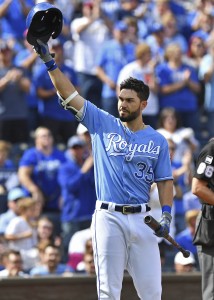 Hosmer, now 34, was one of many high-profile prospects in the Royals’ system, going back almost a couple of decades. The club leaned into a lengthy period of tanking in the early parts of this century, losing at least 87 games in nine straight seasons from 2004 to 2012. Over that time, they were able to pile up young talent in their farm system thanks to some strong draft picks. The deepest part of the rebuild was 2004 to 2007, with the club losing at least 93 games in each of those campaigns, but also getting a top-three pick in the draft for four straight years.
Those four picks were used on Alex Gordon, Luke Hochevar, Mike Moustakas and Hosmer. Those players combined with other youngsters like Lorenzo Cain, Salvador Pérez and Yordano Ventura to form a promising young core that the club was hoping to use to return to prominence.
Hosmer hit well on his way up the minor league ladder and was considered one of the top 10 prospects in the game going into 2011. He made a strong debut that year and showcased some tendencies that would go on to define his career, namely an ability to avoid strikeouts but also an inability to get under the ball. He didn’t walk much either, so the ball was often in play, with his numbers swaying from year to year depending on whether he was finding holes or not.
He only struck out in 14.6% of his plate appearances in his rookie season, well below that year’s league average of 18.6%. But 49.7% of his balls in play were pounded into the ground, noticeably above the 44.4% league average. Regardless, he still hit 19 home runs and slashed .293/.334/.465 for a wRC+ of 113.
In 2012, he suffered through a sophomore slump, hitting just .232/.304/.359 for a wRC+ of 80. Part of that was batted ball luck, as his BABIP dropped to .255 from .314 the year prior. But his grounder rate also ticked up to 53.6% and he only hit 14 homers. These sorts of oscillations continued into the next few years. In 2013, his batting average was up at .302 and he hit 17 homers, but then those numbers dipped to .270 and just nine long balls in 2014.
Despite the challenges for Hosmer in the latter year, the club’s planned return to contention finally clicked in a big way. The Royals went all the way to the World Series that year, though they ultimate were felled by the Giants in seven games. Hosmer was a big part of that run, as he hit .351/.439/.544 that postseason.
Just about everything went right the next year, despite Hosmer still putting 52% of batted balls into the dirt. He also hit 18 homers and slashed .297/.363/.459 for a wRC+ of 124. The Royals went back to the World Series and finished the job this time, taking down the Mets in five games to hoist their first trophy since 1985.
The club slipped near .500 in the next two seasons as the up-and-down performance continued for Hosmer. His bat dipped closer to league average in 2016, though he rebounded with arguably the best season of his career in 2017. His grounder rate was still very high at 55.6%, but he managed to park the ball over the fence 25 times and slashed .318/.385/.498 for a wRC+ of 135.
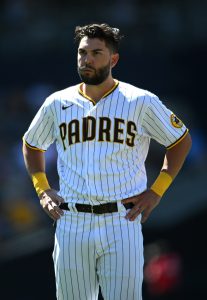 That was excellent timing for a career year, as that was his platform season for his first trip into free agency. Despite the inconsistent performance, the Padres took a chance on him, agreeing to an eight-year, $144MM deal. In addition to the offensive questions, his defensive metrics were never strong, in spite of his four Gold Glove awards while with the Royals. But the Padres had been undergoing their own period of insignificance, having just finished the seventh of what would eventually be nine straight losing seasons. The signing of Hosmer, the largest deal in franchise history at the time, was meant to signal an end of the rebuild and a return to relevance.
Unfortunately, the deal quickly went south, as Hosmer’s bat was around league average for most of his time in San Diego. From 2018 through 2021, he hit .264/.323/.415, translating to a wRC+ of 99. He was often the subject of trade rumors in that time, as the Friars looked to get out from under the deal. He was going to be sent to the Nationals as part of the deal that sent Juan Soto to San Diego, but Hosmer had a limited no-trade clause that allowed him to block the deal. That deal went through with Luke Voit taking Hosmer’s place, though Hoz was flipped to the Red Sox instead, with that club not covered by his clause. The Padres ate the remainder of Hosmer’s contract, apart from the league minimum, and included a couple of prospects in order to get Jay Groome from Boston.
A stint on the injured list due to some back inflammation limited him to just 14 games with the Sox after the deal and they released him in the offseason to clear a path for prospect Triston Casas. The Cubs took a flier on Hosmer, which was essentially a free look since the Padres were still on the hook for his salary. But he hit poorly in 31 games as a Cub last year, producing a batting line of .234/.280/.330, and was released in May. He didn’t latch on elsewhere and has now decided to officially call it a career.
Though there were some ups and downs, Hosmer still has plenty of accolades on his ledger, including four Gold Gloves, a Silver Slugger Award, an All-Star appearance and a World Series ring. He also won the World Baseball Classic with Team USA in 2017. He racked up 1,753 hits in his MLB career, including 322 doubles, 20 triples and 198 home runs. He scored 812 runs and drove in 893. Baseball Reference lists his career earnings just under $175MM. We at MLBTR salute Hosmer on a fine career and wish him the best in his next steps.
Padres Sign Austin Davis, Zach Reks To Minor League Deals
The Padres recently agreed to minor league contracts with lefty reliever Austin Davis and outfielder Zach Reks, according to Matt Eddy of Baseball America. Reks returns after a stint in Korea, while Davis spent part of last season in Triple-A.
Davis, 31, has pitched in parts of five MLB seasons. The Cal-Bakersfield product got to the big leagues each year between 2018-22 and tallied 136 appearances between the Phillies, Pirates, Red Sox and Twins. Davis turned in a solid 4.15 ERA as a rookie with Philadelphia. He allowed more than five earned runs per nine in each of the following four seasons.
That includes a 5.79 mark over a career-high 56 innings two years ago. Davis spent the vast majority of that year in Boston before a late-season cameo with the Twins. He punched out a solid 24.2% of hitters but issued walks at a near-13% rate. That proved an ominous lead-up to a dreadful season in Triple-A.
Davis inked a minor league pact with the Astros. Assigned to Triple-A Sugar Land, he pitched in 20 games. Over 25 contests, he was tagged for 11.22 earned runs per nine. His control completely evaporated. Davis walked more than a quarter of batters faced and was released in June. He issued 11 more walks in 18 1/3 innings of winter ball in the Dominican Republic, although he nevertheless managed a 2.45 ERA there and impressed San Diego evaluators enough to get another non-roster look.
Reks, a left-handed hitter, logged brief MLB action with the Dodgers and Rangers between 2021-22. He signed with the KBO’s Lotte Giants midway through the ’22 campaign. Reks turned in an impressive .330/.410/.495 slash with Lotte, earning a new contract over the offseason. His follow-up KBO campaign didn’t go as well. Reks got out to a .246/.338/.345 start while battling a knee injury. Lotte released him in June.
The Padres will add him to the organization, likely sending him to Triple-A El Paso to open the season. Reks owns a .290/.388/.537 line over 902 plate appearances at the level. That’s partially a reflection of the hitter-friendly Pacific Coast League but is strong output in any case. Hitting at something approaching that level for El Paso could get him a midseason look in what currently projects as a thin San Diego outfield.
Tigers Acquire Blake Dickerson From Padres
The Tigers announced this evening that they’ve acquired left-hander Blake Dickerson from the Padres in exchange for $500K in international bonus pool money.
Dickerson, 19, was a 12th-round pick by the Padres in the 2023 draft out of Ocean Lakes High School in Virginia. Dickerson received a bonus of $500K, equivalent to that of a fourth-round pick. The southpaw did not appear in a game for the Padres last year, meaning his Tigers debut will also be his professional debut. Baseball America recently ranked Dickerson as the #22 prospect in the San Diego farm system entering the 2024 campaign, noting that the lefty projects to have a high-velocity fastball and an above-average curveball once his 6-foot-6 frame fills out, giving him a chance to be a #4 starter or future bullpen arm depending on the development of his changeup.
For the Tigers, the addition of Dickerson adds another young arm to a system that already features a top pitching prospect in Jackson Jobe as well as lower-level arms such as Ty Madden and Troy Melton. That’s in addition to the stable of young arms contributing to the club at the big league level, led by southpaw Tarik Skubal along with the likes of Casey Mize, Matt Manning, and Alex Faedo. BA suggests that Dickerson could be a candidate to skip rookie ball and debut at the Low-A level this year.
In exchange for parting ways with Dickerson, the Padres will receive $500K in international bonus pool money, an amount identical to the bonus San Diego signed Dickerson for last summer. The Tigers opened the 2024 international signing period with a bonus pool of $6,520,000 while the Padres opened with a pool of just $4,652,000, tied with the Phillies, Rangers, and Yankees for the smallest among all thirty clubs. The trade, in effect, recoups half of the $1MM in bonus pool space the Padres forfeited by signing shortstop Xander Bogaerts last winter. The vast majority of the club’s bonus pool space for the 2024 signing period was spent on shortstop Leodalis De Vries, who the Padres signed for a $4.2MM bonus last month.
Padres To Move Xander Bogaerts To Second Base
Padres manager Mike Shildt told members of the media today that Xander Bogaerts will be moving from shortstop to second base, with Dennis Lin of The Athletic among those to relay the news. Ha-Seong Kim will cross the bag in the other direction to take over the shortstop position.
It was just a little over a year ago that the Padres signed Bogaerts to an 11-year, $280MM contract. At the time, it was a bit of a puzzling fit on the club’s roster. Fernando Tatis Jr. was supposed to be the franchise shortstop once upon a time. In February of 2021, he and the Friars agreed to a historic 14-year, $340MM extension to keep him on the club for the bulk of his career. He ended up missing the 2022 season both due to injuries and a PED suspension, but he was expected back early in 2023. While he was out, Kim provided excellent glovework at the position.
Going into 2023, there was a bit of uncertainty. Tatis was coming off an entirely missed season and the club was thinking about moving him to the outfield. But even if that scenario, they still had Kim to cover short. It wasn’t really expected that they would head into the offseason looking for a mega deal but they landed Bogaerts nonetheless.
Bogaerts’ first year in San Diego resulted in fairly typical offensive production for him. He hit 19 home runs and slashed .285/.350/.440 for a wRC+ of 120. Defensively, Outs Above Average gave him a positive grade of +3 but Defensive Runs Saved had him at -4. He has long been considered a candidate to move off of shortstop, even as a prospect, and it seems the time has now come. For his career, his tallies at short are -31 OAA and -54 DRS.
In the short term, the move is probably best for the 2024 version of the Padres, as Kim is excellent with the glove. He has played 1,505 1/3 innings at short in the majors, just over a full season’s worth. In that time, he’s tallied 22 DRS and 7 OAA. Having him at short and Bogaerts at second should give the club a great middle infield, as even mediocre shortstops often provide solid defense on the other side of the bag.
But taking the wide view, the decision making from the Padres becomes questionable. Twice now in recent years they have given around $300MM to a shortstop on a deal longer than a decade, and now neither will be playing short. Tatis, who has now been moved to right field, is under contract through 2034 and Bogaerts through 2033. Kim is set to become a free agent after 2024, as his deal has a mutual option for 2025 and those provisions are almost never triggered by both parties.
Assuming Kim reaches free agency a year from now, the club will then be looking for a solution at short for 2025 and beyond. They could always move Bogaerts again but he’ll be 32 years old by then and his abilities at that position will only be trending downwards with age. One of the club’s top prospects, Jackson Merrill, is a shortstop who reached Double-A last year. He could perhaps be a solution at that spot down the road but he is reportedly coming into camp as an outfielder, with the club trying to get creative in covering the spots vacated by trading Juan Soto and Trent Grisham. He could move back to short in 2025 but that might be a bit tricky if he spends this year in the outfield with the big league club instead of getting reps in Triple-A.
The Soto/Grisham deal was necessary because the club is paring back spending this winter. That’s partially a result of their TV deal with Diamond Sports Group falling apart but also connected to their extreme aggression in recent years, which includes giving a massive deal to a shortstop they didn’t really need.