
NL East Notes: Montas, Blackburn, Manaea, Nola, Finnegan
Frankie Montas saw his first proper game action of the 2025 season on Saturday, when the right-hander tossed 37 pitches over 1 1/3 innings for high-A Brooklyn in the first game of a minor league rehab assignment. Montas signed a two-year, $34MM free agent deal with the Mets this past winter, but was immediately sidelined at the start of Spring Training by a significant lat strain. Saturday’s game officially started the 30-day clock on Montas’ rehab assignment, and he’ll naturally need to further build up his arm strength over multiple outings before he is ready to be activated from the 60-day injured list.
Paul Blackburn should beat Montas back to the active roster, as MLB.com’s Jeffrey Lutz writes that the plan is for Blackburn to make his seventh and final minor league rehab outing before joining the Mets at some point in June. Blackburn has missed the entire big league season due to right knee inflammation, while Sean Manaea has also yet to pitch due to an oblique strain. Manaea is throwing off a mound, and Jon Heyman of the New York Post writes that Manaea’s projected timeline is about two weeks behind Montas. Despite all of these pitching injuries, even the makeshift version of the Mets’ rotation has posted tremendous results this season, giving the club a potential arms surplus to address if and when everyone is healthy.
More from around the NL East…
- The Phillies are another club relatively deep in starting pitching options, though they may be without Aaron Nola for longer a 15-day minimum stint on the injured list. Manager Rob Thomson told Lochlahn March of the Philadelphia Inquirer and other reporters that Nola’s sprained ankle is still feeling sore, which scrapped plans for Nola to begin throwing off a mound this weekend. Nola’s IL placement began on May 15, and while Thomson didn’t this continued discomfort as any sort of big setback, he hinted that Nola might need to face some live batters (whether in the form of a live batting practice or a minor league rehab start) before being activated.
- Nationals closer Kyle Finnegan is dealing with some shoulder fatigue, though manager Davey Martinez told MASNsports.com’s Mark Zuckerman that tests didn’t reveal any structural problems. Finnegan hasn’t pitched in either of Washington’s last two games, but figures he can avoid the IL with another day or two of rest. Finnegan has a 2.41 ERA over 18 2/3 innings this season, and figures to be a sought-after pitcher at the trade deadline if the Nationals can’t get into contention. The reliever’s secondary numbers (such as a 3.69 SIERA and slightly below-average strikeout and walk rates) are less impressive, but Finnegan has a 48.1% grounder rate and has done a solid job of inducing soft contact.
Mets Designate José Ureña For Assignment
The Mets officially announced their previously-reported deal for left-hander Brooks Raley, with Sean Manaea transferred to the 60-day injured list. Raley, who is recovering from Tommy John surgery, was promptly placed on the 15-day IL. The Mets also recalled right-hander Kevin Herget to the big league team. Right-hander José Ureña has been designated for assignment as the corresponding move for Herget. Tim Healey of Newsday reported the moves prior to the official announcement.
Ureña, 33, was selected to the club’s roster on Sunday. The Mets had leaned heavily on their bullpen in the prior days. Since Ureña had been pitching out of the Triple-A rotation, he gave them an arm capable of covering multiple innings.
Yesterday, the Mets stomped the Nationals with a 19-5 victory. It was 11-0 after six and a half, when Ureña came in to cover the final three frames. He allowed five earned runs but managed to largely give the bullpen a night off, apart from Max Kranick pitching one inning before Ureña entered.
It took Ureña 68 pitches to get through those three innings, so he might not have been available for a few days. Rather than have him taking up a roster spot while unavailable, the Mets are bringing up a fresh arm in Herget. Since Ureña is a veteran with far more than five years of major league service time, he can’t be optioned to the minors without his consent. He has been bumped off the 40-man entirely and will likely be put on waivers in the coming days.
It’s possible the veteran could garner interest from other clubs who need an innings eater. The Blue Jays just claimed Casey Lawrence, for instance, a somewhat similar veteran capable of tossing multiple relief innings. Ureña has a longer track record than Lawrence, with 951 1/3 career innings with a 4.80 earned run average. If goes unclaimed, he would have the right to reject an outright assignment and elect free agency.
As for Manaea, this doesn’t change anything about his outlook. The 60-day count is retroactive to his initial placement on the 15-day IL, which was at the start of the season. He can therefore be reinstated by late May, which doesn’t seem to be a realistic possibility. He has been out all year with an oblique strain. He suffered a setback in early April and was to be shut down for another couple of weeks. It’s unclear when he’ll be ready to get into game action as part of a rehab assignment.
Even if he were to start such an assignment right now, he would likely need more than a month to get into game shape anyway as an unofficial spring training. That means this 60-day IL transfer was an inevitable formality.
Photo courtesy of Brad Penner, Imagn Images
Sean Manaea To Be Shut Down Another Two Weeks Due To Setback In Rehab
Mets left-hander Sean Manaea started the season on the 15-day injured list due to a right oblique strain but he’ll need more time than that to rejoin the club. Manager Carlos Mendoza today told reporters, including Tim Healey of Newsday, that the southpaw suffered a setback in his rehab. He got a platelet-rich plasma injection and will be shut down for another two weeks. Even if he’s healthy after that shutdown period, he’ll need a full ramp-up after that, meaning the best-case scenario is a return in late May or early June.
That’s obviously less than ideal news for the Mets. Manaea gave them 32 starts last year with a 3.87 earned run average. He logged 181 2/3 innings with a 24.9% strikeout rate and 8.5% walk rate. The club liked his performance enough to re-sign him via a three-year, $75MM deal, though with some notable deferrals.
So far, they’ve received nothing for that investment. Manaea was diagnosed with his oblique injury in late February and missed the entire spring. He’s already missed a few days of the regular season and his absence will extend for several more weeks.
He’s one of several starters currently on the shelf. Christian Scott had Tommy John surgery in September of last year and will most likely miss the entire 2025 season. Frankie Montas is out with a lat strain and still isn’t throwing. Paul Blackburn also started the season on the injured list due, in his case due to right knee inflammation.
The Mets have started the season with Clay Holmes, Tylor Megill, Griffin Canning and David Peterson starting the first four contests. Kodai Senga is scheduled to start tonight. That rotation will have to do for the time being, as it doesn’t appear any of Manaea, Montas or Blackburn are close to a return.
If another injury should pop up before anyone in that group can make it back, Justin Hagenman is on the 40-man roster. Prospects like Brandon Sproat and Blade Tidwell aren’t yet on the roster but are pitching in Triple-A to start this year.
One small silver lining of Manaea’s delay is that the Mets could now transfer him to the 60-day injured list, as such a move would still allow him to be activated in late May. That will give the club an extra 40-man roster spot to use on selecting a player from the minors or perhaps grabbing someone off waivers. Their 40-man count is currently at 38, however, so they won’t need to make a call on Manaea until they make a few more roster moves.
Photo courtesy of Sam Navarro, Imagn Images
Madrigal Diagnosed With Shoulder Fracture; Manaea To Begin Season On IL With Oblique Strain
Mets infielder Nick Madrigal has been diagnosed with a fracture in his left shoulder after undergoing an MRI, manager Carlos Mendoza announced to the team’s beat this morning (via Anthony DiComo of MLB.com). He’ll be out “for a long time,” per Mendoza, though a formal timeline isn’t yet established. Madrigal is headed for a CT scan for further evaluation. Mendoza also revealed that left-hander Sean Manaea has a right oblique strain that will shut him down for the next couple weeks, likely ticketing him for the injured list to begin the season (via Newsday’s Tim Healey).
Madrigal’s injury occurred while playing shortstop during yesterday’s spring contest against the Nationals. The former top prospect charged a grounder that kicked off the mound, making a barehanded play and falling to the ground as he threw to first base (video link via MLB.com). Commentary noted that Madrigal headed straight for the dugout upon getting up, so it’s clear he knew something was amiss right away. He was originally diagnosed with a dislocated shoulder, but imaging revealed the fracture that will shelve him for a considerable period.
The Mets inked Madrigal to a split major league contract that paid him at a $1.35MM rate in the majors. The former No. 4 overall pick has a minor league option remaining and might’ve been bound for Triple-A to begin the year, but he’ll presumably head to the major league 60-day IL whenever the Mets next need a roster spot instead. He wasn’t expected to have a starting role, with Francisco Lindor and Jeff McNeil lined up in the middle infield and Mark Vientos at third base, but a strong camp would likely have put Madrigal in line for a bench role.
Instead, the Mets will presumably tap into their upper-minors depth. Brett Baty, Ronny Mauricio and Luisangel Acuña have all drawn top-100 fanfare at various points in recent seasons. Baty isn’t an option to back up at shortstop, however, and Mauricio is still on the mend from the ACL tear that cost him the entire 2024 season. He’s not expected to play in spring games until mid-March. Acuña, who made his big league debut late last year, seems the likeliest in-house candidate to step into Madrigal’s spot.
It’s possible that the long-term nature of the injury could prompt the Mets to look outside the organization, where fan and clubhouse favorite Jose Iglesias remains unsigned. The Mets all but announced they were moving on from Iglesias a couple weeks back, with president of baseball operations David Stearns noting a lack of roster flexibility at the time.
Signing Iglesias would give the Mets a bench full of players who cannot be optioned to Triple-A. Catcher Luis Torrens and outfielder Tyrone Taylor have both exhausted their slate of minor league options, while Starling Marte can’t be optioned without his consent — as is his right as a player with five-plus years of major league service time. Iglesias would be in that same boat. In the event of an Iglesias signing, the only position player on the Mets’ roster who could be optioned would be Francisco Alvarez, who’s obviously not at risk of being sent down.
The loss of Manaea, meanwhile, further thins out a rotation that will see Frankie Montas shelved by a lat strain to begin the season. That takes two members out of the Opening Day rotation, which now likely includes a combination of Kodai Senga, David Peterson, Clay Holmes, Paul Blackburn, Griffin Canning and Tylor Megill. It’s not a formidable group, with health and workload questions permeating the entire staff.
That said, the Mets weren’t planning to add another starter after losing Montas to a longer-term injury than the one Manaea currently faces. Montas will likely be sidelined into mid-May at the earliest. Manaea could very plausibly return in April if he rehabs the oblique issue without any setbacks. The immediate outcry among many Mets fans on social media was to use the Manaea injury as the impetus to re-sign Jose Quintana, but Will Sammon of The Athletic reports that the Mets are still planning to stick with in-house options.
On the one hand, it’s sensible enough that a short-term Manaea absence won’t prompt what would surely be an eight-figure expenditure after factoring in luxury taxes. Signing Quintana, Kyle Gibson, Lance Lynn or another veteran hurler for the full season when Manaea could miss as few as three to four starts in April could be construed as an overreaction.
On the other, the Mets quite arguably didn’t do enough with their rotation this winter in the first place. Senga pitched in one game last year due to injuries. Montas’ 2023 was wiped out by shoulder surgery, and he posted a 4.84 ERA over 150 innings in last year’s return. Holmes is converting to the rotation after six years pitching exclusively as a reliever. Canning was non-tendered and has a 4.96 ERA over his past three seasons. Blackburn is a fourth/fifth starter who was limited to 75 innings by a spinal injury last year. The rotation lacks certainty even when it’s at full strength — and the Mets are a ways off from full strength as things stand.
MLBTR Podcast: Brent Rooker’s Extension, Gavin Lux, And Catching Up On The Holiday Transactions
The latest episode of the MLB Trade Rumors Podcast is now live on Spotify, Apple Podcasts, and wherever you get your podcasts! Make sure you subscribe as well! You can also use the player at this link to listen, if you don’t use Spotify or Apple for podcasts.
This week, host Darragh McDonald is joined by Tim Dierkes of MLB Trade Rumors to discuss…
- The Athletics and Brent Rooker agreeing to a five-year extension (1:40)
- The Dodgers signing Hyeseong Kim and trading Gavin Lux to the Reds (6:40)
- The Diamondbacks signing Corbin Burnes (14:45)
- Do the Blue Jays have unique challenges in signing free agents to come to another country? (16:30)
- Will Burnes opt out in two years and will the Diamondbacks trade a starter now? (21:05)
- The Yankees acquiring Cody Bellinger from the Cubs and signing Paul Goldschmidt (26:35)
- The Astros signing Christian Walker (34:40)
- The Mets signing Sean Manaea and Griffin Canning (39:15)
- The Red Sox signing Walker Buehler and Patrick Sandoval (43:35)
- The Phillies acquiring Jesús Luzardo and signing Max Kepler (50:35)
- The Orioles signing Charlie Morton (55:35)
- The Guardians trading Josh Naylor to the Diamondbacks and signing Carlos Santana (58:30)
- The Rangers trading Nathaniel Lowe to the Nationals and signing Joc Pederson (1:01:25)
- The Nationals get Lowe as well as signing Josh Bell, Michael Soroka and Trevor Williams (1:05:30)
- The Tigers signing Gleyber Torres and shuffling their infield around (1:08:25)
Check out our past episodes!
- Kyle Tucker To The Cubs, And Trades For Devin Williams And Jeffrey Springs – listen here
- Winter Meetings Recap – listen here
- Blake Snell, Dodger Fatigue, And The Simmering Hot Stove – listen here
The podcast intro and outro song “So Long” is provided courtesy of the band Showoff. Check out their Facebook page here!
Mets Notes: Manaea Contract Details, Alonso
After previously reporting that Sean Manaea‘s deal with the Mets would include $23.25MM in deferred payments, Will Sammon of The Athletic offered more details on the structure of Manaea’s contract this morning.
Manaea will earn equal $25MM salaries in all three years of the deal, adding up to the reported total guarantee of $75MM. However, $7.75MM of his salary will be deferred without interest each season, adding up to the reported total of $23.25MM in deferrals. As Sammon previously mentioned, the deferrals will be paid out in equal portions over 10 years from 2035-44. Sammon also notes that Manaea can earn standard additional incentives for making an All-Star appearance ($50K), winning a Gold Glove ($50K), winning LCS MVP ($50K), winning World Series MVP ($100K), and finishing top-three in Cy Young voting ($50K for first place, $25K for second place, $10K for third place).
The deferred payments mean that Manaea’s contract isn’t quite worth $75MM in present-day value. Therefore, the luxury tax hit for the Mets won’t be quite as high as his $25MM AAV. Jon Becker of FanGraphs suggests the present-day value of his AAV for luxury tax purposes is just over $22MM. That’s not entirely insignificant to the Mets, who will be paying the luxury tax once again in 2025. It’s also interesting that Manaea’s contract is about $1MM less valuable than the three-year, $67MM deal his former teammate Luis Severino signed with the Athletics. Jon Heyman of the New York Post reported last week that Manaea turned down that same offer from the A’s before they gave it to Severino instead. Of course, it’s not hard to understand why Manaea would rather pitch for the Mets than the A’s, but it’s interesting that he technically took a discount to re-sign with New York.
In another Mets update, Sammon theorizes that “contract length” is currently what’s holding up a deal between the Mets and Pete Alonso. Heyman recently made a similar suggestion, saying “I do think the years are the hang-up right now” (per Jon Heyman’s Insider Notebook on Bleacher Report). Back in December, Bob Nightengale of USA Today reported the Mets were still “pushing hard” to reunite with Alonso. From Alonso’s perspective, it’s hard to picture a better fit than the only team he’s ever known. Yet, a deal hasn’t come together. A disagreement over contract length could certainly explain why.
Presumably, Alonso and his agent Scott Boras are still looking to beat the guaranteed money from the seven-year, $158MM extension he reportedly turned down from the Mets in the summer of 2023. To do so, he’d need to sign for at least $137.5MM this winter (he already earned the first $20.5MM in 2024 during his final year of arbitration). It’s hard to imagine Alonso approaching that number on anything shorter than a six-year contract. Meanwhile, it’s not hard to understand why teams would balk at offering a six-year contract to a 30-year-old first baseman coming off two consecutive down years.
Mets Sign Sean Manaea
On Friday evening, the Mets officially announced the signing of left-hander Sean Manaea to a three-year deal. The Boras Corporation client receives a $75MM guarantee. The deal reportedly contains $23.25MM in deferred money, which will be paid between 2035-44. New York had multiple open roster spots, so no further move was necessary.
Manaea, 33 in February, is now poised to sign with the Mets for the second consecutive offseason. In the first week of January earlier this year, the southpaw landed with New York on a two-year deal that guaranteed him $28MM and included an opt-out following the 2024 campaign. It was the second winter in a row that saw Manaea sign a two-year deal with an opt out after he signed with the Giants on a $25MM guarantee during the 2022-23 offseason.
That first contract in San Francisco was inked on the heels of a brutal 2022 season in San Diego that saw Manaea struggle to a 4.96 ERA (76 ERA+) with a 4.53 FIP in 158 innings of work. His time with the Giants went better than that; while his 4.44 ERA (94 ERA+) was still below average but he nonetheless entered the offseason boasting much stronger peripherals (3.91 FIP, 3.83 SIERA) and a solid run of starts down the stretch that September where he posted a 2.25 ERA and 3.21 FIP.
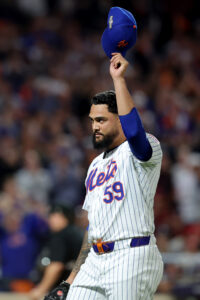
The Mets clearly believed that portended better days in Manaea’s future, and it certainly did. The lefty emerged as a quality mid-rotation option for New York in 2024 as he posted a 3.47 ERA (114 ERA+) with a 3.83 FIP in a career-high 181 2/3 innings of work across 32 starts. With a career year in the books ahead of his third consecutive trip to free agency, it seemed as though Manaea was looking for longer-term security. The Mets opted to tag the lefty with the Qualifying Offer at the outset of the winter, but it was hardly a surprise when Manaea rejected that one-year, $21.05MM offer and entered the open market anyway. After all, the lefty came into the winter ranked by MLBTR as the #10 free agent available on our annual Top 50 MLB Free Agents list and the #5 starter behind only Corbin Burnes, Blake Snell, Max Fried, and Jack Flaherty.
Early in the offseason, the fact that Manaea was encumbered by the QO led a number of clubs that likely would’ve had interest in a mid-rotation veteran like him to turn towards alternative options. The Angels, Dodgers, and Cubs turned in the early days of the offseason to unencumbered free agents like Yusei Kikuchi, Snell, and Matthew Boyd rather than delve into the markets of qualified free agents like Manaea, Nick Pivetta, or Luis Severino.
That’s not a consideration for the Mets, however, as reuniting with Manaea only costs the hypothetical draft pick they would’ve received had he signed elsewhere. That’s allowed Manaea to land a healthy guarantee despite a fairly small list of teams connected to him this winter: his three-year, $75MM deal exceeds the three-year, $60MM guarantee MLBTR predicted for him at the outset of the offseason but that’s hardly a surprise given that virtually every starting pitcher’s contract has exceeded expectations. Additionally, it’s of course possible that the deferred money in Manaea’s deal drops the net present value closer to MLBTR’s prediction.
For New York, a reunion with Manaea serves as a likely capstone on the club’s efforts to reconstruct its starting rotation after he, Severino, and Jose Quintana all hit the open market last month. The club added Frankie Montas and Clay Holmes to their rotation mix earlier this winter, but that duo offers little stability given Montas’s struggles in 2025 and the fact that Holmes last started a game in the majors back in 2018. Manaea provides that much-needed stability while slotting towards the front of a rotation that also includes talented right-hander Kodai Senga and young southpaw David Peterson.
With depth options like Paul Blackburn, Tylor Megill, and Griffin Canning all in the wings to help cover for potential injuries, it would hardly be a surprise if Manaea’s return wrapped up the team’s rotation additions for the winter. That doesn’t mean the club is done entirely, however. Even with a hefty 2025 payroll that RosterResource estimates will land just shy of $280MM as things stand, that still leaves $56MM of room to work with before the Mets match their 2024 figure. That should leave plenty of room for the Mets to sign a corner infield bat to pair with Mark Vientos, whether that ends up being a reunion with Pete Alonso or an alternative option such as Alex Bregman and perhaps bolster other areas of the roster such as the bullpen or the bench.
ESPN’s Jeff Passan first reported the Mets and Manaea had agreed to a three-year, $75MM deal. Will Sammon of the Athletic reported that the deal included $23.25MM in deferred money to be paid between 2035-44. Image courtesy of Imagn.
Mets Interested In Eovaldi, Manaea, Pivetta, Flaherty
The Mets’ offseason has thus far revolved around their pursuit of Juan Soto and their attempts to reload a pitching staff full of free agents. Sean Manaea and Jose Quintana are on the open market and Luis Severino has already departed to sign a three-year, $67MM deal with the Athletics. New York has responded by signing Frankie Montas and Clay Holmes to relatively inexpensive contracts, but the team could be looking at further bolstering the rotation with a bigger splash.
Nathan Eovaldi, Nick Pivetta, and Jack Flaherty are three of the names the Mets have shown interest in this winter, according to The Athletic’s Ken Rosenthal and Will Sammon. Re-signing Manaea is also still a possibility, as Rosenthal/Sammon note that the Mets remain open to a reunion with the left-hander.
Montas signed a two-year, $34MM contract, while the Mets gave Holmes $38MM over a three-year deal. Given that Eovaldi has a lengthy injury history and is entering his age-35 season, his next contract isn’t likely to surpass three years in length, which fits David Stearns’ preferred method of giving shorter-term contracts to pitchers. MLBTR projected Eovaldi to land a two-year, $44MM contract, though it is easy to imagine Eovaldi landing more from the Mets or another team considering how many pitchers have already landed higher-than-expected paydays this offseason.
Despite his age, Eovaldi has remained a very solid pitcher, and it was just in 2023 that he posted an All-Star season while helping the Rangers win the World Series. The 2024 campaign saw Eovaldi deliver a 3.80 ERA and above-average strikeout and walk rates, and his 170 2/3 IP marks the third-highest innings total of his 13 big league seasons. The right-hander is no stranger to high-pressure championship games in big markets, and seems like a strong fit on a Mets team that has designs on contending for a World Series in 2025.
Flaherty won a ring himself with the Dodgers just this season, capping off a strong bounce-back season that saw him post a 3.17 ERA over 162 combined innings with Los Angeles and Detroit. The righty is now looking to translate that platform year into a big contract, and since he just turned 29, Flaherty is also younger than Eovaldi, Manaea (33 in February), and Pivetta (32 in February). However, that also means Flaherty is seeking a longer-term deal, with Rosenthal and Sammon figuring a contract of between four and six years.
MLBTR’s projection split that difference with a five-year, $115MM prediction for Flaherty’s next contract. It remains to be seen if the Mets would be willing to meet that price, or if Stearns is wary about giving such a deal to a pitcher who battled injuries and ineffectiveness from 2020-23. This isn’t to say that the Mets president of baseball operations is entirely adverse to longer-term contracts, though Stearns’ chief tactic has been to seek out “the next Flaherty” in the sense of looking for promising arms with bounce-back potential.
Re-signing Manaea is perhaps the most comfortable option given the Mets’ pre-existing familiarity with the veteran left-hander. There was plenty to like about Manaea’s first season in Queens, and he chose to capitalize on his strong season by opting out of the final year of his contract (worth $13.5MM) with the Mets to pursue a bigger deal in free agency. Interestingly, Rosenthal and Sammon write that at least one other team interested in Manaea has discussed the possibility of a four-year contract, which would be a bold commitment to a pitcher of Manaea’s age and somewhat inconsistent track record.
The qualifying offer is also a factor in the Mets’ pursuits. Eovaldi and Flaherty weren’t eligible for the QO and thus no compensation is attached to their services. Manaea and Pivetta both turned down qualifying offers from the Mets and Red Sox, so their next teams will have to surrender some form of draft or international bonus pool capital in order to sign either pitcher. This wouldn’t be an obstacle for the Mets in re-signing Manaea since teams don’t have to give up any compensation to re-sign their own player, but signing Pivetta would cost the Mets $1MM in int’l bonus money plus their second- and fifth-highest selections in the 2025 draft.
Boston’s decision to issue Pivetta was seen as a bit of a surprise, and it could be that being attached to a compensation package might dull Pivetta’s market to some extent. Pivetta is a durable pitcher with quality secondary metrics, yet he was more solid than outstanding over his four-plus seasons with the Red Sox, posting a 4.29 ERA over 633 innings. This might not be enough of a resume to move the Mets to give up two picks and $1MM from their bonus pool, especially since New York might already be giving away such a bounty if they sign Soto (another qualified free agent). Signing two QO-rejecting players would cost the Mets $2MM in pool money, as well as their second, third, fifth, and sixth-highest picks in the 2025 draft class, so it doesn’t seem like the Mets would add onto Soto with another qualified free agent.
A’s Also Made Offer To Sean Manaea
The Athletics’ three-year, $67MM contract with Luis Severino stunned many baseball fans. As shown in MLBTR’s Contract Tracker, the West Sacramento-bound club hadn’t spent more than $15MM on a free agent since signing Ryan Madson to a three-year, $22MM deal nearly a decade ago. The $67MM guarantee stands as the largest in franchise history, surpassing Eric Chavez‘s 20-year record by $1MM. The A’s had signaled that they might be willing to spend in free agency or via trade — MLBTR’s Darragh McDonald explored the possibilities at length last month — and there were multiple reports that the A’s were aiming for a $100MM payroll. Many still took an “I’ll believe it when I see it approach.”
We’ve now seen it — or at least the early stages of it. It might still feel unusual to say the A’s agreed to sign a player for $22MM+ annual value, but that’s the reality. There are also some indications that the on-the-move A’s could continue to spend. For instance, Jon Heyman of the New York Post reports that the A’s also made a “big” offer to free agent southpaw Sean Manaea, who made his MLB debut with the Athletics after coming over from the Royals in the 2015 Ben Zobrist trade.
That offer came prior to their deal with Severino, Heyman notes. It’s not expressly clear that the A’s would be willing to put forth another competitive offer for an upper-tier free agent like Manaea, but the Severino deal and talk of a $100MM payroll target suggests it’s certainly possible. Even with Severino in the fold, RosterResource projects a modest $58MM payroll. There’s room for another weighty salary to be added to the mix, be it in the form of a free agent, a trade acquisition, or both.
One notable aspect of the reported offer to Manaea: the left-hander, like Severino, rejected a qualifying offer from the Mets at the beginning of the offseason. The A’s seem willing to spend at the expense of next year’s draft pool. Severino cost them their third-highest pick — the standard price paid by a revenue-sharing recipient — and now that they’ve forfeited that selection, the cost to sign an additional qualified free agent is reduced. The A’s surrendered their second-round pick to sign Severino — they pick in the first round and in Competitive Balance Round A, between the first and second rounds — and they’d now “only” need to punt their third rounder to bring in Manaea, Nick Pivetta, Christian Walker or another free agent who turned down the qualifying offer.
The A’s could use more stability in the rotation and have at least one corner outfield opening. They have young options at first base (Tyler Soderstrom), second base (Zack Gelof) and shortstop (Jacob Wilson) — all of them picked in the top two rounds of the draft and all of whom are/were highly touted prospects. There’s more of an opening at third base, where Darell Hernaiz and Max Schuemann likely lead the pack, although Gelof could potentially slide over to third base as well if the A’s want to pursue a second baseman. The bullpen, of course, could use some setup arms behind standout closer Mason Miller. There’s no shortage of areas at which to spend, and it seems the A’s are indeed intent on bolstering payroll ahead of the move to their temporary home at Sutter Home Park.
Cubs Rumors: Rotation Market, Bellinger, Bullpen, Catcher
The Cubs’ focus this offseason has reportedly been on pitching, and while Sahadev Sharma of The Athletic reports that’s very much still the case, he also throws some cold water on the idea of Chicago making a major strike in free agency. Sharma’s colleague, Patrick Mooney, reported less than three weeks ago that the Cubs planned to “aggressively” pursue starters who could help near the top end of the rotation, but Sharma now writes that the “top tier of the starting pitching market has been ruled out.” That would seemingly remove the Cubs from the running for Corbin Burnes, Blake Snell and Max Fried, at the very least.
It’s the latest signal of a measured offseason approach, even at a time when the Cubs’ division appears ripe for the taking. The Cardinals are scaling back payroll and focusing more on player development in 2025 than on putting a playoff-caliber roster on the field. The Brewers, one year after trading Burnes, now seem likely to lose Willy Adames in free agency — and they could also trade closer Devin Williams. The Pirates and Reds have yet to break out as perennial contenders in the Central. Logically speaking, the deep-pocketed Cubs could take an aggressive stance and position themselves well in a wide-open division field.
For now, it seems they’ll shop primarily in the second and third tiers of the rotation market. Sharma points out that the Cubs have typically shied away from starters who’ve been attached to qualifying offers, though it’s worth noting that the Cubs were willing to part with draft picks and international funds in order to sign Dansby Swanson after he rejected a qualifying offer. They technically signed Cody Bellinger after he rejected a QO … though that offer came from the Cubs themselves, so they were really only “forfeiting” the theoretical comp pick they’d have received if he signed elsewhere.
Assuming the Burnes/Snell/Fried trio isn’t being considered by president of baseball ops Jed Hoyer and his staff, the Cubs will be looking at the next tier, with Jack Flaherty, Sean Manaea, Yusei Kikuchi, Nathan Eovaldi, Nick Pivetta and Luis Severino among the options. Of that group, Manaea, Pivetta and Severino rejected QOs and would cost the Cubs their second-highest pick and $500K of international space in their 2025 draft pool.
There are certainly names in that bunch who’d represent upgrades over incumbent starters at Wrigley Field. Justin Steele and Shota Imanaga form a nice one-two punch atop the in-house rotation, and the Cubs will follow them with veteran Jameson Taillon and young Javier Assad. Candidates for the fifth spot include Ben Brown, Jordan Wicks, Hayden Wesneski and top prospect Cade Horton. It’s a nice bunch of arms, but there’s some uncertainty in at least the fifth spot, if not the fourth. Assad posted a solid 3.79 ERA in 29 starts but did so with worse-than-average strikeout, walk and home-run rates. Metrics like FIP (4.64) and SIERA (4.72) are far less bullish than his earned run average.
Looking at the team’s payroll, the Cubs should have some spending room. RosterResource projects a $180MM payroll at the moment — $34MM shy of last year’s Opening Day mark. That includes a full arbitration class that could include some non-tender candidates (e.g. Nick Madrigal, Julian Merryweather).
The Cubs could also explore other ways to drop their payroll further. Ken Rosenthal of The Athletic wrote yesterday that the team could be looking to move Bellinger, though there are plenty of roadblocks to doing so. Bellinger is owed a $27.5MM salary in 2025 and a $5MM buyout on a 2026 player option. If he plays well for a season, the acquiring team would effectively be getting Bellinger at $32.5MM. That’s a hefty price tag in general and particularly for the 2024 version of Bellinger. While he played at an extremely high level in 2023, Bellinger was more of an above-average regular in 2024. A lack of impact left-handed bats and viable center fielders could still lead a team to consider the possibility, it’s hard to imagine a team giving a meaningful return and taking on the remainder/majority of Bellinger’s salary.
Still, moving Bellinger is also one of the only ways for the Cubs to plausibly pursue upgrades to the everyday lineup in 2025. As we noted when listing Bellinger near the back of our list of offseason trade candidates, the Cubs’ roster is already filled with expensive veterans who have no-trade clauses (Ian Happ, Dansby Swanson, Seiya Suzuki) or generally productive and affordable younger players like Michael Busch, Isaac Paredes and Pete Crow-Armstrong. Nico Hoerner might’ve been a trade candidate and could still be — but he also underwent flexor tendon surgery one month ago. Obviously, that cuts down on his appeal. The Cubs have a clear opening for an upgrade at catcher, but the free agent market offers little in the way of meaningful help there.
All of those challenges to upgrading the lineup make a notable splash on the pitching side of things feel more logical, but it seems the Cubs don’t feel similarly — at least not with regard to free agent starters. There are upgrades to be had on the bullpen market, of course, but the Cubs haven’t given out a multi-year deal to a reliever since Craig Kimbrel in 2019. Last winter’s $9MM guarantee to Hector Neris was the largest bullpen expenditure the Cubs have made since signing Kimbrel.
It’s possible the Cubs could just look to the trade market for much of their offseason dealing. The Cubs have a deep farm system with multiple top prospects whose path to a regular role at Wrigley is blocked. There aren’t, however, many impact arms or high-profile arms expected to be available. Crosstown ace Garrett Crochet headlines the offseason class of trade candidates, but demand for him will be fierce and trades of significance between the two Chicago clubs, while not unprecedented (Jose Quintana, Craig Kimbrel), also aren’t common.
There probably are still additional trades on the horizon for the Cubs. Sharma writes that this week’s acquisitions of reliever Eli Morgan from the Guardians and backup catcher Matt Thaiss from the Angels do not mean the Cubs are content in those areas. They’ll continue to explore both free agency and trades for help in those portions of the roster. But if pitching help remains their focus and they’re unwilling to shop in the high-rent district for starters, the Cubs will need to either break tradition with their free agent bullpen targets, get creative on the trade market, be content to address the middle ranks of the starting staff — or a combination of all the above.