
Yankees Notes: Cole, Montgomery, Sanchez, Rizzo, German
In the wake of another COVID-19 outbreak in the Yankees clubhouse, some of the impacted players are preparing to return to the field. Manager Aaron Boone told reporters (including Kristie Ackert of The New York Daily News) that Gerrit Cole and Jordan Montgomery will be activated from the COVID-related injury list to start the Yankees’ next two games. Cole will face the Angels on Monday, while Montgomery will face the Red Sox on Tuesday in one half of a doubleheader.
Additionally, catcher Gary Sanchez started a Double-A rehab assignment today, and could potentially be activated for one of those games against the Red Sox. “We’ll see if we want to do another rehab game with them, potentially on Tuesday, but the idea would be he plays [today] and then come be with us tomorrow and work out, have a full day with us and then we’ll kind of evaluate the next step,” Boone said.
Six players are currently on the COVID list, which only added to roster issues for the injury-riddled Yankees. Despite all these absences, however, the Yankees have been one of baseball’s hottest teams, with a 19-9 record since the All-Star break.
Anthony Rizzo was a big part of that hot streak, batting .281/.400/.563 in his first 40 plate appearances in the pinstripes since being acquired by the Cubs at the trade deadline. Rizzo was also hit by a positive COVID test, and after over a week away, will begin to take steps towards returning to the field by undergoing cardiac testing on Monday.
Domingo German has been sidelined by right shoulder inflammation since August 1, and the right-hander tossed a bullpen session yesterday to continue his recovery process. Boone said German threw all fastballs yesterday and will add more pitches in his next bullpen, which could take place as early as Monday.
Luis Severino To Undergo MRI On Right Shoulder
Yankees right-hander Luis Severino reported tightness in his throwing shoulder yesterday, and was scratched from a planned Triple-A rehab start. MLB Network’s Jon Heyman (Twitter link) reported that Severino will see doctors on Monday, with Yankees manager Aaron Boone telling reporters (including Newsday’s Erik Boland) that Severino will undergo an MRI. More will be known once Severino is examined, with Boone expressing hope at this point that the injury is only “something minor,” and saying “I feel awful for [Severino]” in the wake of yet another potential injury setback.
Severino missed much of the 2019 season due to shoulder and lat injuries, and then didn’t pitch at all in 2020 because of Tommy John surgery. His return from that rehab was tentatively scheduled for around the All-Star break before he suffered a groin injury in June that pushed his timetable back another month. The righty had already made four minor league rehab appearances, and it is possible Friday’s outing might have been his final hurdle before finally returning to the Yankees’ active roster.
Now, it is fair to wonder if Severino might be sidelined for another full season, given the timing of this shoulder issue. Anything beyond basic soreness could require another shutdown, so it could conceivably be September before Severino again appears in a game. It’s worth noting that Severino didn’t make his 2019 debut until September 17 (appearing in three regular-season games before starting two postseason contests), though even this usage may not be feasible depending on the nature of this new shoulder problem. After such a long layoff, the last thing the Yankees would want is for Severino to incur yet another injury due to a desire just to get any game action in for the 2021 season.
The Bronx Bombers have long been counting on Severino to provide a late boost to the pitching staff, especially considering the team’s pitching ranks have been decimated by other injuries and a COVID-19 outbreak. On the latter front, there is some good news, as Boone said Gerrit Cole and Jordan Montgomery threw bullpen sessions yesterday and are on pace to be activated from the COVID list early next week.
Gerrit Cole, Jordan Montgomery Test Positive For COVID-19
AUGUST 3: Montgomery has also tested positive for the virus, general manager Brian Cashman said on WFAN Sports Radio (h/t to Erik Boland of Newsday). That’ll leave the Yankees quite shorthanded on the starting staff over the next week and a half.
AUGUST 2: Yankees ace Gerrit Cole had been scheduled to start tomorrow’s game against the Orioles but won’t take the mound after testing positive for Covid-19, manager Aaron Boone announced to reporters this evening (Twitter link via Tyler Kepner of the New York Times). Boone also revealed that third baseman Gio Urshela is headed to the 10-day injured list due to a hamstring strain.
Cole will presumably be placed on the Covid-19 injured list and, as a player who tested positive, be subject to a quarantine period of at least 10 days, as is stipulated in Major League Baseball’s health and safety protocols for the 2021 season. Boone added that “as of now,” Cole is the only new positive on the Yankees’ roster. Nestor Cortes Jr. is “likely” to get the start in Cole’s place, although the team has yet to make any firm determinations on how they’ll proceed with the rotation.
With Cole subtracted from the rotation mix for the foreseeable future, the Yankees will likely rely on a combination of Jameson Taillon, Jordan Montgomery, newly acquired Andrew Heaney and the aforementioned Cortes to start games. Domingo German recently went on the injured list due to some shoulder inflammation, and Michael King was recently moved to the 60-day IL because of a finger injury.
Meanwhile, the Yankees are still waiting on the likes of Corey Kluber, Luis Severino and Clarke Schmidt to mend from their own injuries. Severino was cleared last week to head out on a minor league rehab assignment, and Schmidt has already made one minor league rehab start. Both figure to need a couple weeks worth of rehab stints before they’re options, however.
As for Urshela, his absence will also prove costly. He’s enjoying another solid all-around year in the Bronx, batting .274/.315/.439 with 11 home runs in 330 plate appearances and his typical brand of plus defense at the hot corner. Tyler Wade and the versatile DJ LeMahieu can step in at the hot corner for now, and depending on the length of Urshela’s absence and the yet-unclear timeline of the also-injured Miguel Andujar, the it’s possible Andujar could eventually surface as another option. He’s been out since July 10 thanks to a sprained wrist, however, and it’s not yet clear just when he’ll head out on a rehab assignment.
Does Trevor Bauer Have A Case For Gerrit Cole’s AAV?
In an article yesterday, MLB.com’s Mark Feinsand made a statistical case that Trevor Bauer’s recent body of work justifies him matching or exceeding the record $36MM average annual value Gerrit Cole received in December 2019. While it may not be true that Cole and Bauer currently have beef, we can at least say the former UCLA teammates once had a rivalry. Beating Cole’s AAV record would be a major feat for Bauer and agent Rachel Luba. But as Homer Simpson once said, “Aw, people can come up with statistics to prove anything, Kent. Forfty percent of all people know that.” So I set out to see how Feinsand’s claims hold up.
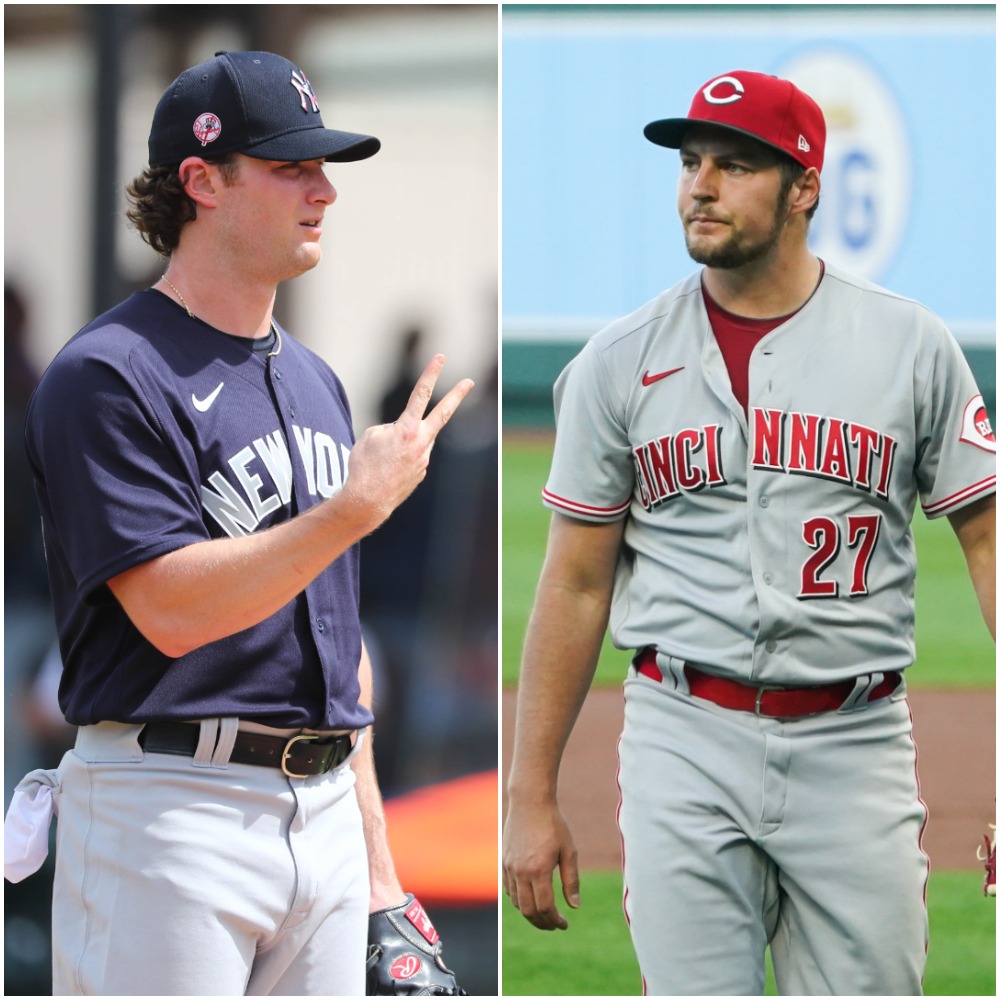
Bauer has had an up-and-down career. Since 2017, his season ERAs are 4.19, 2.21, 4.48, and 1.73. Feinsand, who also included Stephen Strasburg in his comparison, mainly focused on each pitcher’s final 90 starts heading into free agency. Why 90? Well, a three-season lookback is pretty standard. A 90-start lookback also happens to be quite convenient for Bauer, as it excludes his rough first half of 2017.
One thing I did not see in Feinsand’s article was any form of a strikeout rate, walk rate, or groundball rate. Those are the things pitchers do that actually correlate year-to-year. So here’s that look, with the additional info. We’ll remove Strasburg, since the question is whether Bauer is worthy of Cole’s AAV record. (App users can click here to see the 90-start comparison).

Cole had better strikeout and walk rates in his previous 90 starts, which is more important than the ERA difference. But I was also thinking it’s strange to do a comparison that includes 25 starts from Cole’s 2017 season, his last with the Pirates. Upon joining the Astros in a January 2018 trade, Cole famously changed his pitch mix and approach, to drastically improved results. So how would a Bauer-Cole comparison look over the previous 60 starts? (App users can click here to see the 60-start comparison).

Even though this window excludes Cole’s first five starts of 2018, which were dominant, it further accentuates the differences between the two hurlers. They’re both strikeout pitchers. But what Cole did in his walk year – a 39.9 K% – is literally the best in baseball history for a pitcher with at least 100 innings (Cole pitched 212 1/3). Bauer’s walk year strikeout rate of 36% was historic in its own right – seventh all-time for a qualified starter – but it was only 11 starts due to the 60-game season. That brings us to one last comparison, one that Feinsand made of each pitcher’s best 11 starts in their walk year (app users click here):

Both dominant stretches, yet Cole’s was clearly better. If we’re comparing post-2019 Cole to current Trevor Bauer, we can state the following:
- Cole averaged 97.2 miles per hour on his fastball in his walk year. Bauer averaged 93.5.
- On a related note, while both are strong strikeout pitchers, Cole was significantly better for longer.
- Cole had better control than Bauer.
- Cole was dominant in two full, consecutive seasons leading up to free agency. Bauer has never been dominant in two consecutive seasons.
- Bauer will be 234 days older on 4-1-21 than Cole was on 4-1-20.
On the merits of statistics, I don’t see how one can say that Bauer is better than Cole and therefore deserves a higher AAV. Feinsand makes a good point, though: if Bauer limits himself to an artificially shorter contract, his AAV should go up from where it would have been had he maxed out the years. But what is Bauer’s actual years maximum, assuming he won’t take an artificially low AAV like Bryce Harper did?
Given the current state of baseball economics, I’d suggest six. So to bring enhanced AAVs into play as a reward for an artificially short term, Bauer would probably have to sign for four or fewer years. Remember, the Dodgers reportedly offered Harper a $45MM AAV on a four-year term. Instead, he took a $25MM AAV on a 13-year term.
There are several reasons why the Bauer-Cole comparison actually doesn’t matter. The first is the state of the market in December 2019 compared to the current state of affairs. All 30 teams brought in significantly smaller amounts of revenue in 2020 than in 2019. Most of the best free agents remain unsigned, but the ones that did sign exceeded expectations. It’s an odd combination. But it’s fair to say market conditions are worse for Bauer than they were for Cole.
The second reason contract comps don’t matter is that free agency is a bidding war. The goal of every team targeting a free agent is to get that player for as little as possible. Agents don’t convince teams to spend more money by holding up other free agent contracts from years past. Generally speaking, teams run circles around agents in statistical chops, anyway. It’s certainly possible that Luba will be able to get a couple of teams to bid irrationally on Bauer, but it won’t be because of what Cole received.
The last point is that teams don’t pay free agents for what they have done; they pay for what they expect the player to do in the future over the life of the contract. Again, we have to defer to teams’ superior abilities to forecast what Bauer will do. They’ll use advanced stats, Statcast data, health history, and proprietary information we’ll never see. They won’t use ERA, which generally has a year-to-year correlation around 0.4. But that’s how a team’s GM will approach it. Signing Bauer is an ownership-level decision, and an owner is unlikely to analyze a potential signing with the same sophistication as the GM.
As Bauer once put it, he and Cole are “intertwined forever.” The UCLA teammates were drafted two picks apart in 2011 and made their way to MLB free agency coming off fantastic walk years. But as I see it, Bauer’s current position falls short of where Cole stood when he hit the market in 2019.
Former Angels Staffer Alleges Widespread Use Of Foreign Substances
Last March, the Angels dismissed visiting clubhouse manager Brian “Bubba” Harkins amidst allegations he’d been providing opposing teams’ pitchers foreign substances to aid their grip on the baseball. Harkins responded by filing a defamation action against both the organization and Major League Baseball. The Angels and MLB filed a motion to dismiss the lawsuit last November.
Harkins’ opposition to the defendants’ motion for dismissal was filed in Orange County Superior Court yesterday and obtained by Mike DiGiovanna of the Los Angeles Times. Therein, Harkins alleges widespread use of a rosin and pine tar concoction by MLB pitchers to alter the feel of the ball. Harkins’ assertions involve players from the Angels and opposing teams alike, spanning across the past two decades. In his court filing, Harkins names such players as Troy Percvial and Brendan Donnelly, who last played for the Angels in 2004 and 2006, respectively, as alleged users of the rosin/pine tar mix. Additionally, Harkins includes several recent or current Angel pitchers among those he claims have altered the ball.
Harkins further alleges that MLB has evidence of various high-profile pitchers from other teams using foreign substances to affect the baseball. DiGiovanna relays a text allegedly sent by Yankees starter Gerrit Cole (then with the Astros) to Harkins in January 2019 stating “Hey Bubba, it’s Gerrit Cole, I was wondering if you could help me out with this sticky situation. We don’t see you until May, but we have some road games in April that are in cold weather places. The stuff I had last year seizes up when it gets cold.”
It’s worth noting that none of these specific allegations have been substantiated. To this point, these allegations (more of which can be found in DiGiovanna’s full piece) are limited to Harkins’ pre-trial court filings. The case is set for a January 21 hearing on the defendants’ dismissal motion. If the case were to proceed to trial, Harkins’ attorney will seek at least $4MM in damages, notes DiGiovanna.
More generally, MLB pitchers’ supposed usage of ball-altering foreign substances has become a notable issue throughout the sport in recent months. Last February, then-MLB senior vice president Chris Young sent a memo to teams prohibiting club personnel “from providing, applying, creating, concealing or otherwise facilitating the use of foreign substances by players on the field” (relayed by Ben Lindbergh of the Ringer in July). Nevertheless, Lindbergh spoke with several players who estimated that at least 70% of pitchers were using some form of illegal substance. In November, Eno Sarris of the Athletic spoke with nearly twenty MLB players and coaches about ball-doctoring, and the “median answer was more than three-quarters of the league (uses illicit foreign substances).”
Lindbergh and Sarris note the correlation between the usage of a grip-altering foreign substance and higher spin rates for pitchers. (Both pieces are worth a full read for those interested). This figures to remain a topic of discussion for Major League Baseball, whether or not Harkins’ specific allegations are sufficient to warrant the continuation of his lawsuit.
Yankees, Rays Set Game 5 Starters
It will be Gerrit Cole against Tyler Glasnow in tomorrow’s deciding Game 5 of the ALDS matchup between the Yankees and Rays. New York recorded a 5-1 win in Game 4 tonight to force the winner-take-all contest on Friday at Petco Park (the Rays will be the designated home team).
It isn’t any shock that Cole will get the call for the Yankees’ biggest game of the season. Signed to a nine-year, $324MM free agent deal last winter, Cole lived up to that ace billing in the regular season and is 2-0 in two playoff starts. The home run issues that plagued Cole during the season have again been something of an issue in the postseason, as he has surrendered three long balls in 13 innings of 3.46 ERA pitching during these playoffs.
Two of those homers came in Game 1 of the ALDS, though Cole held on for a quality start in allowing three runs on six hits and two walks over six innings of work, while recording eight strikeouts. Counting the regular season, Game 5 will be the fifth time the Rays have faced Cole in 2020. It will also mark the first time in Cole’s eight-year career that he has started a game on only three days’ rest, though it’s safe to assume manager Aaron Boone will have his entire cadre of pitchers available should Cole run into any early struggles.
The same tactic will almost surely apply for Glasnow and the Rays, as Glasnow will start on just two days’ rest after pitching five innings in Game 2 (allowing four runs on three hits and three walks, with 10 strikeouts). Given the even shorter amount of time between games for Glasnow, he might also be a candidate for a quick hook from Rays manager Kevin Cash. It is also possible Glasnow could be less a proper starter and more of a glorified opener, as Tampa Bay would be pleased to get as many innings as they can from Glasnow before turning things over to their deep bullpen.
Angels’ Arte Moreno On Joc Trade, Rotation, Eppler
The trade that would have sent Dodgers outfielder Joc Pederson and Ross Stripling to the Angels for infielder Luis Rengifo and outfield prospect Andy Pages appears to be dead. A report last week indicated Angels owner Arte Moreno was the one who put the kibosh on it. Moreno confirmed Monday that he did shoot down the LA-LA trade, per Jeff Fletcher of the Orange County Register, though he wasn’t willing to say why.
“It wasn’t all impatience. There were other things,” Moreno said of the causes for the failed swap, which fell through as the Dodgers waited to acquire Mookie Betts and David Price from the Red Sox (that ended up happening). Now, according to Moreno, the Angels have “moved on.”
Had the Angels gotten Stripling, he’d have looked like one of their most talented starters on paper. The club entered the offseason needing rotation help, and it has added a couple durable veterans in Julio Teheran and Dylan Bundy. It looks as if the the Angels continue to need front-end aid, though, especially with Shohei Ohtani set to stay off the mound for at least the first month and a half of the season.
The Halos did make a legitimate attempt to sign the No. 1 free agent available, right-handed ace Gerrit Cole, as they offered him $300MM over eight years back in December. But the Southern California native instead accepted the Yankees’ record-setting offer of nine years and $324MM. Moreno discussed the Angels’ Cole pursuit, indicating they simply couldn’t match the Yankees’ aggressiveness. “Walking in there and you knew, no matter what I bid, we’re going to get outbid,” he said. “We had a pretty big number out there.”
With the season getting closer, it may now be too late for the Angels to land an impact starter. However, if all goes well into the summer and the Angels are contending, Moreno’s hopeful they’ll find one via trade. The team has “the financial flexibility” for such an addition, according to Moreno, who noted it’s seeking someone “who can substantially help us, not a No. 4 or No. 5.”
General manager Billy Eppler may be tasked with finding that type of starter in a few months, but his future’s uncertain beyond 2020. The Angels exercised his option for this season late last year, though they haven’t made the playoffs since hiring Eppler before 2016, so he could be on shaky ground. It doesn’t seem they’re going to rush into an extension for him just yet. Rather, “As a group, we need to win,” said Moreno, who added, “I probably should fire myself” for the franchise’s recent performance.
Teams That Gained Or Lost Draft Picks Via Qualifying Offer Free Agents
Now that Marcell Ozuna has signed, all 10 of the players who were issued a one-year, $17.8MM qualifying offer in November have settled on teams for the 2020 season. Of that group, two (Jose Abreu of the White Sox and Jake Odorizzi of the Twins) accepted their qualifying offers and returned to their clubs — Abreu, in fact, topped off his QO by signing a contract extension that will run through the 2022 season. Stephen Strasburg also isn’t changing uniforms, as the longtime Nationals ace rejected the club’s qualifying offer but eventually re-signed with Washington on a seven-year, $245MM deal.
That leaves us with seven QO players who will be playing on new teams in 2020, and as such, the draft compensation attached to those seven players has also now been allotted. Under the rules of the Collective Bargaining Agreement, the same compensation was handed out to all six teams who lost those players, as the entire sextet fell under the same financial criteria. The Mets, Cardinals, Braves, Giants, Nationals, and Astros all aren’t revenue-sharing recipients, nor did they exceed the luxury tax threshold in 2019, so all six teams will receive a compensatory draft pick between Competitive Balance Round B and the third round of the 2020 draft.
Here is how the so-called “Compensation Round” breaks down. The order of the picks is determined by worst record-to-best record from the 2019 season.
68. Giants (for Madison Bumgarner)
69. Giants (for Will Smith)
70. Mets (for Zack Wheeler)
71. Cardinals (for Marcell Ozuna)
72. Nationals (for Anthony Rendon)
73. Braves (for Josh Donaldson)
74. Astros (for Gerrit Cole)
San Francisco now possesses five of the first 87 picks in next June’s draft. With the Giants still in the NL wild card race last summer, president of baseball operations Farhan Zaidi opted to hang onto Bumgarner and Smith rather than trade either player, a decision that led to some criticism since San Francisco was widely considered to be closer to rebuilding than truly contending. The critics’ judgement grew even harsher after the Giants went 22-32 record in August and September and fell well short of the postseason. Still, given that teams were reluctant to part with top-flight young talent for even controllable players (let alone rentals like Bumgarner and Smith) at the trade deadline, Zaidi clearly felt that the two picks he could recoup from the qualifying offer process were more valuable than anything offered for the two Giants pitchers last July.
It’s worth noting that the 74th overall pick will be Houston’s first selection of the 2020 draft, after the Astros lost both their first- and second-highest selections in both 2020 and 2021 as part of their punishment for the sign-stealing scandal. Since the Red Sox are also under league investigation for their own alleged use of electronics to steal opponents’ signs in 2018, Boston could also potentially lose at least one pick in this year’s draft, so we can’t yet say that the 2020 draft order is finalized. Of course, the order could be further muddled if more trades occur involving picks from the two Competitive Balance Draft rounds, which are the only types of draft picks that can be traded. We’ve already seen the Rays and Cardinals swap their picks in Rounds A and B as part of the multi-player trade that sent Jose Martinez and Randy Arozarena to Tampa Bay earlier this month.
Let’s now look at the six teams who signed the seven QO-rejecting free agents, and see what those clubs had to give up in order to make the signings.
Yankees, for signing Gerrit Cole: Since New York exceeded the luxury tax threshold in 2019, they gave up their second- and fifth-round picks in the 2020 draft (a.k.a. their second- and fifth-highest selections). The Yankees also gave up $1MM in funds from their international signing bonus pool.
Diamondbacks, for signing Madison Bumgarner: As a team that didn’t exceed the luxury tax threshold and was a revenue-sharing recipient, the D’Backs had to give up their third-highest draft choice to sign Bumgarner. This ended up being Arizona’s second-round selection — the team’s first two picks are their first-rounder (18th overall) and their pick in Competitive Balance Round A (33rd overall).
Twins, for signing Josh Donaldson: Minnesota also received revenue-sharing and didn’t exceed the luxury tax threshold, so signing Donaldson put the Twins in position to give up their third-highest draft selection. However, the Twins are actually giving up their fourth-highest pick in the 2020 draft, which is their third-round selection. The Twins’ actual third selection is their pick in Competitive Balance Round B, but those picks aren’t eligible to be forfeited as compensation for QO free agent signings.
Angels, for signing Anthony Rendon: Since the Halos didn’t receive revenue-sharing funds and also didn’t pay any luxury tax money, they had to give up their second-highest draft pick (their second-rounder) and $500K in international bonus funds to sign Rendon.
Phillies, for signing Zack Wheeler: The Phillies surrendered their second-highest selection (their second-round pick) and $500K of their international bonus pool, since they were another team that didn’t exceed the luxury tax line and didn’t receive revenue-sharing money.
Braves, for signing Will Smith and Marcell Ozuna: The dual signings put Atlanta in line for a dual penalty. The Braves didn’t exceed the luxury tax threshold and also didn’t receive revenue-sharing money, so they gave up their second-highest draft pick (their second-rounder) and $500K of international bonus money for Smith. In landing Ozuna, the Braves then had to also forfeit their third-round pick (their third-highest selection) and another $500K from their international bonus pool.
Losing two draft picks and $1MM in international pool money isn’t nothing, though these particular sanctions had less impact on the Braves than on other teams, which undoubtedly influenced their decisions. First of all, the compensatory pick Atlanta received for Donaldson is higher in the draft order than their third-round pick, so the net loss is only a second-round pick. Secondly, the Braves’ movement in the international market is still limited by the punishment handed out by Major League Baseball in November 2017 for Atlanta’s past international signing violations. Part of that punishment included the Braves’ pool for the 2020-21 international market being reduced by 50 percent — being so handcuffed in the international market anyway, the Braves probably felt $1MM in pool money was no great loss.
Stan Kasten Discusses Dodgers’ Offseason, Cole, Spending
Though the Dodgers have been linked to several big names in both trade rumors and free agency, it’s been a pretty quiet offseason at Chavez Ravine, with the club’s one-year, $10MM deal with Blake Treinen standing out as the biggest move of note. The lack of action to date hasn’t sat well with many fans and pundits, including Bill Plaschke of the Los Angeles Times, though Dodgers president and CEO Stan Kasten strongly defended his club’s strategies in a recent phone conversation with Plaschke.
As one might expect, Kasten took issue with what he described as “the L.A. Times’ characterization that everyone hates us,” which he felt was incorrect given strong attendance numbers. While “for sure there are some fans…and a lot of people in the Twitterverse” who are critical of the Dodgers’ decisions, “based on the fans that support us…including this coming year…incredibly strong support and ticket sales…you keep trying to convince yourself that everyone hates us. I just think you’re wrong.”
Kasten denied that the Dodgers were in any way limited by payroll considerations, or lacked full commitment to winning their first World Series since 1988, saying “we really need” to capture that elusive title.
“There are metrics in business that are mostly private that we look at, and I’d say we feel successful there,” Kasten said. “But there’s no question that all of us who are competitive, from every owner that has a piece of the team to the junior people in the front office, we’re laser-focused on winning the World Series….It’s obviously not about what you spend, it is about the moves you make, the decisions you make. I think questioning those things, criticizing those things, that’s absolutely fair. But just to say there’s a [payroll] number you need to hit and if you don’t hit it you’re not trying, that’s just silly.”
To that end, Kasten noted that the Dodgers were fourth in spending last season, and are likely to be beyond the $208MM Competitive Balance Tax threshold by season’s end. Roster Resource’s Jason Martinez estimates that L.A. has a current luxury tax number of just under $189MM, though “the team we have now is not going to be the team we have to start the postseason,” Kasten said. “I expect that team, this year, it looks like it’s going to be well over the CBT, or somewhat over.”
The types of larger-salaried players who would boost a CBT number could come sooner rather than later, as Kasten said “there are guys that we think could be difference makers and we have pursued them, we are continuing to pursue them, when there is an opportunity we will certainly jump at it.” One of the players who was on the Dodgers’ radar earlier this winter was Gerrit Cole, though Kasten doesn’t believe Cole shared that interest in coming to L.A., no matter the dollars involved. Cole joined the Yankees on the largest contract ever given to a pitcher — a nine-year, $324MM deal.
“It is clear now, I think it was clear to us in the middle of the process, he wanted to be a Yankee, he just did,” Kasten said. “In retrospect, I think we were just the stalking horse to get a number he finally could get from a team he wanted to go to. I don’t have any quibble with his approach…it was all very fair, but he wants to be somewhere, he got a lot of money to be where he wanted to be.”
Whether adding a particular star player is necessarily the right move to finally put Los Angeles over the top in a World Series, however, is far from a certainty. Kasten points out that recent postseason heroes Daniel Hudson (with the Nationals in 2019) and Steve Pearce (with the Red Sox in 2019) were unheralded additions to their respective teams.
This strikes to the heart of the debate between Kasten and Plaschke, as the latter is concerned that the Dodgers’ focus on sustained success will keep the team from making a direct and concentrated push to end the championship drought in any one given year. Kasten, by contrast, feels that the team’s approach allows it to be in the hunt every season.
“We won 106 games and came a couple of outs away from beating the team that won the World Series, that doesn’t suggest to me a system that needs to be completely torn apart,” Kasten said. “What about the renewed pipeline, the old Dodger value of a player pipeline that I think we’ve had a reasonable amount of success at rebuilding? How about the kids that are homegrown Dodgers? We have a payroll of $200 million. How can you call us cheap? It blows my mind.“
Yankees Sign Gerrit Cole
The Gerrit Cole sweepstakes has reached an end just over a month after the start of free agency. The Yankees have agreed to sign the ace right-hander to a nine-year, $324MM contract, Jon Heyman of MLB Network reports. It includes a full no-trade clause and an opt-out clause after the fifth year, per Jeff Passan of ESPN.
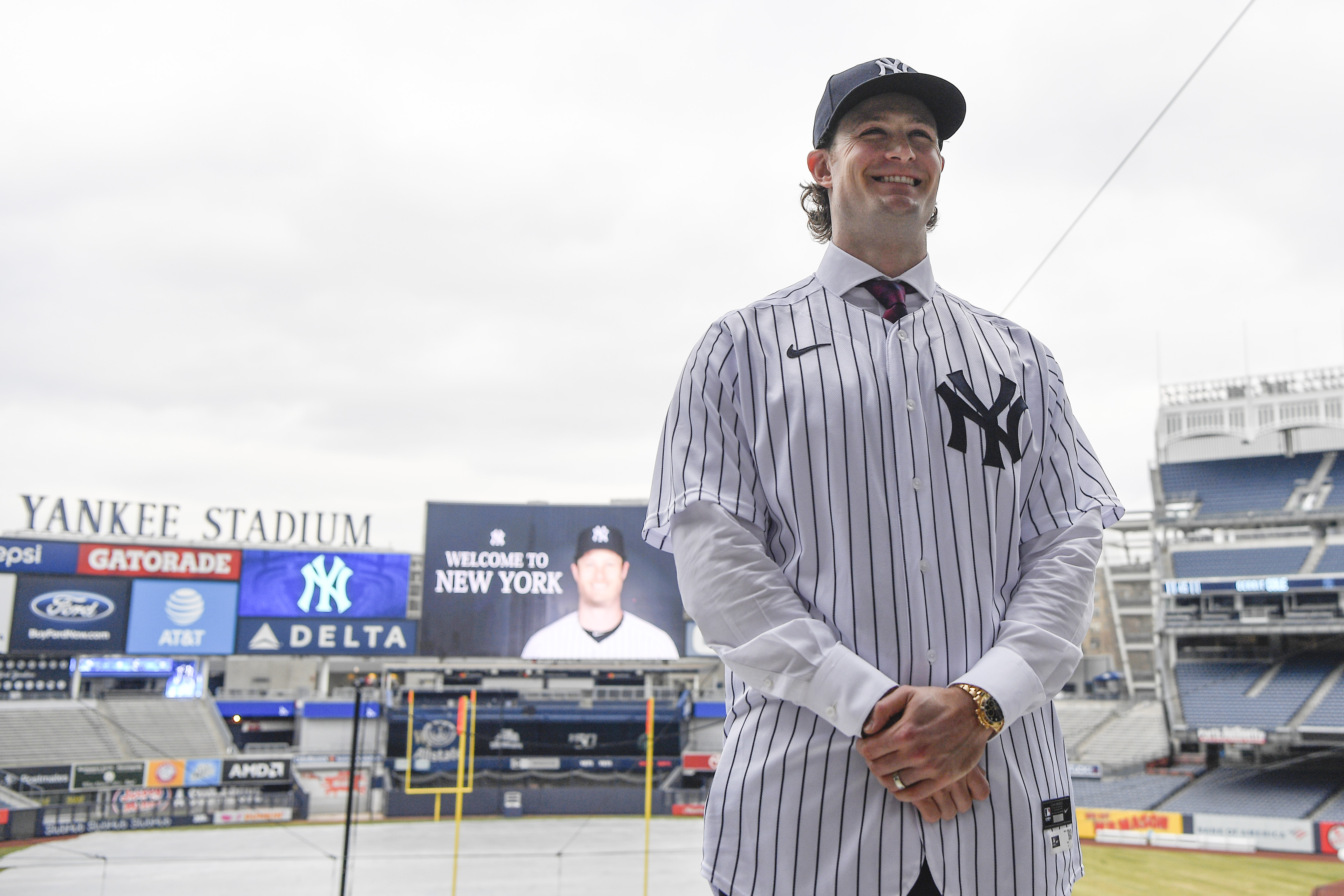
It’s a historic pact for Cole, a Scott Boras client who has landed the largest deal ever for a pitcher and the second-greatest payday in the history of major league free agency. Cole has smashed the seven-year, $245MM contract righty Stephen Strasburg signed with the Nationals earlier this week, and he nearly matched the $330MM guarantee outfielder Bryce Harper received from the Phillies last offseason. But Harper’s money will come in over 13 years, meaning Cole has easily eclipsed him in average annual value. Cole will take home a whopping $36MM per year.
For the Yankees and general manager Brian Cashman, the addition of Cole brings to an end a years-long pursuit of the Southern California native, who was a fan of the club growing up. The Yankees selected Cole in the first round of the 2008 draft, but he elected to attend UCLA instead. It proved to be a wise decision for Cole, who further improved his stock as a Bruin and wound up as the No. 1 overall pick of the Pirates in 2011.
Cole, who debuted in the majors in 2013, generally thrived in Pittsburgh through 2017. However, the Pirates knew they wouldn’t be able to reach an extension with Cole, so they traded him to Houston prior to the 2018 campaign. The Yankees were among the teams the Astros upended to acquire Cole, which proved costly for New York. Thanks in large part to Cole, the Astros took down the Yankees in this fall’s American League Championship Series, though Houston fell to Strasburg and the Nationals in the World Series.
The Yankees couldn’t beat Cole, but he’ll now join them after he found another gear in Texas. Cole became a truly elite pitcher as a member of the Astros, with whom the flamethrower posted back-to-back 200-inning seasons of sub-3.00 ERA ball. He was particularly amazing in 2019, when he amassed a jaw-dropping 326 strikeouts with a 2.50 ERA/2.64 FIP across 212 1/3 frames. That performance wasn’t enough to defeat then-teammate Justin Verlander for AL Cy Young honors, but it was enough to help earn Cole an absolutely massive payday. This deal blows past the eight-year, $256MM that MLBTR predicted Cole would receive this offseason.
The Yankees now have a lights-out workhorse to accompany Luis Severino, James Paxton and Masahiro Tanaka as their top four starters, and the Cole signing indicates they and owner Hal Steinbrenner aren’t concerned about paying the luxury tax going forward. With Cole’s money factored in, Jason Martinez of Roster Resource estimates the Yankees are on track to spend just under $250MM in 2020, which is without having made any other additions. If that holds up, the Yankees will exceed the highest tax penalty of $248MM next season. Doing so would subject the Yankees to a 42.5 percent overage tax for outspending the threshold by $40MM or more. It’s possible, however, that the Yankees will shave off some of their tax bill if they’re able to trade $17MM left-hander J.A. Happ, a rumored candidate for a change of scenery who now looks all the more likely to exit now that Cole is in the fold.
The Cole pickup represents an act of free-agency aggression that late Yankees owner George Steinbrenner would have saluted. It’s also a sign the Yankees are all-in toward returning to the top of the major league mountain for the first time since 2009. Not only does Cole look as if he’ll greatly strengthen their roster, but it’s a major blow to their biggest AL competition, the Astros. Undoubtedly, Cole’s decision is also an enormous disappointment to both Los Angeles-based teams, who all along joined the Yankees as the most obvious-looking fits to sign him. Those two teams will now have to look elsewhere in a free-agent market that has moved much quicker than in recent years, and has already seen several of its best players sign in a matter of weeks.
While Cole should have a hugely positive effect on the Yankees’ near-term chances, it’s clear this deal presents a sizable risk for the club. Assuming Cole doesn’t opt out after the fifth season, the 29-year-old will pitch almost the entirety of his 30s on this contract. The good news for the Yankees is that Cole has never had anything as major as Tommy John surgery. However, he did miss a large portion of 2016 with injuries, including to his elbow. Cole has since bounced back with three consecutive 200-inning seasons, though signing pitchers to long-term, big-money contracts is nonetheless risky, which will leave the Yankees to hope he continues to hold up as he ages.
Should Cole exercise his opt-out provision in the 2024-25 offseason, the Yankees will have the opportunity to void that decision by extending him for an additional year and $36MM, Ken Rosenthal of The Athletic reports (Twitter link). Cole would need to be willing to walk away from four years and $144MM at age 34 for that clause to be relevant, and the Yankees would likewise need to be willing to pay him a total of $180MM for his age-34 through age-38 seasons to void the opt-out decision. It doesn’t seem particularly likely that the clause will come into play, but in the event that it does, Cole would earn $360MM over a decade-long term with the Yankees.
While all free agents bring some level of concern, that hasn’t stopped Boras from securing a windfall of cash for his clients this offseason. After helping get Harper his contract last year, Boras has seen Cole and Strasburg collect a combined $569MM this winter. He may help negotiate yet another $200MM-plus deal next for third baseman Anthony Rendon, who just took over as the No. 1 free agent available now that Cole’s off to the Bronx.