
Pitching Chatter: Vazquez, Diaz, Ray, Colome, Greene
As the Dodgers continue to try to pry closer Felipe Vazquez loose from the Pirates, ESPN.com’s Buster Olney reports (Twitter link) that the sides are at a bit of an impasse. It seems the Bucs would (quite understandably) like to receive soaring L.A. prospect Gavin Lux, a versatile infielder who has completely obliterated Triple-A pitching (.474/.553/.918 in 114 plate appearances with eight home runs and a 17:17 K/BB ratio) since a mid-season promotion. The clubs may well be engaged in a bit of a staring contest as the deadline draws near.
More news and rumors from the pitching market …
- The Rays may have faded in the AL East, but they’re not planning to go quietly. Olney tweets that the club is “doing work” on Mets reliever Edwin Diaz, making for an intriguing (if vague) connection. Beyond the obvious appeal of a high-charged young hurler who has shown a past ability to dominate like few others, there are a few other reasons to like this match. Diaz’s run of poor results will limit his arbitration earning power, boosting his appeal to the payroll-conscious Rays. And as Mike Petriello of MLB.com explains, there are plenty of reasons to believe that Diaz is every bit as good as ever before.
- Rival organizations “fully expect” the Diamondbacks to deal southpaw Robbie Ray, according to Bob Nightengale of USA Today (Twitter link). Arizona GM Mike Hazen continued to acknowledge his club’s tricky middle ground while avoiding a firm commitment to a particular course of action, as Nick Piecoro of the Arizona Republic reports. The top baseball ops man did acknowledge that there’s a possibility the team could pull off enough sell-side moves that it wouldn’t make sense to reload in the offseason. At the moment, the Brewers, Astros, and Yankees are among the teams with active talks or interest in Ray, per Jon Heyman of MLB Network (via Twitter).
- With a real shot at a much-anticipated return to the top of the heap in the NL Central, the Cardinals could yet swing a big deal. Ken Rosenthal of The Athletic reports (subscription link) that the St. Louis ballclub is interested in a controllable starter. Beyond that, the Cards’ precise plans remain a bit difficult to ascertain. The club is interested in lefty relief pitching, though that’s a trade deadline staple for many contenders. We haven’t seen the team connected prominently to any high-end hurlers, but a bold move seems tempting.
- We’ve seen the Yankees connected to a wide variety of hurlers in recent weeks, with the club focused primarily on starters but also entertaining relief upgrades. They’ve recently chatted with the Tigers about old friend Shane Greene, according to MLB.com’s Jon Morosi (Twitter link). Most contenders are no doubt at least checking in on Greene, who’s among the likeliest players in baseball to be traded in the coming days.
- Similarly, the Phillies have cast an exceedingly broad net. Their relief situation remains problematic; now, there are indications that David Robertson‘s rehab may drag into September, as Nightengale was among those to tweet. Another name to add to the list of Phils possibilities: Alex Colome of the White Sox. Morosi tweets that there’s “continued interest” on the part of the Philadelphia organization.
Red Sox, Mets Have Discussed Edwin Diaz
As the Red Sox continue their search for bullpen help and the Mets continue to puzzle onlookers, the two teams have been in touch about a potential Edwin Diaz deal. ESPN’s Buster Olney tweeted early this morning that third base prospect Bobby Dalbec or corner infielder Triston Casas would likely be targeted as the centerpiece of any deal by the Mets. Mark Feinsand of MLB.com tweets that Boston has indeed discussed a possible Diaz swap with the Mets, though, adding that the Red Sox are likely to add at least one, if not two relievers in the coming days. SNY’s Andy Martino tweets that there’s “nothing hot” between the two sides at the moment, however.
It’s shaping up to be quite the deadline for the Mets, who shipped their two best pitching prospects to the Blue Jays yesterday in a trade that netted them Marcus Stroman. At the same time, the Mets appear poised to trade away some combination of Noah Syndergaard, Zack Wheeler, Jason Vargas, Todd Frazier and Diaz — the latter of whom was portrayed as a signature offseason acquisition in what proved a near-immediately regrettable trade with the Mariners.
Instead of anchoring the bullpen and reprising his role as one of the game’s premier relievers, Diaz has taken a step back in nearly every category this season. The 25-year-old has seen virtually every one of his rate stats — strikeout, walk, home-run, ground-ball, swinging-strike, hard-hit and opponent chase — trend in the wrong direction. His premium velocity has held strong, as he’s averaged 97.2 mph on his heater, but the across-the-board results for Diaz have been ugly. It doesn’t help him that the Mets’ defense is awful, but he’s sitting on a bloated 4.95 ERA and has already allowed more runs, hits and homers in 40 innings this season than he did in 72 1/3 frames last year. A 3.24 xFIP and 2.87 SIERA each portend better days, but it’s tough to understate what a disappointing season it’s been for Diaz so far.
All of that said, Diaz appears healthy and still possesses an elite arsenal of pitches. Paired with the fact that he’s not eligible for arbitration until this winter and can be controlled through the 2022 season, Diaz’s plus raw stuff surely gives other clubs confidence that he can be fixed (be it through pitch selection, a mechanical adjustment, improved defense behind him, etc.). The Boston bullpen has lacked established talent all season, and the relief corps has been particularly problematic this summer.
As for the Mets, they seemingly hope to structure their 2020 rotation around 2018 Cy Young winner Jacob deGrom and Stroman — a fine one-two combination, to be sure — and believe they’ll get more in trading away others than they surrendered to acquire Stroman. While they can’t unscramble the egg, so to speak, and recoup the value they lost in dealing Jarred Kelenic, Justin Dunn and Gerson Bautista to the Mariners (while taking on half the remaining money on Robinson Cano‘s deal), the apparently forthcoming slate of trades should indeed replenish their farm to an extent. Syndergaard has more trade value than Stroman did, and Diaz should fetch some quality young talent if he is indeed shipped off.
Nonetheless, it’d be a dizzying sequence of moves that wouldn’t clearly leave the Mets better off than they started. While it’s commendable, on the one hand, that the team continues to eye contention in the short-term rather than acquiesce to the growing trend of large-scale rebuilds, the tightrope act the Mets look to be attempting is rife with risk. Perhaps moving Diaz and Syndergaard can each net a near-MLB-ready asset or two, but it’s not at all clear that they’d be in a better position with Stroman and those theoretical young assets. Stroman himself isn’t a particularly controllable player, after all, as he’ll be a free agent in the 2020-21 offseason. If things go south again next year, he’d likely be traded as a rental for less than the Mets paid to acquire him. And, in moving Diaz by Wednesday, they’d open a need for further late-inning bullpen help in the offseason — the very same need that led to this situation.
Braves, Dodgers, Rays, Jays Pursuing Edwin Diaz
Just four months into his first season with the Mets, ballyhooed winter acquisition Edwin Diaz has already emerged a potential trade chip amid a disappointing campaign. The Braves, Dodgers, Rays and Blue Jays are among the teams in on the right-handed closer, Mike Puma of the New York Post reports. Andy Martino of SNY.tv passes along different information on the Braves, tweeting there’s “no traction” on Diaz to Atlanta.
The fact that Atlanta, Los Angeles and Tampa Bay are rumored to have interest in Diaz isn’t a shock. They’re all contending teams that are known to be in the market for bullpen help. The inclusion of rebuilding Toronto looks especially intriguing on paper, though it’s possible Diaz wouldn’t ever throw a pitch for the Blue Jays. The club could instead acquire Diaz and flip him to the Braves – one of the Mets’ division rivals – for prospects, according to Puma.
It’s the latest creative trade idea involving Diaz, whom the Mets are reportedly considering putting in a package with righty starter Zack Wheeler before Wednesday’s deadline. But whether anyone will even be able to pry Diaz out of New York is up in the air. Diaz was rookie general manager Brodie Van Wagenen’s signature offseason addition, so BVW has predictably indicated it would take an enormous return for the Mets to deal him away so soon.
Van Wagenen, for his part, surrendered two of the game’s top prospects – outfielder Jarred Kelenic and righty Justin Dunn – in a package for Diaz and second baseman Robinson Cano. The Mets also took on $100MM of Cano’s remaining money to get Diaz, but the trade has blown up in the non-contending club’s face so far. The typically great Cano may be deteriorating at the age of 36, while Diaz hasn’t been able to match his otherworldly 2018 swan song in Seattle.
The hard-throwing Diaz arrived in New York as a celebrated bullpen savior after closing 57 of 61 opportunities, posting a 1.96 ERA/1.61 FIP and logging 15.22 K/9 against 2.09 BB/9 in 73 1/3 innings last season. The Mets’ version has been lit up for a 4.81 ERA over 39 1/3 frames and blown as many saves as he did last season (in 35 fewer chances). The home run ball has been a major concern this year for Diaz, who yielded HRs on a career-best 10.6 percent of flies in 2018. That figure has shot to a personal-worst 17.9 percent this season as his groundball numbers have fallen precipitously.
Even factoring in the difficulties Diaz has endured in 2019, there’s plenty to like – including his 97 mph heat, pre-2019 track record and the 3.50 FIP, 13.96 K/9 and 2.97 BB/9 he has logged this season. Diaz has also suffered from poor luck, it seems, evidenced in part by a .407 batting average on balls in play against and a wide gap between the .336 weighted on-base average/.271 xwOBA that hitters have recorded off him.
Diaz may be a prime candidate for a turnaround, which – coupled with his team control – helps make him extremely attractive to the Mets and other clubs. The 25-year-old’s earning just over $600K this season and will go through the first of three potential trips through arbitration over the winter. However, whether he’ll do so as a Met or as a member of another team is now surprisingly in question.
Mets Considering Packaging Of Zack Wheeler, Edwin Diaz
In what one must imagine is an extremely hectic organizational war room, front office employees for the Mets are mulling the packaging of Zack Wheeler and Edwin Diaz in a potential trade, according to a report from Joel Sherman of the New York Post (link).
For a club that is seven games under .500, the Mets–for all of the criticism they’ve received this year–are a team still laden with desirable players. According to Sherman, Mets officials have indicated that as many as 16 teams are currently “serious” about acquisitions involving Wheeler, Diaz, and/or Noah Syndergaard, and employees of rival clubs have informed the reporter that all three are expected to be moved before the July 31st trade deadline.
While an exit may be imminent for the recently recuperated Wheeler and the flamethrowing Diaz, the merit of packaging the two together is, at first glance, dubious. For one thing, with such a large number of clubs involved in the postseason running, it is hard to imagine that either Wheeler or Diaz could not, on their own, net at least a top-30 prospect or two. Secondly, we often see clubs package players as a means of jettisoning undesirable contracts, as was the case with Diaz’ arrival in New York. However, neither Wheeler nor Diaz are attached to burdensome contracts, and one could argue that a trade return on either player would be best maximized in isolated dealings with rival clubs, wherein their individual asset values could be more easily agreed upon.
While it is true that Wheeler’s ho-hum results and impending free agency limit his appeal, his lack of a long-term deal could also be seen as a limitation of risk–if he doesn’t perform well down the stretch, an acquiring club can simply walk away in the offseason. With Diaz, one has to respect that a great deal of his 4.81 ERA is allowable, partly, to a sky-high .407 BABIP. He only enters arbitration next year for the first time, which, despite his 2019 struggles, should make him the more desirable of these two players–this is the same player, after all, that was supposed to provide solace in dealing with the back portion of Robinson Cano‘s monstrous $240MM contract. Diaz’ inclusion in yet another package deal, wherein his value is somewhat harder to determine, may make Mets fans feel justifiably queasy.
Meanwhile, in a piece of Mets reportage which runs somewhat contrary to this Sherman piece, Newsday’s Tim Healey relays that his sources within the New York organization are indicating that they fully expect to retain Syndergaard past the deadline (link). The report is relatively sparse on details, but it does suggest–especially when paired with this Wheeler/Diaz news–that the club is indeed more focused on trade permutations involving those latter players.
Latest On Noah Syndergaard, Edwin Diaz
Mets starter Noah Syndergaard and closer Edwin Diaz have come up as potential trade candidates in advance of the July 31 deadline, but general manager Brodie Van Wagenen may have trouble dealing either. Van Wagenen’s difficulty wouldn’t necessarily stem from trying to find a trade partner, but from attempting to sell Mets ownership on a return for one or both right-handers. Van Wagenen doesn’t even want to present a possible Syndergaard or Diaz trade to owners Fred Wilpon and Jeff Wilpon unless he’s confident they’ll sign off on it, according to Joel Sherman of the New York Post.
While the Mets are reportedly “fully intent” on trading Syndergaard, talks haven’t grown so serious that Van Wagenen has gone to the Wilpons yet, per Sherman, who adds moving Syndergaard or Diaz wouldn’t signify the beginning of a rebuild. Instead, the Mets could part with one or both with the intention of immediately improving their roster – one that has stumbled to a 47-55 record in 2019.
As a rookie GM, Van Wagenen inherited Syndergaard – a member of the organization since 2013 – but he’s just a few months from swinging a blockbuster trade that brought Diaz to New York. The goal in acquiring Diaz and expensive second baseman Robinson Cano from the Mariners last offseason was to push the Mets toward contention this year. But the deal hasn’t worked out at all for the Mets, who’ve gotten disappointing contributions from Diaz and Cano and have watched Jarred Kelenic and Justin Dunn – the top two prospects they gave up – impress with their new organization. The Mets are leery of risking similar embarrassment now in selling Syndergaard or Diaz, Sherman suggests.
Diaz hasn’t been nearly the pitcher he was a year ago, when he turned in a 1.96 ERA with 15.22 K/9, 2.09 BB/9 and an eye-popping 57 saves in 73 1/3 innings, but he remains valuable. Although Diaz has recorded a 4.81 ERA over 39 1/3 innings, a 3.50 FIP with 13.96 K/9, 2.97 BB/9 and 97 mph velocity accompany that bloated figure. He’s also young (25), on a near-minimum salary this season and under control via arbitration for the next three years. It’s understandable the Mets would need a huge return to move him, though their hope of acquiring a comparable or better package for Diaz than they originally gave up for him is likely a pipe dream.
Meantime, it could be an even bigger challenge for Van Wagenen to talk the Wilpons into giving their blessing to a Syndergaard deal. There’s skepticism Fred Wilpon, in particular, wouldn’t “appreciate the quality” of a return for Syndergaard, writes Sherman. He points to what the Rays received last summer for Chris Archer (whom the Pirates got for Tyler Glasnow, Austin Meadows and Shane Baz) as a possible comparable for Syndergaard. However, even a valuable package along those lines may not be enough to convince the Wilpons that it would be OK for Van Wagenen to move the coveted 26-year-old hurler.
Latest On Interest In Mets’ Pitchers
Most reports out of New York over the past few weeks have echoed a familiar trio of names when assessing their trade chips: Zack Wheeler, Todd Frazier and Jason Vargas. The three are free agents at season’s end — Vargas does have an $8MM club option ($2MM buyout) that looks increasingly intriguing — making them natural candidates to be shipped out by a 46-54 Mets team that is closer to the NL’s worst record than to the division lead.
The larger source of intrigue surrounds whether the Mets would move assets controlled beyond the current season. To that end, ESPN’s Jeff Passan reports within his latest column that the Mets “have been open to dealing” embattled closer Edwin Diaz. General manager Brodie Van Wagenen isn’t in any type of rush to move his offseason headliner, however. Rather, he’s endeavored to receive a comparable package to the one he surrendered in order to get Diaz in the first place. MLB.com’s Anthony DiComo tweets a similar sentiment, noting that the ask on Diaz is “so sky-high that it’s basically a non-starter.” Though ESPN.com’s Buster Olney suggests on Twitter that the Dodgers are a nice match on paper, he doesn’t indicate whether the sides have had actual discussions — let alone whether the Los Angeles organization would meet the Mets’ asking price.
Finding a deal that compares to the one that brought Diaz to New York seems an impossible order. In addition to taking on a hefty chunk of the Robinson Cano contract, the Mets parted with a pair of young players — Jarred Kelenic and Justin Dunn — who are soaring through the Mariners’ system and up top prospect rankings. Diaz’s strikeout, walk, ground-ball and swinging-strike rates have all gone in the wrong direction. And while he’s tossed six shutout innings since his most recent meltdown — a four-run collapse against the Phillies — he’s still lugging a 4.81 ERA with as many blown saves (four) as he had all of last season.
Even teams that feel they have an answer for Diaz’s struggles wouldn’t be willing to pay a metaphorical dollar-for-dollar rate in negotiations with the Mets. As for taking a lesser deal, the optics of trading him for cents on the dollar while retaining Cano and the sizable portion of his salary they absorbed in that deal would be poor, to say the least. Diaz is controlled through 2022, so a strong finish and/or a 2020 rebound would do wonders for his value.
It seems more plausible that if the Mets were to receive a sizable offer on a controllable arm, it’d be Noah Syndergaard. Olney tweets that the Mets are “seriously listening” to rival clubs that have interest. While Syndergaard hasn’t really thrown in a way that buttresses his own trade value, he’s throwing hard and seems to be in good health. His 4.36 ERA, 8.9 K/9 and 2.3 BB/9 would all be career-worsts if the season ended today, but his track record and upside are so impressive that there’ll be loads of interest.
Whether that listening stance has a real chance of turning into meaningful trade talks remains to be seen. Both Jon Heyman of the MLB Network (Twitter links) and Andy Martino of SNY cite the Yankees as the club with perhaps the keenest level of interest in Syndergaard. Both reports suggest that top pitching prospect Deivi Garcia could be a headliner in such a deal, and while GM Brian Cashman plainly stated a couple weeks back that he wouldn’t move Garcia for a rental, Heyman suggests that the Yankees would “surely” put Garcia in play if meant obtaining Syndergaard, who is controlled through 2021.
Of course, the Yankees and Mets simply haven’t dealt with one another on the trade market at any point in recent history, which makes negotiations all the more complicated. And Olney tweets that he doesn’t think the New York rivals will be able to make a deal on such a significant player. Martino writes that the two teams have nevertheless talked Syndergaard “many times” this month, swapping proposals and counterproposals with no real progress being made. A deal is characterized as unlikely, although he also lists the Astros, Padres, Brewers and, to a lesser extent, the Twins as teams trying to pry Syndergaard loose.
That high asking price may not be the case with regard to Wheeler, whose value partially hinges on how well he performs in Friday’s expected return from the injured list. The Mets’ hope seems to be that a strong outing will quiet some concerns about Wheeler’s recent shoulder flareup, but the injury undoubtedly quelled some interest in him. Despite the concerns, Yahoo’s Mike Mazzeo cites a Mets official as calling the chances of a Wheeler trade “pretty high.”
If the Mets don’t find any offers on Wheeler to be viable or, even worse, he experiences renewed shoulder discomfort and is forced back to the IL, the club could retain him and issue a qualifying offer at season’s end. Barring a worrying showing, though, it may be that the Mets will end up simply taking the best offer on a player whose tenure in New York has seen its share of peaks and valleys.
Brodie Van Wagenen Addresses Mets’ Struggles, Deadline Plans
Embattled Mets GM Brodie Van Wagenen discussed his team’s dire straits today with the media. Deesha Thosar of the New York Daily News and Mike Puma of the New York Post were among those to round up the choicest quotes. MLB.com’s Christina De Nicola approached it from a bit of a different perspective, focusing on the forward-looking aspects of Van Wagenen’s chat.
With the Mets all but buried in the standings, Van Wagenen faced the music on his “come get us” pre-season bravado with respect to the rest of the NL East contenders. As he put it today, “they came and got us.”
That may put a satisfactory wrap on a memorable quote, though it also glosses over some of the actual causes of the Mets’ failings by suggesting their rivals simply got the better of them. Van Wagenen’s claim that the club was the favorite in the division wasn’t just an attention-grabbing statement worthy of skepticism; it also seemingly represented a key driving factor for the team’s decisionmaking over his first offseason at the helm.
Van Wagenen did accept blame for how things have gone, though he did so in a curious manner, deflecting even as he absorbed culpability. “I wouldn’t want to put the blame on players or coaches or scouts or anybody of that matter,” he said, “but I can tell you that this team we built was one of unified vision and it hasn’t worked, so I accept my responsibility in that capacity as well.” Likewise, he seemingly minimized the role of big-picture roster-building when he cited a failure to “do enough of the little things right as a team.”
At the end of the day, the top roster-building decisionmakers have to own their missteps. There are quite often intervening factors that do help explain unanticipated struggles, to be sure. But it’s hard to argue that unforeseeable or simply unlucky happenings have really driven the disaster in Queens this season — Jed Lowrie aside, at least. (The oft-injured veteran has yet to play. He is now said to be dealing with a calf injury, with no apparent target for a return.)
The single major blunder, to this point, has been Van Wagenen’s signature trade — the swap that brought in ace closer Edwin Diaz and highly compensated veteran Robinson Cano. It seemed a highly questionable decision at the time, albeit one that would almost certainly deliver short-term rewards. Instead, both players have struggled mightily, and rather unexpectedly, even as the key prospects sent in the trade have prospered.
“You have to look at where we were and where we are now,” Van Wagenen said when asked whether he has had second thoughts on the deal. He noted that Diaz and Cano still have the remainder of the season to “change the narrative.”
Once again, this explanation seems to miss the mark. The real problem isn’t (just) the ensuing struggles of those players. It’s the series of conceptual failings that led to the deal in the first place. First, the deal was rough for the Mets from a value standpoint, given the huge amount of Cano’s contract the team absorbed. Even assuming that away, it was legitimately questionable whether the Mets had a strong enough roster to justify that kind of outlay for such clearly win-now players (a closer and an aging second baseman). Beyond all that, there were quite possibly better ways to utilize the team’s resources — a dedicated pursuit of Manny Machado, increased offer to Yasmani Grandal, etc. — even in a scenario in which the team pushed for contention.
The point here isn’t to lay on the blame. Van Wagenen had a distinctly difficult task as an agent-turned-GM who was trying (with limited resources) to turn around a roster that had struggled in the prior season. That was the strategic direction of ownership — even if the new GM pitched it in his interviews. And it wasn’t a ridiculous thing to attempt. It’s just that the undertaking came with obvious risks, especially in the manner it was pursued, and several of the downside scenarios have come to fruition — none moreso than the big-picture one, in which the Mets are left yet again facing a need to pursue some amount of rebuilding or reloading while also carrying a series of player assets that hints towards near-term contention.
It was a tricky spot; it is now, all the more. Van Wagenen will need to adapt on the fly. So, where do the Mets go from here?
Most notably, Van Wagenen slammed on the brakes so far as expectations are concerned. In mid-June, Van Wagenen said that the Mets were “right where we wanted to be.” Now, about a month later? “In the second half of the year I think we have low expectations for what we can be,” he said bluntly. Rather than posturing as front-runners, says the GM, the Mets will fashion themselves as “underdogs” who’ll “try to prove some people wrong this year and certainly try to improve on it next year.” It’s a starkly different look from an executive who said before the season, upon his latest hot stove conquest: “This action, rather than our inaction, should demonstrate to the fans that we say what we do and we do what we say.”
Without any pretense to immediate contention, the Mets can turn to making the best of the roster they have compiled. “We have to face our reality, to some degree, about where we are in the standings,” said Van Wagenen. Rental players — Zack Wheeler, Todd Frazier, Jason Vargas (who does have an option remaining) — seem clearly to be on the block. But the question remains whether the Mets will also “face reality” with respect to their broader organizational position, which is certainly a question that can’t be answered by Van Wagenen alone.
Van Wagenen says the Mets will be “open-minded, … thoughtful and measured” at the deadline, though that characterization obviously doesn’t offer much in the way of specific direction. He was clear that he does not “anticipate being in a situation where we’d have a total teardown rebuild.” He also says he “fully expect[s]” the team’s best veterans with future contract control “to be on our roster” past the trade deadline — though he didn’t rule out deals of star pitchers Jacob deGrom and Noah Syndergaard. The front office has been bombarded with phone calls of late, adds Van Wagenen. It’ll certainly be interesting to see whether any of those chats lead to creative scenarios in which it makes sense for the Mets to move some of their best and best-known players.
If there’s a definitive statement on the Mets’ near-term approach to be found in Van Wagenen’s words today, it probably resides in this passage:
“The reason why we put some chips on the table this year is because we felt like we had a core of starting pitchers from which we could build around. … Right now, as we look at the halfway point, we feel like we have a core going forward, just maybe a different core. … We have a core from which we can compete, and we’ll look at our moves with both win now or certainly win in 2020 [perspectives] and looking beyond that.”
You can probably read that to mean just about whatever you want it to, but it certainly sounds as if Van Wagenen sees a vision of the future. Perhaps it suggests the club’s ace hurlers are now open to be moved … or that they are part of the “different core.” If there’s a core in place, one might think that a big push for 2020 would yet make sense … yet Van Wagenen was careful to note that the team needs to be “looking beyond that” point in time.
Whatever the precise core concept — it presumably features Michael Conforto, Pete Alonso, and Jeff McNeil at a minimum — there’ll be an awfully tough path to navigate. Whether they pursue immediate contention or some manner of rebuilding, the Mets face a tricky financial situation in 2020, when they owe about $115MM to players (not including David Wright) even before accounting for raises to Syndergaard, Diaz, Conforto, Steven Matz, Seth Lugo, Brandon Nimmo, and a few others. For a team that hasn’t yet cracked $160MM in payroll to open a given season, it’ll be challenging to add enough to spur a turnaround. And with so much already on the books, no small part of it (Cano, Lowrie, Jeurys Familia, Yoenis Cespedes) largely immovable, it’ll also be tough to embark upon a dedicated rebuilding effort.
Latest On Edwin Diaz
6:04pm: Diaz remains the Mets’ closer for now, Callaway announced Saturday (via Anthony DiComo of MLB.com).
9:48am: The Mets are considering removing Edwin Diaz from the closer role after another rough outing on Friday night, per Wallace Matthews of Yahoo Sports.
In the span of five batters in the top of the ninth inning last night against the Phillies, Mets closer Edwin Diaz unraveled once again. The half inning provided a microcosm of the season thus far for the moribund Mets. Diaz walked a batter and surrendered three hits, Wilson Ramos gave away an extra base with a throwing error, and the Mets past mistakes came back to haunt them once again – this time in the form of Jay Bruce, who singled in the go-ahead run before being lifted for a pinch-runner.
Mickey Callaway has little choice but to consider removing Diaz from the closer role. Diaz now carries a 5.67 ERA, a far cry from the 1.96 ERA he put together last year en route to 57 saves for the Mariners. The situation is further pressurized by the prospects whom the Mets surrendered for Diaz, who continue to climb up prospects boards as they near their new futures in Seattle. Robinson Cano, either the tax in the deal or Diaz’s sidekick, depending on your perspective, hasn’t helped matters either. Hampered by injuries, Cano has produced just a .244/.292/.368 batting line while drawing boos from the New York crowd.
The devolution of Cano isn’t all that stunning – though Brodie Van Wagenen clearly did not see this coming – but few expected Diaz to stumble into the All-Star break such as he has. How bad Diaz has been is a matter of debate, as he’s been worth -0.4 wins above replacement by measure of rWAR, whereas Fangraphs takes a brighter view, putting his worth on the year at a positive 0.4 fWAR. Neither are what the Mets hoped for, but by Fangraphs measure there is some hope that Diaz hasn’t lost what made him so special last season.
Looking at fielding independent metric, Diaz looks downright functional with 3.72 FIP and 2.87 xFIP. His 14.85 K/9 is only down a little from last year’s mark, while a .425 BABIP and 21.9% HR/FB% speak to a certain degree of poor luck. If Diaz can get the balls to stop leaving the yard, his overall numbers should rebound. Of course, it’s a zero sum game for closers, and no matter how the peripheral numbers look, the blown saves have piled up and forced Callaway to consider his options, such as they are.
Were there a deputy on hand to depose Diaz, his removal might be hastened, but it’s slim pickings these days in the Mets bullpen. Jeurys Familia has been an equal disaster, and Seth Lugo blew three saves from June 23-29. Robert Gsellman saved 13 games for the Mets last season, but his surface numbers (4.96 ERA) aren’t much better than Diaz. The lack of alternatives might buy Diaz some time to turn it around, but the watch is on.
Last Season’s 2 Best Closers Have Fallen Off
Right-handers Edwin Diaz and Blake Treinen were unquestionably the two best closers in baseball in 2018. And unless you want to make an argument for dominant Brewers lefty Josh Hader, Diaz and Treinen were likely the game’s top two relievers period. However, a couple months into the 2019 season, they’re no longer running roughshod over their competition.
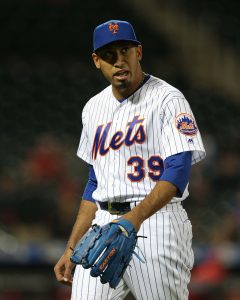
In what proved to be his final season in Seattle, where he burst on the scene in 2016, Diaz tossed 73 1/3 innings and notched a 1.96 ERA/1.61 FIP with an eye-popping 57 saves in 61 attempts. Along the way, the flamethrower ranked fourth among relievers in K/9 (15.22) and 15th in BB/9 (2.09), leading to the league’s fourth-best K/BB ratio (7.29). He also trailed only Hader in swinging-strike percentage (18.9).
Despite Diaz’s incredible performance, the retooling Mariners deemed him expendable in the offseason. Seattle sent the 25-year-old to the Mets in an earth-shattering December trade that saved the M’s a ton of money and improved their farm system.
No doubt, the Mets expected Diaz to be the driving force behind a much-improved bullpen in 2019. To this point of the season, Diaz has perhaps been the Mets’ premier late-game option, but their bullpen has been a weak unit overall. For his part, the 25-year-old Diaz has been closer to the pitcher he was in 2017, when he was good but not otherworldly.
Diaz’s most recent outing, which came Wednesday against the Dodgers, surely counts among the worst of his career. He entered the game with an 8-5 lead in the bottom of the ninth inning and proceeded to allow six straight base runners amid a stunning collapse. Diaz yielded four earned runs on five hits (two home runs) and an intentional walk in what turned into a 9-8 loss for New York. The only batter he retired, Alex Verdugo, hit the game-winning sacrifice fly. The defeat left Diaz with a 3.22 ERA after he entered it with a 1.64 mark.
It’s easy to look at the shiny ERA Diaz had prior to Wednesday and attribute it to one bad performance. Similarly, it doesn’t take a lot of effort to say his .347 batting average on balls in play has been unlucky. However, the reality is that there are concerns across the board.
Diaz’s FIP (3.99) is up almost a run and a half since last year, while his weighted on-base average/expected wOBA against has risen from .214/.215 to .324/.289. It doesn’t help that Diaz’s strikeout rate has plummeted. After fanning 44.3 percent of batters in his Seattle swan song, Diaz has fallen to 36.1 in his introduction to New York. Beyond that, Diaz’s swinging-strike, line drive, hard/soft contact and chase rates have also gone in the wrong direction. He’s not keeping the ball on the ground as much either, which has led to newfound home run troubles. Diaz has already given up as many HRs as last season (five) through 51 fewer innings (22 1/3), and he’s now halfway to 2018 in blown saves (two).
Treinen, who made good on 38 of 43 attempts in 2018, has joined Diaz in failing on two tries so far this season. The 30-year-old may have been even better than Diaz in ’18, when he compiled a ridiculous 0.78 ERA/1.82 FIP across 80 1/3 innings. Treinen’s strikeout and walk rates (11.2 and 2.35 per nine) were excellent, albeit not as great as Diaz’s, as was his 51.9 percent groundball rate. But Treinen, who has significantly cut back his sinker and slider usage, is at 9.55, 3.95 and 40.3 in those categories this season. Meanwhile, Treinen’s ERA/FIP is up to 3.62/3.87 and his wOBA/xwOBA against has shot from .187/.214 to .313/.298.
What are some of the factors behind Treinen’s drop-off? Well, the .230 BABIP batters logged against him a year ago has moved to a more reasonable .306. At the same time, he’s not stranding as many base runners, having gone from an 85.9 percent left-on-base rate to 79.9. Furthermore, the right-hander is generating fewer swinging strikes, getting fewer out-of-zone swings and giving up more hard contact than he did last season. With that in mind, it’s no surprise that Treinen, like Diaz, has had more difficulty keeping the ball in the park. Just two balls left the yard then against Treinen, who has allowed three through 27 1/3 innings in 2019.
While Diaz and Treinen have recorded disappointing numbers this season, the letdown is largely as a result of the utter brilliance they displayed last year. Any team in the majors would still take either hurler, though their current clubs – both of which are playoff hopefuls – may need more from them if they’re going to earn postseason bids.
Photo courtesy of USA Today Sports Images.
Braves’ GM Anthopoulos On Kimbrel, Trade Market
The Braves’ offseason began with a bang, signing both Josh Donaldson and Brian McCann early on, but there’s been little activity out of Atlanta since that time. The club did strike up a surprisingly affordable deal to bring Nick Markakis back for at least a fifth season (and possibly a sixth) earlier this week, filling an obvious hole in right field.
Many fans, however, were hoping to see a bigger splash to fill that vacancy — or at least some type of splash following the aggressive November deal that brought Donaldson into the fold. General manager Alex Anthopoulos’ comments about the financial flexibility that Markakis’ contract affords the club only fueled the fire for the Braves’ fanbase and their hopes for another marquee pickup, with many pining for a Craig Kimbrel reunion. However, Anthopoulos’ comments in a recent appearance on MLB Network Radio on SiriusXM at the very least downplay that possibility — if not almost entirely rule it out (Twitter links, with audio):
“He makes everybody a lot better,” said Anthopoulos of Kimbrel. “He’s one of the best closers of all time. I did come out early in the offseason and, not speaking specifically about him, but [said] our payroll, our model, I don’t know that us spending big, elite dollars on a reliever — length, the term and all that — I don’t know that that model works for us.”
Kimbrel entered the offseason reportedly seeking a massive payday north of $100MM, and while reports since that time have indicated that goal has dropped a bit, the latest update on his asking price suggested the $86MM and $80MM contracts of Aroldis Chapman and Kenley Jansen as targets (although that was a month ago). A closer with Kimbrel’s track record, understandably, is aiming exceptionally high, and even if his price drops a bit further, it wouldn’t be a surprise to see his camp eye a deal that tops Wade Davis‘ $17.33MM average annual value record for a reliever.
Wherever Kimbrel’s contract eventually lands, it seems reasonable to think that he’ll command the “big, elite dollars” to which Anthopoulos expressed an aversion. If that proves to be the case, Anthopoulos suggested that he’s happy with the end-game options the Braves already have in house while acknowledging that he’s still considering veteran additions.
“From a bullpen standpoint, A.J. Minter, Arodys Vizcaino did a nice, solid job for us,” said Anthopoulos. “…Hopefully, a young guy like Minter can take one more step. I think having a healthy Darren O’Day is going to be big, and then some of the other young kids that really took a step and had a nice year have a chance to continue to contribute. But, there’s no doubt if we can get more talent, more experience — especially at the end of the game — it’s going to slot everybody down. That’s definitely something we’ve explored, both in trade and free agency.”
The trade market — specifically, Atlanta’s lack of activity on that front — has been another potential source of consternation among fans. The Braves organization has famously built up a wealth of premium prospects and a deep reserve of secondary (but still high-quality) minor leaguers that has made their farm system one of baseball’s best. Clearly, there isn’t room for all of the stockpiled talent to claim regular roles with the big league club, and many would like to see the team cash in some of those farmhands for proven MLB talent. That, said Anthopoulos, is something the team has explored at length, though there’s been no common ground reached with teams shopping intriguing talent.
The GM plainly stated that his club was “definitely engaged” with the Mariners with regard to James Paxton, though the lefty eventually went to the Yankees in a package headlined by MLB-ready top prospect Justus Sheffield and another high-quality, near-MLB arm in Erik Swanson. Atlanta also spoke to the Mariners about closer Edwin Diaz before Seattle sent him and half of Robinson Cano‘s remaining contract to the Mets in exchange for a package led by this past draft’s No. 6 overall pick, Jarred Kelenic.
“At the end of the day, we had the ability to say ‘yes,'” said Anthopoulos of those talks. “We got a price on players like that. We’re definitely going to be ‘in’ on those guys. … I think, at the end of the day, we really feel strongly about the talent that we have. We put some good young players on the table in deals. I think maybe where we hit a bit of a snag in some of these things is just the volume — and that’s where we do pause, and we kind of pump the brakes a little bit.”
Though the inability to reach an agreement is surely frustrating for the Braves’ front office as well, Anthopoulos indicated that it’s often a relief to look back on some deals that ultimately weren’t made. He noted that he was most frequently asked about both Ronald Acuna and Ozzie Albies last offseason and is thankful not to have budged on either player and also “pretty happy” to have passed on some trade-deadline offers with which they were presented. (Of course, there are undoubtedly prospects whose stock has dropped that the Braves may, with the benefit of hindsight, been able to have let go without significant consequence.)
Ultimately, it sounds as though the Braves will continue to explore the trade market — they’re still oft-connected to J.T. Realmuto, for instance, and there are teams with relief pitchers available — but at the very least, it seems Atlanta fans should temper their expectations with regard to a Kimbrel reunion, which is a disheartening reality not only for them but also for Kimbrel’s camp. Kimbrel still seems destined for a sizable payday, but Anthopoulos is the second baseball ops leader in the past two weeks to suggest that paying Kimbrel at a premium rate likely isn’t in the cards; Red Sox president of baseball operations Dave Dombrowski made similar comments recently, all of which only further clouds the market for the offseason’s top free-agent reliever.