
Injury Notes: Mallex, Pena, Hicks, Kendrick
Mariners center fielder Mallex Smith has been sitting out the early portion of camp due to a strained flexor mass in his right forearm, but doctors have cleared him to begin baseball activities, Greg Johns of MLB.com tweets. Smith has already played light catch and will begin the process of getting himself into game shape. It’s perhaps a stretch to think he could be ready for the team’s two-game set against the A’s in Japan on March 20-21, but he still has a bit more than three weeks to prep for the Mariners’ home opener on March 28. Acquired in the trade that sent Mike Zunino to the Rays this winter, the 25-year-old Smith is penciled in as Seattle’s primary center fielder for the upcoming season. In 141 games for Tampa Bay last season, he hit .296/.367/.406 with a pair of homers and 40 stolen bases.
A few more injury updates from around the game…
- The competition to serve as the Cardinals‘ backup to catcher Yadier Molina may have gained further clarity Tuesday, as Derrick Goold of the St. Louis Post-Dispatch tweets that Francisco Pena will be sidelined for the next 10 to 15 days due to an apparent oblique injury. It’s awful timing for Pena, who looked like the primary choice to serve as Molina’s backup until the Cardinals signed Matt Wieters to a minor league contract last week. Now, with Pena ailing, Wieters looks all the more likely to secure a roster spot with the Cards come Opening Day. While Pena would be the stronger defensive option of the two, even Wieters’ diminished offensive production in recent seasons dwarfs that of Pena; in 271 plate appearances last season, Wieters slashed .238/.330/.374 to Pena’s .203/.239/.271 (142 PAs).
- Yankees center fielder Aaron Hicks underwent an MRI after feeling discomfort in his back, per Brendan Kuty of NJ.com. Doctors didn’t express concern upon viewing the results of the test, and Hicks said he’s confident he’s headed in the right direction. However, there’s also no clear timeline for when Hicks will return to game activity. He’s been out since last Friday, and Bryan Hoch of MLB.com tweets that it’ll be “several more days” before Hicks resumes batting practice. Hicks signed a seven-year, $70MM contract extension recently, forgoing a trip through free agency next offseason in the process.
- Nationals infielder/outfielder Howie Kendrick could be headed for an MRI after exiting this morning’s Grapefruit League game with a hamstring strain, tweets Jesse Dougherty of the Washington Post. The 35-year-old is hoping for a bounceback season in terms of health after missing the majority of the 2018 campaign due to a ruptured Achilles tendon. Kendrick was excellent in the 40 games he played last year, hitting .303/.331/.474 through 160 plate appearances. He’ll back up all around the infield and in the outfield corners this season, health permitting, as he plays out the second season of a two-year, $7MM contract in D.C.
Salvador Perez To Undergo Tommy John Surgery
A second opinion on the right elbow of Salvador Perez has confirmed the Royals’ worst fears: Perez will undergo Tommy John surgery tomorrow, the team told reporters (Twitter link via Lynn Worthy of the Kansas City Star). The surgery should put Perez on the shelf for the entirety of the 2019 season.
The Royals first announced that Perez had damage to the ulnar collateral ligament in his right elbow last Friday. The initial recommendation for Perez was Tommy John surgery, though the team first sought a second opinion from renowned surgeon Dr. Neal ElAttrache before scheduling the procedure.
Perez, 28, is earning $10MM in 2019 as part of a $52.5MM contract extension to which he agreed prior to the 2016 season. He’s also owed $13MM in both the 2020 and 2021 seasons as part of that long-term arrangement.
A six-time All-Star, five-time Gold Glove winner, two-time Silver Slugger winner and the MVP of the 2015 World Series, Perez has emerged as the face of the Royals’ franchise in recent seasons. Though Kansas City has embarked on a substantial rebuilding effort following its run of prominence (including consecutive World Series appearances in 2014-15), there’s never been any serious indication that the club would give thought to moving Perez.
With Perez on the shelf, the top catchers on the Royals’ depth chart at present are Cam Gallagher and Meibrys Viloria — the former of whom is a .218/.274/.333 hitter in 96 MLB plate appearances and the latter of whom has all of 29 MLB plate appearances. Viloria, in fact, jumped from Class-A Advanced to the Majors last season as a September call-up but still seems years away from legitimate MLB readiness.
Suffice it to say, it’d register as a surprise if the Royals didn’t look to address their catching situation in some fashion following the unwelcome news. Martin Maldonado is the most obvious and straightforward choice: a premier defensive backstop with nearly 2000 Major League plate appearances under his belt who (surprisingly) still remains unsigned. Maldonado was most recently connected to the Mariners, though at the time of that report, Seattle was still wary of giving him a guaranteed 40-man roster spot. Light-hitting as Maldonado may be (.220/.289/.350 in his career), it’s still jarring that a player with his defensive prowess has struggled to find a 40-man spot this winter. The Royals, it now seems, can not only provide that but could also provide a fair bit of playing time as well.
Beyond Maldonado, there’s little in terms of proven assets on the open market, though the Royals could certainly wait until later in Spring Training to see if a veteran on a minor league pact with another club opts out of his deal. Veterans such as Nick Hundley (Athletics), Rene Rivera (Giants), Stephen Vogt (Giants), Matt Wieters (Cardinals), Devin Mesoraco (Mets) and old friend Drew Butera (Phillies) are all in Major League camps as non-roster invitees — but not all will earn a roster spot with his current organization. Alternatively, the Royals could also look to the trade market or waiver wire late in camp as a means of acquiring some additional depth. Notably, the Red Sox have reportedly been exploring deals involving their trio of backstops (Christian Vazquez, Sandy Leon and Blake Swihart).
Cameron Maybin Arrested On DUI Charge
Outfielder Cameron Maybin, in camp with the Giants as a non-roster invitee, was arrested for driving under the influence of alcohol last Friday, according to ABC 15 News, citing a Scottsdale police report. Per the report, Maybin was arrested at 2:43am with a .127 blood-alcohol content, which is north of the legal limit of .08. Maybin was cooperative when arrested, officers noted within their report. Maybin has since appeared in multiple games for the Giants. The team issued a statement today indicating that it is “aware and monitoring the situation.”
The 31-year-old Maybin, signed to a minor league deal with an invitation to Major League Spring Training back in February, had hoped to secure a spot in a thin Giants outfield mix. Currently, San Francisco has Steven Duggar, Mac Williamson, Austin Slater, Chris Shaw and Rule 5 pick Drew Ferguson as options on the 40-man roster. Gerardo Parra, Craig Gentry, John Andreoli and Mike Gerber are among the Giants’ non-roster options, in addition to Maybin.
2019-20 MLB Free Agent Power Rankings
We’ll have 2019 Major League Baseball about two weeks from now, perhaps with Oakland’s Mike Fiers throwing the season’s first pitch to Seattle’s Mallex Smith in Tokyo. Though Dallas Keuchel, Craig Kimbrel, and others remain unsigned, I’m going to begin our monthly look ahead at the 2019-20 MLB free agent class. These players are on track to become free agents after the 2019 season.
As you can see in MLBTR’s Extension Tracker, we had three notable would-be free agents come off the board in February: Nolan Arenado, Miles Mikolas, and Aaron Hicks. I feel that Arenado and Mikolas did about as well as they would have in free agency, while it’s possible Hicks’ deal reflects some trepidation toward the backwards trend in dollars per WAR that teams have instituted the last two winters. There’s a good chance some of the projected free agents listed here will also forgo the open market if a reasonable contract offer is presented. As always, these players are ranked by my estimate of their 2019-20 open market earning power.
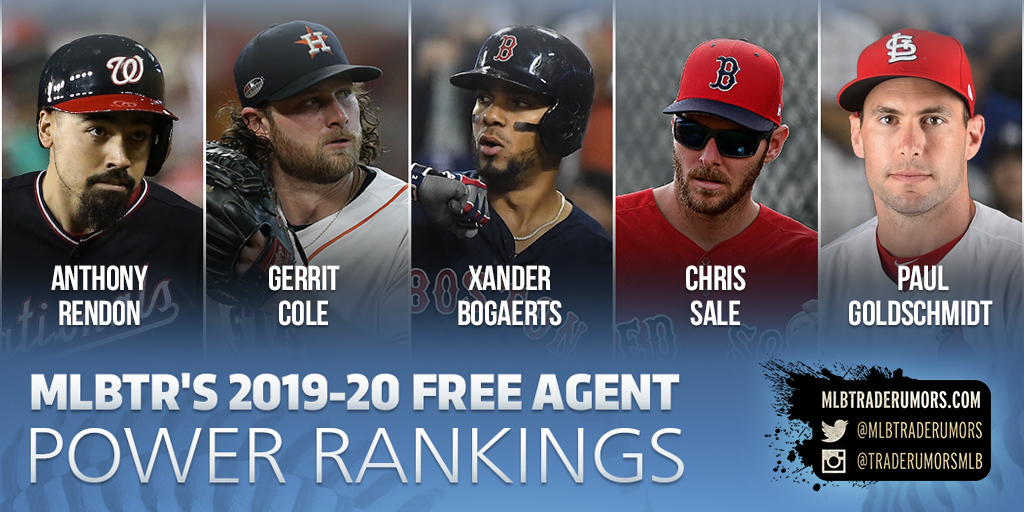
1. Xander Bogaerts. I didn’t begin this exercise expecting Bogaerts to top the list, but if he manages another five win season as Boston’s shortstop, his youth could result in the winter’s longest contract. Bogaerts, a client of the Boras Corporation, won’t turn 27 until October. He’s gone year-to-year throughout his career after signing out of Aruba for $410K in 2009. Bogaerts has now banked over $25MM in his career. He’s coming off his finest season yet, posting a 133 wRC+ that was second only to Manny Machado among qualified shortstops. Bogaerts’ defense has long rated as a plus. While I don’t expect Bogaerts to approach the $300MM contract Machado received, I do think he’ll join the $200MM club with a strong 2019 season.
2. Chris Sale. Bogaerts’ teammate Chris Sale has placed top six in the AL Cy Young voting for the last seven years. The lefty joined the Red Sox in a December 2016 blockbuster trade with the White Sox. Sale’s dominance has continued in Boston, though he was limited to 158 regular season innings in 2018 due to two DL stints for shoulder inflammation. Sale’s earning power in free agency will depend on his health this season. Six years ago, Sale signed a contract extension with the White Sox that has provided tremendous surplus value to both of his clubs. While it had been standard practice for top free agent starters to be paid through age 36 – see Jon Lester, Max Scherzer, David Price, and Yu Darvish (and Zack Greinke, who was paid through 37), the old way of doing things in free agency may no longer apply. So Sale, 30 this month, will likely seek a six-year contract, though he could have trouble getting there unless one team gets irrational or he accepts a reduced average annual value to max out the guarantee. In the best case, Sale could inch his way past Greinke’s six-year, $206.5MM deal, since Sale will be more than 17 months younger than Greinke was when he reached his historic pact.
3. Gerrit Cole. Cole, another Boras client, was drafted by the Yankees out of high school in the first round in 2008. Cole’s signability changed after the draft, and his family requested that the Yankees not even make an offer. After three years at UCLA, Cole was drafted first overall by the Pirates. He was generally solid for the Pirates, including one great season in 2015, before they traded him to the Astros in January 2018. Cole posted the best season of his career in his first season as an Astro. Including his record draft bonus, Cole has earned over $33MM in his MLB career on the year-to-year plan. With another comparable campaign, he’ll be fishing for the seven-year deal signed by Price, Scherzer, and Stephen Strasburg. This would only take Cole through his age 35 season – a reasonable length even in this day and age. Price’s seven-year, $217MM deal will be four years old when Cole reaches free agency. My guess is that Cole will fall short of that level but will still sign one of the five largest pitching contracts in baseball history.
4. Anthony Rendon. The Nationals let Harper defect to the Phillies on a record $330MM contract, but that might pave the way for a deal with yet another Boras client, Rendon. Rendon has quietly amassed 13 WAR over the last two seasons, sixth in all of baseball for position players. The Nationals’ third baseman combines stellar defense with a 140 wRC+ bat, and the result is that he’s every bit as valuable as Harper or Machado right now. Rendon turns 29 in June, and he’s amassed about $47MM already in his MLB career. It’s been rare lately that any top position player gets paid past age 35, as Machado and Eric Hosmer did, and many such as Nolan Arenado, Jose Altuve, J.D. Martinez, Justin Upton, and Yoenis Cespedes were only paid through 34. We’ll put Harper aside, as only drastically reducing his average annual value allowed for him to be paid through age 38. This is my way of saying I think Rendon is looking at a six-year deal in the best case. Back in January, Ken Rosenthal of The Athletic wrote that Rendon was seeking a contract comparable to Altuve, in his extension talks with the Nationals. That deal was essentially $151MM over five years, though things have gotten worse for free agents in the year since then. Also since then was Arenado’s seven-year, $234MM extension with the Rockies, notable mainly for its $33.4MM AAV. Rendon would certainly be within his rights to seek $30-33MM per year in his ongoing extension talks with the Nationals, which may continue into the season.
5. Paul Goldschmidt. Goldschmidt starred for the Diamondbacks for eight years until last December’s trade to St. Louis. Goldy inked what became a club-friendly six-year contract back in 2013. So on the one hand, the slugging first baseman has banked $45MM in his MLB career. On the other hand, he’ll turn 32 in advance of his next contract. These days, that probably caps him at a four-year deal unless he takes a light AAV. The Cardinals clearly would like to make Goldschmidt, a client of Excel Sports Management, more than a rental.
6. Zack Wheeler. Wheeler, 29 in May, posted the best season of his career in 2018. The righty was drafted sixth overall out of high school by the Giants in 2009 and was traded to the Mets for Carlos Beltran in 2011. He made his MLB debut in 2013 and did solid work before going down for March 2015 Tommy John surgery. Wheeler ended up going two and a half years between MLB starts, nearly getting traded to Milwaukee in the interim. That Wheeler failed to return to the Mets in 2016 served as a reminder that Tommy John recovery is not always seamless. Wheeler’s 2017 season was abbreviated due to a stress fracture in his arm, and he actually began the 2018 season in the minors. Wheeler, one of the hardest-throwing starting pitchers in the game, just kept getting better in the 2018 season. He finished with a 2.06 ERA in his final 15 starts. An encore performance could make Wheeler a sleeper Cy Young candidate, but it’s all about stringing together a second consecutive healthy season for the first time in his career. His ceiling would likely be a five-year deal taking him through age 34, the age through which Miles Mikolas, Jordan Zimmermann, Jake Arrieta, and Patrick Corbin were signed. Both Wheeler and Chris Sale are represented by Jet Sports Management.
7. J.D. Martinez. Martinez, 32 in August, has been the second-best hitter in baseball over the last two seasons by measure of wRC+. Though he’s able to play the outfield, he’s best-served as a designated hitter. Martinez signed a five-year, $110MM deal with the Red Sox in late February last year, but the Boras client has the chance to opt out of the 2019 or 2020 seasons. Given the way Martinez has been hitting, it stands to reason that even in this free agent climate, he will stand a good chance at topping the three years and $62.5MM he’ll have remaining on his contract after 2019. Since he’d probably only be looking at a four-year deal this time around, it’s possible the Red Sox could simply tack on one more year to his current deal.
8. Didi Gregorius. Gregorius, 29, was signed by the Reds out of Curacao for $50K back in 2007. A pair of three-team trades eventually led him to the Yankees’ shortstop job in 2015, with the near-impossible task of succeeding Derek Jeter. Gregorius’ bat steadily improved over his four seasons with the Yankees. Combined with strong defense, he’s totaled 8.7 WAR over the past two seasons – on par with Machado and Bogaerts. However, Gregorius went down for Tommy John surgery in October. He could return anywhere from June to August, complicating his free agency picture. Both Gregorius and the Yankees seem open to an extension, and the club did just prevent Aaron Hicks from exploring free agency by giving him a seven-year, $70MM deal. Like Goldschmidt, Gregorius is represented by Excel Sports Management.
9. Justin Verlander. Verlander, 36, finished second in the AL Cy Young voting last year, in a dominant season that was every bit as good as his Cy/MVP 2011 campaign for the Tigers. He’s a likely Hall of Famer and is one of the game’s best starting pitchers currently. When it comes to the topic of Verlander’s free agency, it’s difficult to ignore his age. I have to think it caps him at a three-year deal, albeit with a premium AAV in the $30MM range. The Astros have difficult decisions on the horizon regarding their pair of aces. Verlander is represented by ISE Baseball.
10. Madison Bumgarner. Like Verlander, Bumgarner was an ace for an extended period of time. But with the Giants’ lefty, it remains to be seen what his second act will look like. An April 2017 dirt bike accident caused injuries to Bumgarner’s ribs and shoulder, limiting him to 17 starts that year. Then in March of last year, the pitcher’s left hand was fractured during a Spring Training game, delaying his season debut until June. Upon his return, he wasn’t quite the Bumgarner of old, with his strikeout and walk rates going in the wrong direction. Still, Bumgarner doesn’t turn 30 until August, and by then we should know whether his 2018 season was a blip on the radar or the start of a trend. His contract, which will be negotiated by The Legacy Agency, will depend on that question.
Honorable mentions: Marcell Ozuna, Yasiel Puig, Rick Porcello, Nick Castellanos, Josh Donaldson, Yasmani Grandal, Khris Davis, Scooter Gennett
Note: I’m currently operating under the assumption that club options for Corey Kluber, Anthony Rizzo, Jose Quintana, Chris Archer, Starling Marte, and Matt Carpenter will be exercised after the season, and that Stephen Strasburg and Yu Darvish will not opt out of their contracts.
Luis Severino Shut Down For Two Weeks Due To Shoulder Inflammation
2:53pm: The MRI showed inflammation to Severino’s rotator cuff, MLB.com’s Bryan Hoch tweets. He’ll rest for at least two weeks while undergoing treatment, including injections and anti-inflammatories, before picking up a ball. That’ll likely knock Severino out for Opening Day, though it seems the broader prognosis is still generally optimistic.
1:26pm: Severino is going to go in for an MRI, skipper Aaron Boone says (via Kristie Ackert of the New York Daily News, on Twitter).
12:39pm: The Yankees announced today that prized righty Luis Severino would miss his scheduled spring outing. He had begun to warm up but experienced “discomfort” in his pitching shoulder, per the team.
The level of concern is not yet apparent, but the 25-year-old is due for a closer look from medical personnel. Per the team’s announcement, Severino “will undergo further evaluation this afternoon.”
Severino is a key piece for the Yanks, who’ll need all their best players at full strength to do battle with the other American League super-teams. The club’s starting five is set, presuming they all make it through camp unscathed, with the next layer of depth consisting of 40-man members Luis Cessa, Domingo German, Jonathan Loaisiga, and Chance Adams along with non-roster invitees Drew Hutchison and David Hale.
No matter the outlook, Severino is earning a guaranteed $40MM under the contract he and the team struck last month. He has been one of the game’s most productive starters over the past two campaigns, working to a 3.18 ERA with 10.5 K/9 and 2.3 BB/9 over 384 2/3 frames.
MLB, MLBPA Nearing Rule Change Agreement
Major League Baseball and the MLB Players Association have spent the winter negotiating over rules changes while publicly bickering over the operation of the player market. The sides now appear to be nearing agreement on a package of new rules, per Ken Rosenthal of The Athletic (Twitter link), though it’s not likely to address the broader concerns.
According to Rosenthal, a new deal may only be a day or two away from completion. It’s not clear just what’ll be covered by the pact, though we’ve known of the areas under consideration for the past week or so. From a hot stove perspective, the application of a single trade deadline and roster size modifications (26-man roster with two extra openings in September) appear to be the most important possible tweaks under contemplation.
There are some much more consequential possibilities that the union would also like to discuss, given its frustrations with the transactional landscape. Those conversations would occur during the season to come, per Rosenthal’s prior reporting, with at least some possibility of a CBA renegotiation and extension.
Meanwhile, the league has announced a new deal with the Liga Mexicana de Beisbol. The MLBPA has ratified the pact, which will govern the movement of players from Mexico’s top league to MLB organizations.
Players who have deals with LMB clubs will be free to go to the majors without compensation once they reach 25 years of age and have accumulated six seasons of professional ball. To acquire a LMB player who hasn’t yet reached that status, MLB teams will need to work out a contract with the player and convince his former team to accept a release fee — 15% of guaranteed MLB money or 35% of a signing bonus on a minors deal — to cede its control over the player’s services.
MLBTR Chat Transcript
Click here to read a transcript of this week’s chat with MLBTR’s Steve Adams.
Miguel Sano To Miss Start Of Season
Twins third baseman Miguel Sano will not be prepared for Opening Day and could miss the first month of the season, chief baseball officer Derek Falvey told reporters including Phil Miller of the Star Tribune (via Twitter) and Betsy Helfand of the St. Paul Pioneer-Press (Twitter link).
A cut on Sano’s foot has kept him out of action throughout camp. That injury, sustained during a celebration of a Dominican Winter League title, required a second debridement procedure to clean up the wound.
Clearly, this is not how the organization expected things to proceed when Sano showed up to camp in noticeably excellent shape. The hope then was that the cut would heal up quickly, allowing him to get back to work in search of redemption following a miserable 2018 season.
Sano, who’s earning $2.65MM in the first of three seasons of arbitration eligibility, has at times seemed primed to be one of the game’s best sluggers and is still a month shy of his 26th birthday. Injuries and inconsistencies have plagued his career, though, and he has yet to reach five hundred plate appearances in a single MLB season.
The Twins recently inked Marwin Gonzalez to function as a heavily-used utility player. He’ll presumably be the top option at the hot corner to begin his tenure in Minnesota. The fascinating Willians Astudillo could also see an expanded role to open the year.
Zack Cozart Diagnosed With Calf Strain
The Angels will go without third baseman Zack Cozart for at least “a few weeks,” skipper Brad Ausmus tells reporters including J.P. Hoornstra of the Southern California News Group (via Twitter). He has been diagnosed with a grade 1 calf strain.
Given the timing, it’s fair to wonder whether Cozart is at risk of missing the start of the season. It emerged over the weekend that he was dealing with a minor calf problem, though it now seems it’s significant enough to earn a place on the scale. A grade 1 diagnosis is at the mild end of the spectrum, though the Halos will need to take a careful approach to avoid a lengthier absence.
Cozart, 33, is due $12.67MM this year and next. He earned the same in 2018, which turned out to be a forgettable debut season with the Angels. Cozart limped to a .219/.296/.362 batting line in 253 plate appearances before undergoing a significant shoulder procedure.
The focus this spring was on the health of Cozart’s left arm and his ability to regain the form he showed in an outstanding 2017 season. Now, he’ll also need to work through this lower-leg ailment.
At his best, Cozart is an elite defender and quality hitter. His ability to get back on track is a key aspect of the Angels’ hopes for the coming campaign. Earning a postseason spot promises to be a tall order in a top-heavy American League. Tommy La Stella, Taylor Ward, and Kaleb Cowart are among the options to fill in at third if Cozart misses time early.
Travis Jankowski Diagnosed With Broken Wrist
TODAY: Jankowski is expected to require surgery and miss approximately three months of action, MLB.com’s AJ Cassavell tweets.
YESTERDAY: Padres outfielder Travis Jankowski has been diagnosed with a broken wrist, Kevin Acee of the San Diego Union-Tribune reports on Twitter. It’s not yet known how long he’ll be sidelined, but it is anticipated that he “will miss significant time.”
The 27-year-old Jankowski suffered the injury laying out for a catch. Particulars aren’t yet known this time around, but he has once previously suffered a generally similar injury. Back in 2014, Jankowski fractured his wrist in a collision with an outfield wall.
Jankowski is earning $1.165MM this year as a Super Two player. While he has not yet shown much with the bat at the MLB level, he is coming off of a personal-best offensive season. Over 387 plate appearances in 2018, Jankowski slashed .259/.332/.346 with 24 stolen bases. He’s a quality outfield defender who can play up the middle, significantly boosting his utility.
The Friars have the depth to deal with an absence from Jankowski, with Manuel Margot and Franchy Cordero representing a potential righty/lefty mix up the middle. But they’ll lose a roster element they had hoped to carry entering the season. The Pads have a few lefty-hitting outfielders on the depth chart in Boog Powell and Alex Dickerson, though both were recently sent to minors camp.
With Jankowski down to open the year, then, the San Diego organization could consider a wide variety of alternative means of utilizing the 25-man roster opening. It could open the door to intriguing outfielder Franmil Reyes. Utilitymen Jose Pirela and Javy Guerra are also candidates who already have 40-man roster spots. The same goes for corner infielder Ty France, though it’s less clear how he’d function on a roster that now features high-priced regulars at his accustomed positions.