
Latest On Sam Dyson
Twins reliever Sam Dyson has a consequential medical appointment today, with the expectation being that he’ll require a significant procedure to his ailing shoulder. It’s not clear whether the Minnesota organization has any way of salvaging the transaction that brought Dyson into town, but LaVelle E. Neal III of the Star Tribune reports that the team has begun exploring its options.
Dyson’s troubles cropped up not long after he changed hands, which made for inopportune timing. Eyebrows were no doubt raised when the veteran righty informed his new organization that he had experienced problems since mid-July. After all, the Twins had found no reason to fear this sort of situation when they checked over the medicals at the time of the deal.
Unsurprisingly, Neal reports, the Twins have “investigated” the situation since it arose. That has included “discussions” with the Giants’ front office. To this point, as Neal puts it, “The Twins have been unable to find any evidence that the Giants had knowledge of an injury.”
It isn’t clear whether Dyson has spoken directly on the subject. But there’s no public indication that he had informed his prior organization of the health issue before the deadline. And he has made clear through prior comments that he simply believed he was dealing with typical soreness that wasn’t a major concern.
Assuming that the Twins don’t end up coming across any evidence that anything untoward occurred, it seems they’ll have no recourse vis-a-vis the Giants. In that case, the question becomes one of dealing with an unfortunate medical situation as with any other player.
The trouble for the Twins is that Dyson’s anticipated procedure comes with a lengthy rehab process. Per the report, the 31-year-old wouldn’t be expected to return until some time in the middle of next season. If that’s the best-case scenario, it’d be awfully difficult to tender Dyson a contract for his final year of arbitration eligibility. He’ll be due a raise on his $5MM salary. Given all the uncertainties inherent in a shoulder procedure, that seems like a hefty bill.
It’s certainly possible the Twins could attempt to work out some kind of multi-year arrangement, as we’ve seen with other injured players who sign during the recovery process. Otherwise, it is possible that the organization has already received the entire return for its investment of three young players (Prelander Berroa, Jaylin Davis and Kai-Wei Teng).
Ned Yost Announces Retirement
Royals manager Ned Yost will officially retire following the completion of the 2019 season, the team announced today in a press release. He’ll finish his career with the most victories in Royals franchise history and is the only Royals manager to ever make consecutive World Series appearances. Yost issued the following statement in today’s release:
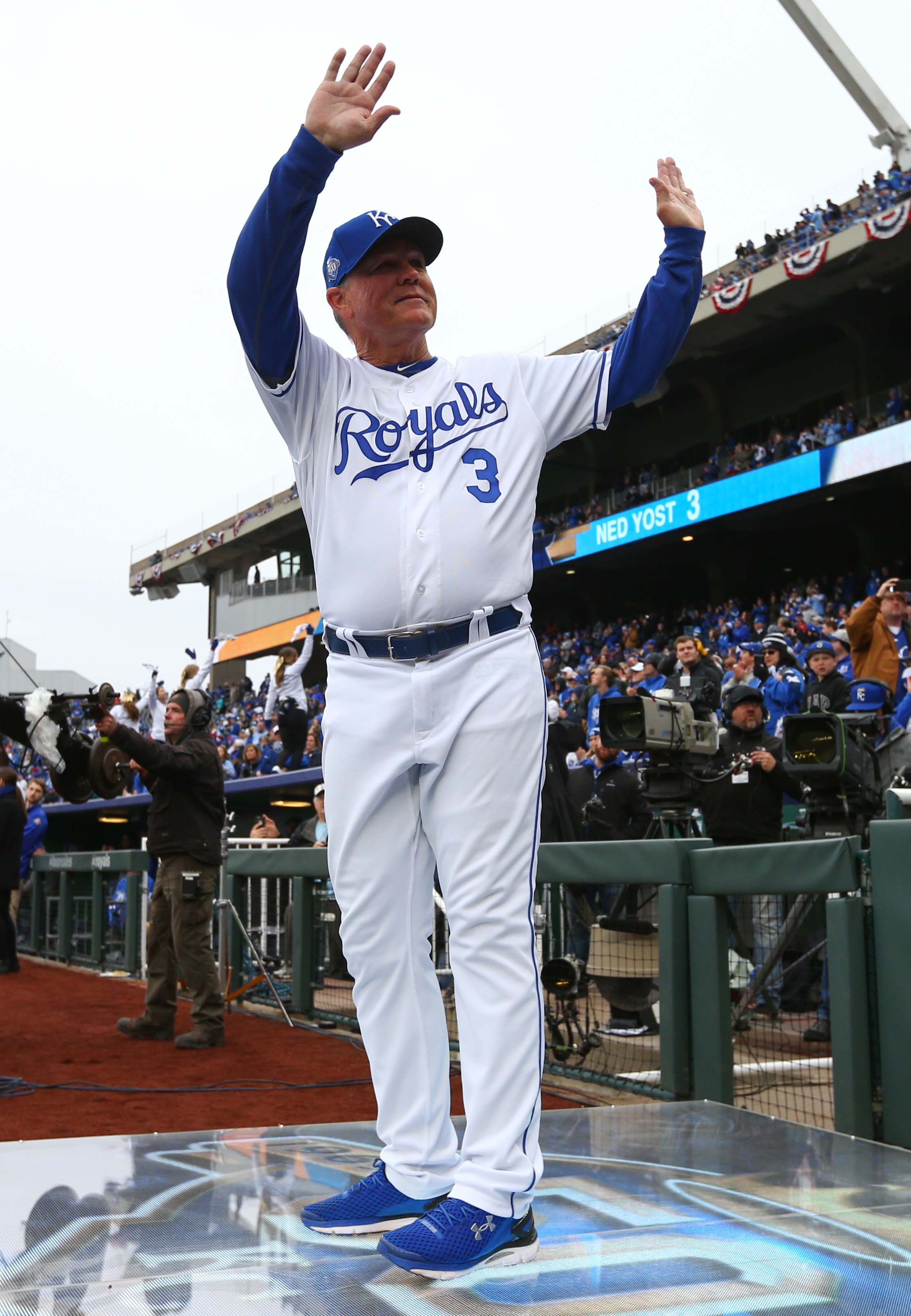
“With the development of our young players and our returning veterans, I feel and hope the worst is behind us in this rebuilding phase of our organization. My plan all along was to get us through the rough times then turn it over to a new manager to bring us the rest of the way. I’ve thoroughly enjoyed my time here as your manager and will never forget the good and the hard times we had together as an organization and a fan base.
I will never forget the fact that you fans supported us through it all. Kansas City will always have a special place in my heart, and I look forward to rooting for the Royals on to their next World Championship very soon.”
Yost, 65, has managed the Royals since the 2010 season, logging a collective 744-836 record in that time. Prior to that, he’d spent parts of six seasons skippering the Brewers, with whom he won 457 games. Overall, Yost will complete his managerial career with a 1201-1338 record, two American League pennants and one World Series title. He’s 32nd all-time in total games managed at the MLB level, and his current total of 1201 wins ranks 45th — though he’ll have the opportunity to tack on a few more victories and six more games managed between now and Sunday’s farewell game.
Yost’s retirement has been widely expected, as the skipper himself has hinted in the past that he isn’t likely to see a rebuild all the way through. There’s no firm word yet on a successor to Yost, of course, but it was speculated last November when the Royals hired former Cardinals skipper Mike Matheny as a special advisor that he was a strong candidate to take the reins following Yost’s retirement. The Royals won’t make any formal announcement on the matter for now. USA Today’s Bob Nightengale tweets that Matheny is indeed “expected” to be the team’s next manager, but MLB.com’s Jeffrey Flanagan reports that the Royals have yet to commit to Matheny as the new manager (Twitter link).
Of course, even if that was the plan last November, much has changed in the Royals organization since Matheny’s hire. Owner David Glass has agreed to sell the team to Kansas City entrepreneur John Sherman, and while it’s been reported that general manager Dayton Moore will receive a contract extension once the new ownership regime formally takes over, it’s not as clear that the new owners will have the same vision for the manager and his coaching staff.
Giants’ Baer On Bumgarner, Offseason
The 2019 season has been a transitional year, to say the least, for the Giants franchise. Ownership hired Dodgers GM Farhan Zaidi last offseason and named him president of baseball operations, and the Bruce Bochy farewell tour is nearing its completion as the end of the season looms. A perhaps improbable midseason hot streak may have kept the Giants from completely tearing down the roster, but it’s eminently possible that impending free agent Madison Bumgarner‘s scheduled Sunday outing could be his last in a Giants uniform.
Giants CEO Larry Baer joined Henry Schulman of the San Francisco Chronicle for a half-hour interview (audio link) over the weekend to discuss a host of Giants topics. Giants fans, in particular, will want to give the entire interview a listen for Baer’s discussion of potential changes to Oracle Park, ticket prices, his perspective on the time he spent away from the team during his recent suspension and his overall impressions and takeaways from Zaidi’s first year on the job. But from a pure roster standpoint, specifically with regard to Bumgarner, Baer doesn’t speak as though a parting of ways is a foregone conclusion.
“I think Farhan has had ongoing discussions with his representatives throughout the 2019 season,” Baer says when asked about the possibility of an extension. “Characterizing them — I don’t want to get into what is or isn’t being discussed, but I know they’ve kept open lines of communication.”
The 30-year-old Bumgarner likely has two starts left as he looks to put the finishing touches on his healthiest season since 2016. He’s already topped the 200-inning mark for the eighth time in his illustrious career and is currently sporting a 3.86 ERA (3.78 FIP, 4.18 SIERA) with averages of 8.7 strikeouts and 1.8 walks per nine innings pitched. It’s not quite the dominant Bumgarner of old, but it’s nevertheless been a sharp rebound effort that has helped to quiet any concerns that might’ve existed surrounding his durability in the aftermath of 2017’s dirt bike debacle.
The question for Baer, Zaidi, the Giants and other interested parties, of course, will be one of how long and how lucrative an offer they’re willing to make to outbid the competition for Bumgarner. The lefty won’t turn 31 until next August, so he likely has at least a couple of prime years remaining. But the free-agent market has become increasingly harsh for players on the wrong side of 30, and we’ve seen fewer and fewer teams willing to push an offer past the hard number at which they value a particular asset. The days of impassioned bidding wars may not be over entirely, but they appear to be waning.
Furthermore, Zaidi’s track record with the Dodgers doesn’t suggest that he’ll adopt a “whatever it takes” mentality to keep Bumgarner. The largest sum of new money the Dodgers promised to a player under Zaidi and Andrew Friedman was Kenley Jansen‘s five-year, $80MM contract — and Schulman reiterates in the podcast that he’s heard that was more an ownership-fueled decision than a front-office-driven reunion. The Dodgers also extended Clayton Kershaw shortly before Zaidi’s departure, but that deal “only” promised Kershaw an additional year and $28MM on top of the two years and $65MM from which he could’ve opted out. Baer references that as a “top-of-the-market” contract and points to the Giants’ own pursuit of Bryce Harper under Zaidi in suggesting that they won’t necessarily shy away from free agency — so long as a deal makes sense.
“It’s not so much, ‘Hey do you have the money for Player X or the money for Player Y, and how much does ownership want to spend?'” Baer explains. “It’s more — how does Farhan and the staff want to bake the cake? The way he’s been successful baking the cake is doing a lot from within, making strategic moves when they make sense. … It’s not about being averse to spending money, but how do you really want to put the whole thing together? When you think about the way it was put together [from] 2009 on, when we won, it was put together pretty much internally. We would complement with free-agent signings a little bit — mainly [additions] at the break, at the trade deadline.”
Again utilizing the cake-baking analogy, Baer states that he believes Zaidi & Co. will do so “with depth, and with looking at current players and what we have in the farm system.” There’s nothing that expressly rules out a series of notable offseason additions, but it’s also far from the aggressive tone that ownership reps from other teams have offered up in recent offseasons (e.g. the Phillies’ “stupid” money decree or the Astros’ public acknowledgment of efforts to add a high-end starter). And while near the end of the interview, Baer suggests that contending for the postseason is a goal every year, including 2020, he spends more time preaching the importance of “taking another large stair-step” forward next season. Progress, he contends, can be measured by the “energy around the Giants,” which he expects to improve in 2020.
Given the Giants’ history with Bumgarner, it’d be a surprise if they didn’t have a significant presence in his offseason market, but beyond that obvious connection, Baer’s comments hardly seem like a portent for aggressive spending on the free-agent market.
Jason Kipnis To Undergo Surgery On Tuesday
Sept. 23: Kipnis will undergo surgery to repair the injury tomorrow, per Paul Hoynes of the Cleveland Plain Dealer.
Sept. 17: An MRI performed on Indians second baseman Jason Kipnis revealed a fracture in the hook of the hamate bone in his right wrist, the team announced Tuesday. The team is currently scheduling a followup appointment for him, but surgery is expected to be required, which would sideline Kipnis for four to six weeks and ostensibly remove any chance of him appearing in a potential postseason series. Cleveland has recalled infielder Andrew Velazquez to add some infield depth in the wake of the injury.
The injury not only brings an end to Kipnis’ 2019 season but could very well bring an end to his career with the only organization he’s ever known. Cleveland’s second-round pick in the 2009 draft, Kipnis was a heralded top prospect who made an immediate impact upon debuting in 2011 and eventually signed a six-year, $52.5MM contract extension covering the 2014-19 seasons. That contract carries a $16.5MM option for the 2020 season, but the Indians are likely to opt instead for a $2.5MM buyout given Kipnis’ recent decline. It’s possible that he could be brought back at a more affordable rate, but both he and the organization will be able to explore alternative options once he reaches free agency.
Kipnis, a two-time AL All-Star, signed the contract early in the 2014 campaign. At the time, he was a 27-year-old coming off a superlative .284/.355/.452 (130 OPS+) showing. He’d swatted 17 home runs, swiped 30 bases and played generally solid defense at second base during his breakout 2013 campaign and looked every bit the part of a potential building block in Cleveland. Injuries, namely an oblique strain, may have hampered Kipnis in 2014, as he floundered through a lackluster season. But he bounced back with a second All-Star nod in 2015 and turned in another strong effort in 2016. Between those two seasons, Kipnis batted a combined .289/.357/.460 with 32 home runs and 27 steals.
Since that time, it’s been a steady downhill trajectory for Kipnis, though. This season’s .245/.304/.410 slash is well below league-average production (84 OPS+), and dating back to 2017 he’s managed only a .236/.305/.403 output. Along the way, he’s been slowed by shoulder, hamstring and calf injuries in addition to his current wrist issue. He’ll quite likely hit the open market on the heels of that unproductive trio of seasons as he heads into his age-33 campaign, making a one-year deal the likeliest outcome for him.
The Indians, meanwhile, will look to a combination of Velazquez, Ryan Flaherty and Mike Freeman to pick up the slack at second base. Velazquez, who has a career .260/.316/.415 batting line in 163 games of Triple-A experience, is in the lineup and getting the nod tonight. He only appeared in a dozen games with Cleveland’s Triple-A affiliate this season, spending the rest of the season in the Rays organization. Velazquez joined the Indians in an early July trade — he was injured at the time, hence the minimal time with Cleveland’s top affiliate — so he’d be postseason-eligible should the Indians secure a Wild Card spot and wish to carry him.
AL Notes: Semien, Orioles, Astros
For those actively searching for a player ready to assume Anthony Rendon‘s former title as the game’s “Most Underrated” player, Athletics shortstop Marcus Semien is making a valid case for himself in 2019. As Martin Gallegos of MLB.com notes, Semien scored his 120th run of the season on Sunday, placing him just three runs behind Reggie Jackson 1969 record for most runs scored by an Athletic in a single season (link). Besides that possibly impending accomplishment, it’s important to note that the 28-year-old Semien has done more than just cross the plate in 2019. Among AL shortstops, his 32 homers place him 3rd, his 90 RBIs are good for 2nd, and his 7.2 WAR valuation places him behind only Houston’s Alex Bregman at his position. However you slice it, 2019 has been a banner year for the former Cal Bear, who will likely garner MVP consideration at season’s end.
Semien’s near-peerless production has been a large reason behind Oakland’s 2.0-game cushion on all Wild Card competitors. He’s likely due a sizable raise in his third trip through arbitration this offseason, as his $5.9MM salary this year represents one of baseball’s biggest bargains.
More notes from around the league on a quiet Sunday eve…
- Yesterday, we passed along word of one dissatisfied ex-employee of Orioles GM Mike Elias’–namely, former special assignment instructor BJ Surhoff, who felt disrespected by Elias’ handling of his dismissal. Despite that bit of scuttlebutt, Elias is feeling good about his organization’s direction now that he’s had nearly a calendar year to direct its progress, as he told Roch Kubotko of MASN Sports in a wide-ranging interview (link).“When we came in here, the big league team (had) the worst record in the league last year,” Elias told Kubotko. “The farm system was ranked in the 20s…We had no real international scouting function, a minimalist analytics group. All of that’s changed. We’ve got our program going internationally. We’re signing players, we’re competing for players out there. We’re building towards a bigger analytics staff. The farm system’s taking a huge jump this year.” There are several other items of note in the article itself, among them his support of manager Brandon Hyde (who did ‘Great’ in 2019, in Elias’ estimation) and his expectations for the club in 2020.
- The Astros were finally able to pop the corks on champagne bottles that had remained on ice through Friday and Saturday, as Sunday saw the team capture its third consecutive AL West title. In a well-written piece from the Houston Chronicle’s Chandler Rome, manager A.J. Hinch credits mentality–not the team’s embarrassment of stars–as the source behind Houston’s success (link). “We just keep on keeping a winning culture, a winning mindset. We show up ready to play every day,” Hinch told Rome. “It’s the thing I’m most proud of. We just stay current in the moment.” Also of note in Rome’s article is a rundown of the club’s utter dominance of its AL West opponents in 2019; the club has won 32 out of its last 38 games at home against AL West competitors, en route to an overall 51-19 record against divisional foes this year.
Yankees Notes: Gleyber, Encarnacion, Sabathia
Gleyber Torres holds the dubious distinction of being the only member of the Yankees Opening Day lineup to not spend time on the injured list this season–a distinction that it appears he will maintain now that Aaron Boone has said he expects Torres back in the lineup on Tuesday (link). Torres was out of the lineup on Saturday and Sunday due to a hamstring issue, but Boone told Kristie Ackert of the New York Daily News that Torres is going to avoid an IL stint (link).
“Gleyber’s good. I just decided yesterday that I wanted to give him one more day going into the off day, but I’m obviously encouraged by the MRI and just from speaking with him, he feels good,” the Yankees manager told Ackert.
In less insightful news, Torres is very good at baseball. In this, his second full big league season, the Venezuelan has hit .284/.343/.546 with 38 bombs while playing passable defense at short and second.
More news from around the Yankee clubhouse…
- Torres’ teammate Edwin Encarnacion may be ready to return to action as soon as this Wednesday, per Bryan Hoch of MLB.com (link). After suffering a “mild” oblique strain on Sept. 12, Encarnacion has been sitting benchside as New York prepares for the postseason. Limited to just 44 games with the Yankees since they acquired him from Seattle in June, Encarnacion has recorded a .249/.325/.531 line with 13 home runs in pinstripes this year. Of course, now that fellow mashers Aaron Judge, Giancarlo Stanton, and Luke Voit are back healthy, it remains to be seen how Encarnacion will be deployed moving forward.
- In a rare piece of non-injury-related Yankee news, today marked a very special afternoon for laureled New York hurler C.C. Sabathia. Similar to those offered to Yankee legends Derek Jeter and Mariano Rivera before their final games in New York, a video tribute before Sunday’s game looked back fondly on Sabathia’s decade-long career in the Bronx. Interestingly, the emotional occasion provided an opportunity for Sabathia to disclose to Ackert that he may be interested in a Yankees front office role after his playing days are up–much like former Yankee players and current employees Andy Pettitte and Carlos Beltran. “We’ll have to wait and see what happens. But yeah, for sure,” Sabathia told Ackert when asked if such a role would interest him. “I talk to Carlos all the time, I talk to Andy all the time, obviously. It seems like they have a pretty fun role. It’s something like I feel like I can do.” The 39-year-old Sabathia holds a 4.99 ERA (5.73 FIP) through 106.1 innings and 22 starts this year.
NL Notes: Zobrist, Sierra, Inciarte
The Cubs have, amazingly, lost five consecutive one-run decisions after another gut-wrenching loss to the Cardinals this afternoon. While much of the conversation regarding the end of their season will focus on this incremental collapse, the Cubs final games are also significant in that they may mark the last occasions on which Ben Zobrist will suit up for the team. A star of the club’s curse-breaking 2016 World Series team, Zobrist spoke at length with The Athletic’s Sahadev Sharma about what may be his last days in Cubbie blue–and about the struggles his team has faced in 2019 (link).
“I think so much of it has to do with momentum,” Zobrist told Sharma. “I’m a big believer in momentum. If you get it early in the season, you can be 10 games up at the All-Star break. When I look at every year, there’s this ebb and flow. It just seems like no matter how good the team is, if you don’t start out fast like that, and kind of push ahead in the division early on, it’s hard to keep that momentum and get to a point where you clinch on Sept. 15.”
The Cubs began this year 2-7 and were without the help of the 38-year-old Zobrist for a sizable chunk of the season as he tended to family matters. Since returning to action on Sept. 3, the versatile former Ray has hit .320/.404/.460 across 57 plate appearances–production which should, if nothing else, entice rival front offices considering him for a contract next season.
More notes from around the National League…
- Outfielder Magneuris Sierra had been in the midst of his first extended success in a Marlins uniform, but it appears that a hamstring strain suffered in today’s game will cut his campaign a bit short, according to a tweet from Wells Dusenbury of the Sun-Sentinel (link). The 23-year-old Sierra, who a lifetime ago was a key component of the Marcell Ozuna trade, did some nice things in 14 September games for Miami, with a .324 batting average across a small sample of 38 plate appearances. That came on the heels of an uneven 2019 minor league campaign, in which he amassed a .282/.337/.365 line in 48 Double-A games before Triple-A exposure mellowed him out a bit (.271/.304/.399 line in 81 games). He did log 36 steals across three levels this year, which should aid him in trying to crack Miami’s outfield mix in 2020.
- Braves outfielder Ender Inciarte was previously said to be expected back this Tuesday, but the veteran may instead return this Friday, per Mark Bowman of MLB.com (link). It’s fair to wonder if the Braves are feeling a little less urgency now that they’ve clinched the NL East, but Inciarte will nonetheless be a welcome component of Atlanta’s postseason roster. Inciarte, who has been downed with a bad hammy since August, has only logged a -1 DRS figure in 63 games on the grass this year–a far cry from the +17 DRS he recorded for the Braves last year. Speedster Billy Hamilton, Inciarte’s replacement as of late, is 8-for-29 at the plate for Atlanta this year.
Adalberto Mondesi Injures Shoulder, Done For Year
Amidst a 100-loss season, Royals fans are likely ready to pack things in with an eye toward Spring Training 2020–unfortunately, their season won’t end with a bit more bad news, as it appears promising young shortstop Adalberto Mondesi reinjured his left shoulder in today’s loss to the Twins. While the severity of the injury isn’t yet known, Manager Ned Yost told MLB.com’s Jeff Flanagan that Mondesi’s season is over with only five games left to play (link).
Mondesi’s left shoulder already forced him to miss nearly two months of action in 2019, as a subluxation suffered on July 17 truncated his second season as a full-time starter. The 24-year-old was reintegrated into the lineup when rosters expanded on Sept. 1, but he will apparently be headed for a little more rest and recovery.
Although the smooth-fielding Angeleno logged just an 81 wRC+ across 442 plate appearances this year, his campaign wasn’t without its highlights. For one, he tied with Arizona’s Eduardo Escobar for the MLB lead in triples with 10 and logged 43 stolen bases in just 101 games. Defensively, Mondesi logged a nice +9 DRS figure in 800-plus innings at short this season. 2020 will mark Kansas City’s last year of team control over Mondesi before arbitration proceedings begin in 2021.
Zach Neal Drawing MLB Interest
It appears that former MLB pitcher Zach Neal is drawing interest from stateside clubs after logging a successful season in Japan’s Nippon Professional Baseball ranks. According to a tweet from MLB Network’s Jon Heyman, Neal, who has previously pitched for the Athletics and Dodgers, is drawing interest from “a lot” of MLB orgs after going 10-1 with a 2.96 ERA for the Seibu Lions in 2019 (link).
While Heyman may be generous in comparing Neal to Miles Mikolas, a pitcher who flummoxed big league hitters in 2018 after spending several years abroad, it isn’t inconceivable to think that the onetime Marlins draftee may have found a new key to success while pitching in NPB. After all, a 2.96 ERA in Japan is impressive when considering that country’s offensively friendly brand of baseball; although he has only thrown 94.1 innings with the Lions this year, that ERA marker would rank fourth in the Pacific League if he had enough innings to qualify.
It may be fair to note that Neal, 30, has continued to post underwhelming strikeout numbers while in Asia. After posting a puny 3.89 K/9 rate in 85.2 big league innings between 2016 and 2018, the righty has struck out just 47 hitters across his 90-plus NPB innings — good for a K/9 rate of just 4.49. T0 his credit, he’s also limited walks (1.43 BB/9) and homers (0.76 HR/9).
If Neal does end up drawing an offseason contract offer from an MLB club, he may prioritize offers that allow him the opportunity to start. The South Carolina native made six spot starts for the A’s back in ’16, and his move to Japan was apparently made with the intent of proving himself in a rotational role. “I wanted the chance to start,” Neal told Jason Coskrey of The Japan Times about his move back in April. “I wanted the chance to be able to start 28 to 30 games with a team that wants me to do that.” Neal signed a one-year deal with the Lions back in November of last year and has replaced much of the production the club lost when former ace Yusei Kikuchi departed for the Mariners organization.
NL Notes: Mattingly, Freeman, Diamondbacks, Lamb
When Marlins manager Don Mattingly signed his freshly-inked two-year contract extension, he may have taken a significant pay cut to keep his position in the Miami dugout, writes Ken Rosenthal of The Athletic. While the precise financials of the contract have not been released to the public, Rosenthal’s sources have indicated that Mattingly will make roughly $2MM annually to stay in Miami—a considerable downgrade the $2.8MM figure that he’s earned this season. While the Marlins are notorious for their conservative spending, Rosenthal argues that Mattingly’s salary reflects an industry-wide trend that has driven managers’ salaries down. A veteran like Mattingly may have found it hard to match his previous salary had he elected to go job-hunting elsewhere in the Majors, where teams increasingly favor younger—and therefore more affordable—analytically-driven managers. That’s not to discount Mattingly’s work with the rebuilding Marlins, who have praised his ability to work with young players; however, it’s notable just how much the landscape of baseball has changed that a lifer like Mattingly is no longer a sought-after skipper.
- Braves first baseman Freddie Freeman, who has been battling through a bone spur in his elbow, was again bothered by the elbow today, according to MLB.com’s Mark Bowman. With his Braves having already clinched the NL East, he’ll play it safe and take the next few days off before rejoining the club on Friday for the series against the Mets. The hope is that four days of rest and treatment will have Freeman ready to go for the rest of year—it’s worth noting that, after the game, manager Brian Snitker said that Freeman would be in the lineup if the playoffs were starting tomorrow.
- With the offseason approaching, there will be no shortage of questions surrounding Diamondbacks infielder Jake Lamb, writes Nick Piecoro of the Arizona Republic. Lamb has struggled through a second consecutive disappointing year after an All-Star campaign in 2017. He’ll be eligible for arbitration this winter, and the organization may opt to non-tender Lamb in favor of more affordable, less risky investments. Injuries to his shoulder and quad have robbed Lamb of regular at-bats, making it difficult to regain the swing that produced 30 home runs just two years ago. Unfortunately for Lamb, those injuries have opened doors for others in the organization, and he may now find himself squeezed out of the D-Backs’ plans.