
Jake McGee Retires
Longtime MLB reliever Jake McGee is retiring, he tells Marc Topkin of the Tampa Bay Times. The 36-year-old said he’ll return to Tropicana Field at some point next season to celebrate his time with the Rays’ organization.
“I feel like it’s kind of the right time,” McGee said. “I’d rather be at home with my family. I played 13 years. I won a World Series in ‘20. It’s about time to stop. I don’t want to grind it out and keep bouncing around and stuff like that.” He tells Topkin that a combination of ongoing knee issues and a desire to spend more time with his wife and their daughter contributed to his decision to step away at this point.
McGee entered the professional ranks nearly two decades ago. Drafted by the then-Devil Rays in the fifth round in 2004 out of a Nevada high school, he spent a few seasons climbing the minor league ladder as a starting pitcher. He thrice appeared among Baseball America’s top 100 prospect list, peaking at 15th heading into the 2008 season. While initial reports of a potential future as a top-of-the-rotation starter didn’t materialize — perhaps in part due to a 2008 Tommy John procedure — McGee took off upon moving to the bullpen in 2010.
The southpaw made his big league debut as a September call-up that year, not long after his 24th birthday. He bounced on and off the MLB roster the following season and carved out a permanent bullpen role by 2012. McGee posted a sparkling 1.95 ERA with a massive 34.4% strikeout rate across 55 1/3 innings, kicking off a few seasons as one of the game’s best relief weapons.
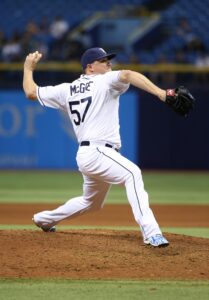
Over a three-year stretch from 2012-14, McGee avoided the injured list and soaked up 189 1/3 frames of 2.61 ERA ball. His 31.9% strikeout percentage over that run ranked 13th among relievers with 100+ innings and only seven relievers had a larger gap between their strikeout and walk rates. While he never made an All-Star team, he was clearly among the sport’s top high-leverage arms.
The 2015 season was McGee’s final with the Rays. It proved a challenge, as he was delayed to start the year by offseason elbow surgery and tore the meniscus in his left knee late in the season. When healthy enough to take the mound, he had another excellent showing. McGee twirled 37 1/3 innings with a 2.41 ERA and 32.7% strikeout percentage.
With Tampa Bay coming off an 80-82 record and McGee two seasons from free agency, he became one of the following offseason’s more intriguing trade chips. The Rays eventually packaged him with then-prospect Germán Márquez to the Rockies for outfielder Corey Dickerson and minor league infielder Kevin Padlo. The deal paid particular dividends for Colorado with Márquez’s emergence into staff ace, but McGee himself had a solid run early in his time there.
After a disappointing 4.73 ERA showing during his first season as a Rockie, he bounced back to the tune of a 3.61 mark across 57 1/3 innings in 2017 — helping the team to a Wild Card berth. That’s no small feat in the sport’s most hitter-friendly home venue, and the Rox kept him around via free agency. He signed a three-year, $27MM deal over the 2017-18 offseason, part of a bullpen spending spree that also saw Colorado bring in Bryan Shaw and Wade Davis.
That didn’t pan out as the organization hoped. Each of Shaw, McGee and Davis struggled to varying degrees. Home runs became a particular issues in McGee’s case, as his heavy reliance on four-seam fastballs up in the strike zone lost effectiveness when his velocity dipped a couple ticks during the 2018-19 seasons. The Rockies released McGee two seasons into the contract, but he promptly kicked off a late-career renaissance with a pair of division rivals.
Signing with the Dodgers for the shortened 2020 campaign, McGee ranked fifth among qualified relievers with a 41.8% strikeout rate over 24 outings. He saw some action in both the Championship Series and the World Series, getting into one game during a Fall Classic against his original organization. The Dodgers defeated the Rays in six games to win the only championship of McGee’s career, though he was part of another very successful club in San Francisco the next season.
He inked a two-year, $7MM deal with the Giants. During the first season, he picked up mostly where he’d left off in L.A. McGee’s strikeouts fell back to 24.3%, but he was among the game’s stingiest at avoiding walks and posted a 2.72 ERA through 59 2/3 innings. He assumed the closing role for a good chunk of the year, saving 31 of San Francisco’s 107 wins. The Giants edged out the Dodgers in a tight NL West race but saw L.A. get their revenge in a five-game Division Series that October.
The 2022 season, which’ll prove to be McGee’s last, was a struggle. He was hit hard through 24 contests in San Francisco, leading to his release in July. The veteran caught on briefly with the Brewers and Nationals at points during the second half but didn’t find much success at either stop. His final outing came in early September before Washington released him.
While he didn’t punctuate things with a great season, McGee steps away with a very strong body of work. He pitched for six different clubs over a 13-year MLB career, posting a cumulative 3.71 ERA through 572 1/3 innings. He struck out 613 of the 2359 batters he faced, a strong 26% clip. McGee finished 182 contests and collected 79 saves while holding 141 more leads and was credited with 32 wins. He had five separate seasons with a sub-3.00 ERA and four years in which he fanned upwards of 30% of opponents. According to Baseball Reference, he collected more than $37MM in earnings along the way.
MLBTR congratulates McGee on an excellent run and wishes him the best in his post-playing days.
Image courtesy of USA Today Sports.
Latest On Yuli Gurriel’s Free Agency
Yuli Gurriel is one of the more accomplished free agent hitters still available, though he’s seeking a bounceback opportunity after a rough 2022 campaign. It seemed things were moving towards a resolution a couple weeks ago when reports suggested his camp was making progress in talks with the Marlins. However, Miami eventually pulled back that pursuit.
That has left the 38-year-old without a publicly defined market. The only other teams tied to Gurriel this offseason are the Twins and the incumbent Astros, with whom the Cuban infielder spent his first seven big league seasons. Jon Heyman of the New York Post wrote yesterday Gurriel had sought a guarantee in the $3MM range at one point this offseason. Whether that’s still his goal is unclear, though the Post reports he declined multiple contract offers that were apparently below his asking price.
Heyman adds Houston manager Dusty Baker would like for Gurriel to return, though it’s not clear if there’s a fit on the roster given the team’s early-offseason pickup of José Abreu. Houston has Yordan Alvarez and Michael Brantley to split time between designated hitter and left field. Any path to playing time on the Astros roster would be as a right-handed bench bat. Houston already has a pair of right-handed infielders — Mauricio Dubón and David Hensley — who could crack the roster while offering more defensive flexibility.
Gurriel has some previous MLB experience at second and third base but has played almost exclusively first base since the start of the 2020 campaign. That’s at least in part because Houston has Jose Altuve and Alex Bregman entrenched at those other infield spots. Gurriel garnered solid marks from public defensive metrics for his intermittent third base work between 2016-19 and was a Gold Glove winning first baseman as recently as 2021. His defensive marks at first base cratered last season, though, which could give teams pause about his ability to handle any more demanding positions as he enters his age-39 season.
His offense is something of a question mark as well. Gurriel is coming off a .242/.288/.360 line with just eight home runs through 584 regular season plate appearances. He finished the year with an excellent 12-game playoff run (.347/.360/.490) before a World Series-ending MCL sprain in his right knee. On the one hand, it was Gurriel’s second well below-average offensive showing in the past three years, as he managed just a .232/.274/.384 showing during the shortened 2020 schedule. Yet his intervening season was brilliant, as he posted a .319/.383/.462 mark in 143 games in 2021, securing an American League batting title.
Gurriel still has excellent bat-to-ball skills. Last year’s 12.5% strikeout rate was a personal high but checked in roughly ten percentage points below the league average. Even with a below-average slash line, he collected 40 doubles for the third time in his career. Still, the 2022 season also represented the first time he failed to reach double-digit homers in a full season, and his on-base percentage was fifth-lowest among 36 first basemen with 400+ plate appearances.
There are a few remaining rebound targets available at the position in free agency. Longtime Twin slugger Miguel Sanó will hold a showcase for scouts next week, while 2020 home run leader Luke Voit is unsigned after being non-tendered by the Nationals. Gurriel brings a far different approach than those high-strikeout sluggers, though Sanó and Voit are far younger.
Dodgers Sign Luke Williams, Yusniel Diaz, Robbie Erlin To Minor League Deals
The Dodgers announced a number of non-roster invitees to Spring Training this afternoon. While the bulk of the group had been previously reported, Los Angeles has brought back a trio of players who have prior experience with the organization: utilityman Luke Williams, outfielder Yusniel Díaz and left-hander Robbie Erlin.
Williams, 26, has played for the Phillies, Giants and Marlins over the past two seasons. He’s gotten into 137 MLB games, tallying 244 plate appearances of .240/.299/.316 hitting. He’s picked up just two home runs while striking out at a 27.5% clip against big league pitching. The former third-round pick swiped 11 bases in only 79 games last season, though, and he’s played every position on the diamond aside from pitcher and catcher.
Los Angeles nabbed Williams off waivers from Miami at the start of the offseason. They opted not to tender him a contract just ten days later, sending him to free agency. That’s not an uncommon path with players whom teams hope to keep in the organization without dedicating a 40-man roster spot. The non-tender meant the Dodgers didn’t have to place Williams on waivers themselves. While he was free to shop for other opportunities as a free agent, the Dodgers circled back to add him on a non-roster pact.
Díaz, also 26, entered pro ball as a high-profile signee by the Dodgers out of Cuba back in 2015. At that point, teams weren’t strictly limited by hard-capped bonus pools for international amateur free agents. Los Angeles gave Díaz a hefty $15.5MM signing bonus (and paid a matching amount in taxes) back when he was 18 years old. He spent the next couple seasons as one of the more highly-regarded players in the system before being traded to Baltimore in 2018 as the headlining piece of a package for Manny Machado.
The following offseason, Díaz appeared among Baseball America’s top 50 overall prospects. Initially praised for his offensive polish and a patient plate approach, his productivity stalled out over the next few seasons. Díaz spent three years in the upper minors with Baltimore, managing only a .210/.295/.313 line through 495 plate appearances for their top affiliate in Norfolk. Fringy athleticism also pushed him primarily to the corner outfield after some early-career work in center. Díaz wound up playing in just one big league contest for the Orioles, striking out in his only MLB plate appearance to date.
At the end of last season, the O’s outrighted him off their 40-man roster. He qualified for minor league free agency and heads back to his original organization in search of a rebound. He joins Jason Heyward, Bradley Zimmer and Steven Duggar among non-roster outfield options who’ll be in Dodgers’ camp. Díaz is likely to start the upcoming season with Triple-A Oklahoma City.
Erlin is the only member of this trio who has appeared in an MLB game for the Dodgers. He came out of the bullpen twice last year, allowing two runs in as many innings. The 32-year-old southpaw was on the roster for less than a week before being designated for assignment in early May. He spent the majority of the season in OKC, where he worked 77 innings across 21 outings (including 14 starts).
The hitter-friendly Pacific Coast League gave Erlin trouble, as he allowed just over seven earned runs per nine innings. He struck out 19.1% of opposing hitters against a 9.7% walk percentage. Despite the middling results, the longtime Padre caught the L.A. front office’s attention enough for a return showing as a depth starter. Erlin has pitched in parts of eight big league campaigns, posting a 4.87 ERA over 341 2/3 innings.
Mariners Outright J.B. Bukauskas
The Mariners announced that reliever J.B. Bukauskas has gone unclaimed on waivers. He’s been sent outright to Triple-A Tacoma and will be in big league camp as a non-roster Spring Training invitee.
Bukauskas didn’t have a particularly long stay on the Seattle 40-man roster. Claimed off waivers from the Diamondbacks on January 17, he lost his spot earlier this week when the M’s grabbed Tayler Saucedo from the Mets. Seattle quickly ran Bukauskas through waivers and will now be able to retain a former first-round draftee and highly-regarded prospect without allocating a 40-man spot.
The 26-year-old was the 15th overall pick in the 2017 draft by the Astros. Houston flipped the UNC product to Arizona two summers later as part of a four-player package for Zack Greinke. A starter early in his minor league days, Bukauskas has come with questions about his ability to hold up in a rotation because of inconsistent command dating back to college. Those concerns have borne out over the past two seasons, as the Snakes moved him to relief after adding him to the roster over the 2020-21 offseason.
Bukauskas made his MLB debut in April ’21, eventually getting into 21 contests. He was hit hard for 19 runs through his first 17 1/3 big league innings despite averaging 94.5 MPH on his fastball and generating plenty of whiffs on his mid-80s slider. An elbow strain cost him a chunk of that season, and a lat injury suffered in Spring Training sidelined him for the first half of last year.
While he didn’t return to the mound until July, Bukauskas closed out the 2022 season with a nice run at Triple-A Reno. Pitching in an extraordinarily hitter-friendly park, he posted a 2.66 ERA with a solid 23.8% strikeout percentage and an excellent 5% walk rate. Nevertheless, he never got another MLB opportunity in a below-average Arizona bullpen and has found himself squeezed off two clubs’ rosters in a matter of weeks.
Bukauskas will try to pitch his way back onto the radar in spring camp and, if necessary, with Tacoma to open next season. The M’s already have a strong bullpen, with Andrés Muñoz, Paul Sewald, Diego Castillo, Matt Brash, Trevor Gott and likely Penn Murfee penciled into jobs. Matt Festa is out of minor league option years and has a strong case to hold onto a roster spot, while whomever of Marco Gonzales and Chris Flexen doesn’t win the #5 starter role could be in the bullpen. The M’s would also have to carry Rule 5 draftee Chris Clarke on the active roster or waive him and, if he clears, send him back to the Cubs. Bukauskas joins Taylor Williams, Casey Sadler, Riley O’Brien and Kyle Tyler among the non-roster depth options in the organization.
Twins’ VP Of Player Personnel Mike Radcliff Passes Away
Twins vice president of player personnel Mike Radcliff passed away today following a three-plus year battle with cancer, the organization announced. He was 66 years old.
“The Minnesota Twins today mourn the loss of Mike Radcliff,” the franchise said in a statement. “Mike was the heart and soul of our scouting department for over 30 years, a man who was beloved and respected by staff, players, fellow scouts, agents and his peers alike. One of baseball’s most revered talent evaluators, his character, work ethic, kindness and sense of humor set the tone for our player development and evaluation processes.
His baseball legacy lives on in the number of Twins Hall of Famers, All-Stars and great teams that bear his fingerprints, while his impact as a person will be forever felt by those that knew him. In the words of his trade, Mike was the epitome of a five-tool player, and he will be greatly missed across Twins Territory. Our deepest sympathies are with his wife Sherry, son Brett, daughter Erin and the entire Radcliff family during this difficult time.”
Radcliff spent the better part of four decades with Minnesota. First hired as an area scout in 1987, he’d worked his way to scouting director within six years. During his tenure as scouting director, the Twins selected numerous players who logged key roles on the Minnesota teams of the 2000’s — including Justin Morneau, Torii Hunter and recent Twins’ Hall of Fame inductee Joe Mauer.
In 2007, the organization gave Radcliff the title of vice president of player personnel — a role he would hold for the rest of his career. He remained involved in the scouting department and played a part in the franchise’s drafting and/or signing of players like Byron Buxton, Max Kepler and Jorge Polanco.
The 2011 recipient of the Midwest Scout of the Year Award from Major League Baseball, he was inducted into the Professional Scouts Hall of Fame a few years ago. Radcliff’s passing has resulted in a flood of tributes from colleagues, peers and media personnel. MLBTR joins countless others around the game in sending our condolences to Radcliff’s family, friends, colleagues and the number of players whose careers he impacted.
Padres Promote Ryan Christenson To Associate Manager
The Padres announced their coaching staff for the 2023 season this afternoon. There are a few shakeups for Bob Melvin’s second season leading the San Diego dugout.
Ryan Christenson has been given the title of associate manager. The 48-year-old joined Melvin in making the jump from the A’s to the Padres last offseason. Christenson had been Melvin’s bench coach in Oakland from 2018-21 and took on that same role for his first season in San Diego. He now earns a bump in title to associate manager, though his position as Melvin’s top lieutenant seems unchanged.
Filling the role of bench coach is Ryan Flaherty, who’s going into year four on the San Diego staff. He also gets the title of offensive coordinator, essentially taking on the hitting coach duties vacated when Michael Brdar was poached by the Tigers at the start of the offseason. San Diego will go without anyone assuming the traditional “hitting coach” title.
The 36-year-old Flaherty has spent the past two seasons as a quality control coach. He drew interest from the Mets in their bench coach search last offseason, but the Friars denied New York’s interview request. One year later, the former Orioles infielder gets both that title and the lead hitting responsibilities in San Diego.
He’ll be joined on staff by assistant hitting coaches Scott Coolbaugh and Oscar Bernard. The 56-year-old Coolbaugh joins the Friars after two years as the lead hitting instructor with the Tigers. He’d also previously served as hitting coach in Baltimore and Texas and an assistant role with the White Sox. He brings plenty of coaching experience to help Flaherty in his first crack as offensive coordinator.
Bernard, meanwhile, gets promoted to the MLB staff after seven years as San Diego’s minor league hitting coordinator. The 39-year-old spent some time as a player and instructor in the Cubs’ minor league system before joining the Friars in 2016. It’s the first big league staff job for the Dominican Republic native. Also joining the group is catching coach Brian Esposito. The 43-year-old spent last season managing the Friars’ Low-A affiliate in Fort Wayne.
The rest are holdovers from last season. Ruben Niebla is back for a second year as pitching coach, pairing with bullpen coach Ben Fritz. Matt Williams and David Macias will coach the bases and defense — Williams the infield, Macias the outfield — with Peter Summerville and Herberto Andrade as coaching assistants. Former big league managers Bryan Price and Mike Shildt will reassume the advisory roles they manned in 2022.
Diamondbacks Sign Yairo Munoz To Minor League Contract
The Diamondbacks have signed utilityman Yairo Munoz to a minor league deal, as indicated on the team’s list of non-roster invitees to Spring Training. Munoz elected free agency after being outrighted off the Phillies’ 40-man roster following the season.
Munoz signed a minors deal with Philadelphia last winter and ended up appearing in 29 games for the NL champions, hitting .211/.250/.404 with three homers over 60 plate appearances. His time on the active roster mostly coincided with Jean Segura‘s stint on the 60-day injured list, as Munoz saw a lot of action at second base while Segura was recovering from a broken finger. Most of Munoz’s other playing time came as pinch-hitter, pinch-runner, or late-game defensive sub.
Beginning his career as a shortstop, Munoz has settled into a role as a versatile fill-in at second or third base, or either corner outfield spot in a pinch. Josh Rojas has a similar role in more of an everyday capacity with the D’Backs, and might be bounced around the diamond a bit more in 2023 now that Evan Longoria could handle some third base action when not DH’ing. Emmanuel Rivera, Geraldo Perdomo, Diego Castillo, and other non-roster invites Jake Hager and Phillip Evans are among the names who will be competing with Munoz to win a job on Arizona’s bench.
Munoz has appeared in each of the last five Major League seasons, with 108 of his 242 career games coming in his 2018 rookie season with the Cardinals. After an impressive .273/.350/.413 performance over 329 PA in that first season, Munoz has since struggled to recapture that form, and left the Cardinals under rather controversial circumstances during Spring Training in 2020. Munoz then caught on with the Red Sox, appearing in only 17 MLB games with Boston in 2020-21.
Big Hype Prospects: Cowser, Bleday, Alvarez, Outman, Steer
Pitchers and catchers report in 10 days, at which point we’ll have more to discuss in virtually every facet of the sport. Until then, let’s review more prospects tangentially connected to the news. Today’s episode coincidentally includes a number of left-handed hitters with holes in their swing.
Five BHPs In The News
Colton Cowser, 22, OF, BAL (AAA)
(A+/AA/AAA) 626 PA, 19 HR, 18 SB, .278/.406/.469
In a recent radio spot, Orioles general manager Mike Elias indicated a belief Cowser will debut later this season. A recent review of the Baltimore farm system published by FanGraphs’ Eric Longenhagen offers modest cause for concern. There are now questions about Cowser’s ability to perform against low-in-the-zone breaking balls and inside fastballs. Those are two very large holes for a big league hitter, indicating Cowser might require a carefully managed role once he is promoted. The lower-half stiffness noted by Longenhagen is a new issue and might relate to the workload Cowser shouldered last season. In order to improve and adjust, Cowser could require a long stint in Triple-A.
JJ Bleday, 25, OF, MIA (MLB)
(MLB) 238 PA, 5 HR, 4 SB, .167/.277/.309
The left-handed hitting slugger has two massive issues to overcome – a weakness against up-and-away fastballs and a pulled, fly-ball-oriented approach lacking in high-quality exit velocities. Both issues were on full display in Bleday’s first season, and he has used up his rookie eligibility. Bleday is currently expected to compete with Jesus Sanchez and Bryan De La Cruz for playing time in left field. Unless he improves upon both shortcomings, the former fourth-overall pick will be limited to heavily scripted usage against right-handed sinkerballers. Achieving such an adjustment will likely require a new swing and a return to Triple-A to digest the changes.
Francisco Alvarez, 21, C, NYM (MLB)
(AA/AAA) 411 PA, 27 HR, .260/.374/.511
A burly backstop who frequently draws hitting comps to Salvador Perez, Alvarez will need to play his way onto an Opening Day roster that already includes catchers Omar Narvaez and Tomas Nido. While neither player is expected to block Alvarez, he also has a second pathway onto the roster – designated hitter. As we learned yesterday, the Mets are carrying a veteran tandem of Daniel Vogelbach, Darin Ruf, and Tommy Pham in part to leave a door open for Alvarez and Brett Baty (covered last week) to get at-bats as part of the revolving door at DH.
As a hitter, Alvarez appears primed for the Show. There is near-term concern about his rate of contact and occasional lapses into over-selectivity. Even so, these are small issues to polish rather than fatal flaws.
James Outman, 25, OF, LAD (MLB)
(AA/AAA) 559 PA, 31 HR, 13 SB, .294/.393/.586
Although the Dodgers have made peace with crossing the first luxury tax threshold, they’ve done little to fortify their left field mix. Outman will compete with the likes of Chris Taylor and Jason Heyward for a regular role this spring. Outman’s approach could serve as a roadmap for Bleday. The left-handed hitting Outman makes frequently pulled, fly ball contact, but he isn’t nearly as extreme as the similarly built Marlins outfielder. Outman also consistently delivers line drives which allows him to post above-average BABIPs. Toss in above-average plate discipline, and he has a chance to hit for average, OBP, and power despite expectations of a 30 percent strikeout rate.
Spencer Steer, 25, 3B, CIN (MLB)
(AA/AAA) 427 PA, 23 HR, 4 SB, .274/.364/.515
Acquired as part of the return in the Tyler Mahle trade, Steer looks the part of a future second-division starter or frequently-used utility man. The Reds are in a year of transition with Steer eyeing a role as the regular third baseman. Long-term, he’ll need to contend with the likes of Elly De La Cruz, Edwin Arroyo, Noelvi Marte, and Matt McLain – whichever among those doesn’t take over at shortstop. Steer is considered a well-rounded hitter with a feel for contact, above-average plate discipline, and an ability to pop mistakes. The cozy confines of Great American Ballpark should help his power production. One question he’ll need to answer relates to his consistency of contact quality. In a 108-plate appearance trial last season, Steer posted an 84.7-mph average and 104.4-mph max exit velocity, which were well below Major League average.
Three More
George Valera, CLE (22): After managing a league-average batting line at Triple-A last season, Valera is on pace to debut at some point in 2023. He won’t be making the Opening Day roster due to a recent hamate injury. Such injuries are hard to predict, as the recovery is speedy in some cases, but some players are left with lesser bat control for weeks or months after returning. Occasionally, as with Alex Kirilloff, a secondary issue can linger indefinitely.
Kyle Stowers, BAL (25): Currently in the outfield and designated hitter mix for Baltimore, Stowers has a brief window to cement a role as a righty-masher before a flood of high-ceiling prospects joins the roster. Stowers is patient, strikeout-prone, and powerful, rendering him a Three True Outcomes option. Such hitters are volatile as they’re heavily reliant on hitting home runs at just the right time.
Grayson Rodriguez, BAL (23): General manager Mike Elias reiterated his belief that Rodriguez will make the Opening Day rotation. There’s still the messy part of actually navigating Spring Training, especially since Rodriguez’s stuff had declined at last look, though he was returning from a lat injury at the time. Even the September version of Rodriguez looked like a future rotation mainstay.
White Sox Acquire Franklin German, Designate Jason Bilous
The White Sox have acquired right-hander Franklin German from the Red Sox in exchange for righty Theo Denlinger. Both teams have announced the trade, and the White Sox also announced that right-hander Jason Bilous was designated for assignment to create roster space.
Boston designated German for assignment earlier this week, in a bit of a surprising move given that the Red Sox had named German their minor league pitcher of the year. German had a 2.72 ERA and a very impressive 32.49% strikeout rate over 49 2/3 total innings between Boston’s Double-A and Triple-A affiliates, all in bullpen work. This performance earned German his first bit of Major League action, though he had an 18.00 ERA over his four innings in the Show.
2022 was German’s first season as a full-time reliever, as he started to run into some struggles working his way up the ladder as a minor league starter. It could be that the move to the bullpen might be a turning point for the 25-year-old German, and the White Sox seem interested in seeing if his 97mph fastball can translate to consistent results as a relief pitcher.
On the flip side, the Red Sox are also picking up a live arm in Denlinger, who has a 35.02% strikeout rate over 65 innings in the minors. Denlinger only began his pro career in 2021 when Chicago drafted him in the seventh round, but the 26-year-old already advanced to Double-A last season, albeit with a 4.70 ERA over 38 1/3 frames with Double-A Birmingham. Home runs contributed to that total, so if Denlinger can improve on keeping the ball in the park, a Triple-A promotion and maybe even a cup of coffee in the majors isn’t inconceivable for 2023.
Bilous, 25, was added to Chicago’s 40-man roster last offseason in advance of the Rule 5 Draft, though he was coming off a shaky season at the high-A and Double-A levels. Unfortunately for Bilous, those struggles continued into 2022, as he posted a 6.30 ERA over 105 2/3 combined innings (83 2/3 at Double-A, 22 at Triple-A). While his strikeout rates were still respectable, Bilous’ walk rate spiked to 15.74%. It is possible that a bullpen move could conceivably be in Bilous’ future as well, though his four-pitch arsenal might lead the White Sox or another club to continue to explore a future as a starter.
Rangers Sign Bernardo Flores Jr. To Minor League Contract
The Rangers have signed left-hander Bernardo Flores Jr. to a minor league deal, as initially reported by Flores’ Mexican League club, Diablos Rojos del Mexico (Twitter link). Flores also addressed the news himself, on his own Twitter feed.
Flores was released by the Rockies last spring, and he caught on with the Reds on a minor league contract before being released again, prior his signing with Diablos Rojos. The southpaw had a 7.13 ERA over his 17 2/3 innings with the Reds’ Triple-A affiliate, and then a more respectable 4.15 ERA in 26 frames of Mexican League action. Walks were a big issue for Flores at both stops, continuing the control problems that began to significantly emerge during Flores’ 2021 season, while he was pitching in the minors in the Rockies and Cardinals organizations.
Originally a seventh-round pick for the White Sox in the 2016 draft, Flores’ tenure with Chicago culminated in his MLB debut — two innings over two games in the 2020 season. St. Louis claimed Flores off waivers in April 2021, and he appeared in only one game with the Cardinals at the Major League level during what ended up as an injury-hampered year for the southpaw.
The 27-year-old will try to add to this brief MLB resume by catching on with the Rangers, though a move to relief pitching might be Flores’ best way of getting back to the Show. Flores has started 93 of his 100 career games in the affiliated minor leagues, but his numbers largely hit a wall once he reached the Triple-A level. Flores has only a 6.15 ERA over 60 innings of Triple-A ball, with unimpressive strikeout (16.84%) and walk (12.98%) rates. There’s no risk for the Rangers in giving him a look during camp, and then perhaps keeping him as rotation depth in the minors or perhaps as a bullpen option.