
Braves To Reinstate Kolby Allard From Injured List
The Braves will reinstate left-hander Kolby Allard from the 60-day injured list to start tomorrow’s game against the Twins, the team informed reporters (including Justin Toscano of the Atlanta Journal-Constitution). It’ll be his season debut.
Allard, a former first-round draftee, made his first three major league appearances with Atlanta in 2018. The Braves dealt him to the Rangers the following season. He spent four years in Texas but never posted an ERA below 4.96. At the start of last offseason, the Rangers traded him back to the Braves for Jake Odorizzi.
So far, neither team has gotten anything out of the swap. Odorizzi might not throw a pitch as a Ranger. He underwent arthroscopic shoulder surgery in April and will miss the entire season; he’s headed to free agency at year’s end. Allard has been down since suffering a Grade 2 oblique strain in Spring Training.
The southpaw has made just two rehab starts for Triple-A Gwinnett. He has combined for 6 2/3 innings of two-run ball with eight strikeouts. Allard tossed 62 pitches in his most recent outing on Thursday, so it’ll likely be a relatively brief start. The Braves optioned AJ Smith-Shawver yesterday, leaving a vacancy in the fifth rotation spot behind Spencer Strider, Bryce Elder, Charlie Morton and Jared Shuster.
Allard will reoccupy a spot on the 40-man roster. Atlanta already has a vacancy after designating Charlie Culberson for assignment last week. They’ll only need to make a corresponding active roster transaction tomorrow.
Royals’ Josh Taylor To Undergo Lower Back Surgery
Royals reliever Josh Taylor will undergo surgery to repair a herniated disc in his lower back, tweets Anne Rogers of MLB.com. The team hasn’t provided a recovery timetable.
Taylor has been on the injured list for a month while battling a shoulder impingement. The back issue apparently arose during his rehab process. Taylor missed the entire 2022 campaign as he battled a lower back strain.
It’s obviously an unfortunate setback that makes it seem likely he’ll find himself on the 60-day injured list once the club needs a 40-man roster spot. A 60-day IL transfer could be backdated to the time of his initial placement even though he’s now dealing with a separate injury.
Kansas City acquired the southpaw over the offseason in a swap that sent Adalberto Mondesí to the Red Sox. The deal hasn’t worked for either team, as both players have battled injuries. Mondesí still hasn’t played for Boston as he works back from last year’s ACL tear. Taylor has made 17 appearances for K.C. but been tagged for 16 earned runs in 17 2/3 innings. He has struck out just under 32% of opposing hitters, an excellent clip, but nine walks and four homers contributed to the inflated ERA.
This is Taylor’s second season of arbitration eligibility. He’s making $1.025MM this year and eligible for the process twice more. An extended absence would increase the odds of Kansas City non-tendering him next offseason, though it’s unclear precisely how long he’ll be out.
Wilson Ramos Signs With Long Island Ducks
Veteran catcher Wilson Ramos has signed with the Long Island Ducks of the Atlantic League, the club announced. He’d briefly appeared in the Mexican League earlier in the year before making the jump to independent ball.
Ramos, a two-time All-Star, is looking to play his way to the majors for a 13th season. The Venezuela native didn’t make it there last year, as his only affiliated experience was a three-game stint with the Rangers’ Triple-A team. He appeared in 44 games between the Tigers and Indians two seasons back but had his year cut short when he suffered a season-ending ACL tear in August.
Now 35, Ramos is unlikely to recapture his 2016-18 peak form. The bat-first backstop claimed a Silver Slugger award and some down-ballot MVP support in the first of those seasons and combined to hit .298/.343/.483 over that stretch.
He was still a productive hitter thereafter, posting a .262/.321/.407 line over three clubs between 2019-21. That wasn’t quite enough to compensate for Ramos’ shortcomings as a defender, though, and the knee injury dealt a major hit to his efforts to find his way back to the big leagues last season.
Red Sox Acquire Andres Nunez From Royals
The Red Sox have acquired right-hander Andres Núñez from the Royals, according to his transactions tracker at MLB.com. The return for the Royals isn’t listed, suggesting it’s likely a cash deal. Núñez wasn’t on a 40-man roster, so no corresponding moves will be necessary. He’s been assigned to Triple-A Worcester.
Núñez, 27, was selected by the Royals in the 29th round of the 2018 draft. The reliever has been quite effective in the minors but has seen his results take a step back this year. In 2018 and 2019, he posted a combined 2.43 ERA in 77 2/3 innings, pitching in Rookie ball and Single-A. The minor leagues were canceled by the pandemic in 2020 and Nunez has been in the upper levels since. He split 2021 between Double-A and Triple-A with a combined 3.98 ERA that year, then had a solid 3.61 ERA mark in Triple-A last year.
Here in 2023, however, things have generally gone in an unfavorable direction with a 6.66 ERA through 24 1/3 innings. He’s allowed a .355 batting average on balls in play and has a 59.6% strand rate, which could point to some bad luck. On the other hand, he generally ran strikeout rates of 25-30% in previous seasons but is down to 17.5% this year. Similarly, his walk rate has jumped to 12.3% after being much lower in previous seasons.
Those poor results have apparently prompted the Royals to accept some cash and move on, while the Sox clearly believe they can get him back on track. He’ll head to Worcester and give the club some extra bullpen depth in Triple-A. He’s yet to crack a 40-man roster but will be eligible for the upcoming Rule 5 draft if not added ahead of time.
Penn Murfee To Undergo Season-Ending UCL Surgery
The Mariners are dealing with a rash of significant pitching injuries, as relayed by Ryan Divish of The Seattle Times (Twitter links one, two and three). Right-hander Penn Murfee will undergo season-ending surgery on his ulnar collateral ligament. Meanwhile, pitching prospect Taylor Dollard will undergo season-ending labrum surgery. Additionally, lefty Marco Gonzales will be shut down for two weeks due to nerve issues in his elbow.
The news is a very unfortunate development for Murfee, who has been a strong presence in Seattle’s bullpen over the past two years. He debuted last season with a 2.99 ERA in 69 1/3 innings, striking out 27.9% of opponents against a 6.6% walk rate. This year, he’s struggled with control but nonetheless dropped his ERA to 1.29. He twice landed on the injured list due to elbow inflammation and will now have to go under the knife.
It’s not exactly clear exactly what kind of surgery Murfee will require, but he’s sure to face a significant absence either way. Full ulnar collateral ligament reconstruction, also known as Tommy John surgery, typical requires 14 to 18 months of recovery time. Even the internal brace alternative usually requires close to a year. That means that, in addition to missing the remainder of the 2023 season, Murfee will miss a chunk of the 2024 campaign as well.
Dollard, 24, is also set to miss the remainder of this year, though his timeline beyond that isn’t clear. He was selected by the Mariners in the fifth round of the 2020 draft and pitched in the lower levels of the club’s system in 2021. Last year, he posted a 2.25 ERA in Double-A, striking out 22.9% of opponents against a 5.4% walk rate. He figured to serve as rotation depth this year but made just three starts in Triple-A before landing on the injured list.
As for Gonzales, his timeline is still up in the air but he’s already been on the injured list for over three weeks and will now be shut down for two more. Even if he’s given a clean bill of health at that time, he’ll need to ramp back up after such a long layoff, which will push his theoretical return further down the line.
He posted a 5.22 ERA before landing on the IL but a 62.1% strand rate was likely pushing that up. His peripherals were roughly in line with his previous seasons and his 4.29 FIP suggests he may have deserved better results. The lefty may not be an ace but has a serviceable 4.02 ERA dating back to his 2018 breakout campaign.
The Mariners have some rotation challenges with Robbie Ray and Easton McGee both out for the year and Chris Flexen now designated for assignment. Bryce Miller has cooled off after a red hot start while Bryan Woo has a 5.09 ERA thus far. With Gonzales now unlikely to be available for a while, it could impact the club’s approach to the deadline. Their 38-39 record has them fourth in the American League West but just four games back of a Wild Card spot.
Brewers Should Look To Add At First Base This Summer
The Brewers knocked off the Mets yesterday, pushing four games above .500. With the Reds losing later in Baltimore, Milwaukee nudged back into first place in the NL Central.
No one will be overwhelmed with the Brew Crew’s first couple months. They’ve been outscored by 20 runs on the year and carry a 23-27 record since the start of May. Yet the Cardinals’ disastrous start leaves the door wide open for Milwaukee to take the division, even with Cincinnati outpacing most expectations and the Cubs playing their way back into the mix.
In his first summer leading baseball operations, GM Matt Arnold figures to look for ways to improve the offense. Milwaukee has been a pitching and defense team for years, but the lineup has become particularly problematic in 2023. The Brewers rank 25th in runs despite the generally hitter-friendly nature of American Family Field. Only the A’s have a lower batting average than Milwaukee’s .226 clip, while the Brewers rank 25th in on-base percentage (.303), 28th in slugging (.373) and have the game’s third-highest strikeout rate (25.7%).
Any time a team is struggling to that extent, there’ll be multiple areas of concern. For Milwaukee, none stands out more than first base. The Brewers have gotten just a .223/.294/.378 showing out of the bat-first position. By measure of wRC+, that’s 25th in MLB. The struggles have mounted over the last two months, coinciding with the team’s slide from an 18-10 start. Since May 1, Milwaukee first basemen are hitting .217/.286/.349. Only the Angels have gotten less in that span.
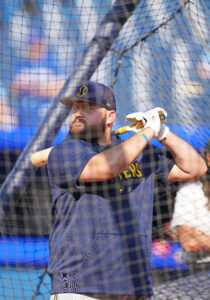
That’s in large part due to an extended slump from Rowdy Tellez. The left-handed hitter had an excellent April (.247/.333/.533) but has hit only .203/.269/.327 in 167 plate appearances over the past two months. His walks and contact quality have both fallen off precipitously. Tellez drew a free pass in over 12% of his trips to the dish in the first month; that’s down to a pedestrian 8.4% clip since.
The drop in batted ball results is even more concerning. Tellez’s calling card has always been big power potential. He popped 35 home runs a season ago and routinely posted excellent batted ball metrics. That hasn’t been the case in 2023. Tellez’s rate of hard contact (batted balls hit 95+ MPH) has fallen from the 45-48% range between 2020-22 to a roughly average 38.4% clip. The softer contact is borne out in the results. He’s on a 25-homer pace with an overall .218/.293/.408 batting line.
Unless Tellez breaks out of this slump in the next few weeks, Arnold and his front office could prioritize a first base upgrade at the deadline. Early-season dice rolls on Luke Voit and Jon Singleton didn’t pan out; neither is still in the organization. Darin Ruf broke a bone in his knee almost immediately after signing and is out into August. Owen Miller is better served as a multi-positional infielder than an everyday first baseman. Keston Hiura is raking in Triple-A again, but he’s struggled to put the ball in play whenever he’s gone up against big league arms.
It’s still too early to know exactly which first basemen could be attainable. Five teams (the A’s, Rockies, Nationals, Cardinals and Royals) are double-digit games out of a playoff spot. Oakland might be open to selling high on Rule 5 find Ryan Noda, but that’s by no means a guarantee. Washington hasn’t gotten much from Joey Meneses or Dominic Smith this year. Colorado could deal C.J. Cron, but he only returned from a nagging back issue yesterday and didn’t hit well before the injury.
Kansas City lost Vinnie Pasquantino to season-ending shoulder surgery and probably wouldn’t have traded him anyhow. It’s still tough to imagine the Cardinals moving Paul Goldschmidt and dealing such a major hit to their 2024 chances; even if they did put the defending NL MVP on the market, they almost certainly wouldn’t want to move him to one of their top divisional competitors.
The Brewers may have to wait a few more weeks to hope for other teams to fall out of contention. Justin Turner is having a strong season and can opt out of his deal with the Red Sox at year’s end. Boston is only three games out of a playoff spot right now; if they dropped five or six back by the deadline, they could listen to offers. Maybe the Orioles would sell low on Ryan Mountcastle, although he’s having an even poorer season than Tellez to date. Pittsburgh’s Connor Joe is a right-handed hitter with a good track record against lefty arms. He’s miscast as a regular but could be a fallback platoon partner with Tellez if Milwaukee can’t swing a bigger upgrade.
Regardless of what the Brewers do this summer, Tellez’s recent struggles put his longer-term future with the organization in doubt. He’s playing this season on a $4.95MM salary and would be in line for a raise in his final season of arbitration. His current trajectory points towards a non-tender. That’d be true on virtually every team and is particularly the case for a Milwaukee organization that has tended not to value the slugging first baseman highly (i.e. non-tendering Chris Carter in 2016 and declining a net $6.5MM option on Eric Thames three years later).
Image courtesy of USA Today Sports.
Diamondbacks Place Merrill Kelly On IL, Option Joe Mantiply
The Diamondbacks announced a series of roster moves today, with right-hander Merrill Kelly being placed on the 15-day injured list due to right calf inflammation, retroactive to June 25. They also optioned left-hander Joe Mantiply to Triple-A Reno. In corresponding moves, righties Kevin Ginkel and Justin Martinez were recalled from Reno.
At this point, it’s unclear how serious Kelly’s injury is, but it’s a notable loss for the club nonetheless. The Diamondbacks have a fairly top-heavy rotation with Kelly and Zac Gallen being the two most effective members. Gallen has an excellent 2.84 ERA on the year and Kelly isn’t far behind with a 3.22 mark. Then there’s a notable drop to the 4.31 ERA of Tommy Henry, the 4.97 of Ryne Nelson and the 7.82 of Zach Davies.
The Diamondbacks are leading the National League West but have a couple of clubs on their heels as each of the Dodgers and Giants are within three games. With the All-Star break now effectively two weeks away, they will have to forge ahead without Kelly for at least that long. Drey Jameson has been with the big league club in a long relief role and could perhaps step into the rotation. Brandon Pfaadt got some big league starts earlier this year but posted an 8.37 ERA in those before getting optioned back down. Konnor Pilkington is also on the 40-man but has been struggling in the minors this year.
As for Mantiply, he posted a 2.85 ERA last year and even got selected to the All-Star game but has taken a step back this year. He’s gone on the injured list a couple of times already, once due to left shoulder inflammation and another time for a right hamstring strain. Around those ailments, he’s tossed 15 2/3 innings with a 5.74 ERA. His peripherals are still pretty similar to last year’s as a 50.8% strand rate seems to be pushing his ERA up. Nonetheless, he now finds himself headed to Reno to get into a groove.
Martinez, 21, will be making his major league debut as soon as he gets into a game. He served largely as a starting pitcher in the lower levels of the minors but required Tommy John surgery in 2021. After a long injury layoff and the minor leagues getting cancelled by the pandemic in 2020, he came back as a reliever last year. He tossed 38 innings across four different levels, finishing the year at Triple-A. He posted a 3.32 ERA in that time with an incredible 36.7% strikeout rate but 13% walk rate.
Despite the free passes, the club was intrigued enough to add him to the roster in November to prevent him from being selected in the Rule 5 draft. This year, he’s been in Triple-A, tossing 28 innings thus far. He has a 4.18 ERA, striking out 29.7% of opponents but with an astonishing 21.1% walk rate. Despite the control issues, he was recently ranked the club’s #21 prospect at Baseball America and #12 at FanGraphs.
Rockies Select Matt Koch
The Rockies announced that they have selected the contract of right-hander Matt Koch. They already had an open roster spot on both their 40-man and active rosters, meaning no corresponding move will be necessary.
Koch, 32, signed a minor league deal with the Rockies over the offseason and has been in Triple-A this year. He’s tossed 34 2/3 innings over 29 appearances with a 7.27 ERA but stronger peripherals in the hitter-friendly Pacific Coast League. His 21.5% strikeout rate and 7% walk rate are each close to typical major league averages, but his .362 batting average on balls in play and 59.3% strand rate are on the unfriendly side of par. That’s led to a 5.90 FIP that’s more than a full run better than his ERA.
Prior to this season, he appeared in 40 big league games with the Diamondbacks and Mariners dating back to 2016. He has an ERA of 5.00 in those, striking out just 13.2% of opponents but limiting walks to a 5.3% clip.
The Rockies’ pitching staff has been stretched in recent days after they were trounced 25-1 by the Angels on Saturday. They then optioned Karl Kauffmann and recalled Nick Mears before bouncing back with a 4-3 victory on Sunday. After that game, they optioned Noah Davis and have now brought up Koch to keep a fresh arm on hand. Koch is out of options but has just over a year of service time.
Cubs To Select Jared Young
3:30pm: Infielder Miles Mastrobuoni was optioned in a corresponding active roster move, per Sullivan. Left-hander Brandon Hughes, who will require season-ending surgery, has been transferred to the 60-day IL to open a 40-man spot for Young.
3:05pm: The Cubs will be selecting the contract of infielder/outfielder Jared Young, reports Paul Sullivan of the Chicago Tribune. Young’s presence at Wrigley Field was first reported on Twitter by @crawlyscubs. Young isn’t on the club’s 40-man roster, so they will have to make a corresponding move or moves in order to make room for him.
Young, 27, was selected to the club’s roster in September of last year and got a cup of coffee in the majors. He had a solid .263/.364/.368 line in 22 plate appearances but was outrighted off the roster in November. He’s spent all of this year mashing in Triple-A. He has 13 home runs in 52 games while walking in 13.8% of his plate appearances and striking out at just a 20.5% rate. His .326/.426/.605 batting line amounts to a 154 wRC+, indicating he’s been 54% better than league average.
Defensively, he’s played a bit of third base and the outfield corners but has seen most of his time at first base. The Cubs haven’t gotten much production at the cold corner this year, as Eric Hosmer hit .234/.280/.330 on the year. He was released and replaced by Matt Mervis, who slashed .167/.242/.289 before getting optioned to the minors. The club returned Cody Bellinger from the injured list before he was 100%, hoping to have him at first instead of his usual center field position but he’s hit just .160/.214/.200 since being activated. Trey Mancini has also seen some time there and hit a tepid .245/.317/.364 on the year.
With all those struggles, it’s understandable that the Cubs are looking for new approaches, especially as they’ve now climbed back into contention. Their 37-39 record isn’t especially impressive but they are just three games back of the lead in the wide open National League Central and they have the best run differential in the division. They’ll now give Young a chance to test his skills against big league pitching again, with just over a month before the club will have to decide whether or not to pursue upgrades at the trade deadline.
Mariners Designate Chris Flexen For Assignment
2:55pm: MLBTR’s Steve Adams reports that Flexen can reject an outright assignment while retaining his whole salary. Unless the Mariners work out a trade in the next week, he will almost certainly wind up on the open market.
2:10pm: The Mariners announced that right-hander Trevor Gott has been reinstated from the injured list with fellow righty Chris Flexen designated for assignment in a corresponding move.
Flexen losing his roster spot is totally unsurprising given his results this season but it’s a shocking turn of events compared to where things stood just a few months ago. After a successful stint in the KBO in 2020, Flexen returned to North America by signing a two-year deal with the Mariners, with an option for 2023 as well.
The guaranteed portion of that agreement went quite well, with Flexen tossing 317 1/3 innings over 2021 and 2022 with a 3.66 ERA. His 16.5% strikeout rate in that time wasn’t especially strong, but his 6.8% walk rate showed strong control. He also did a good job keeping the ball from going over the fence, as his 8.8% home run per fly ball rate was third-best in the league among pitchers with at least 300 innings pitcher. His pitcher-friendly ballpark may have had an impact but his 3.75 road ERA was only slightly higher than his 3.57 mark at T-Mobile Park.
The 2023 option on his contract could be vested at $8MM if Flexen tossed 300 innings over the first two years, which he did. With the M’s having five other rotation options in Luis Castillo, George Kirby, Robbie Ray, Logan Gilbert and Marco Gonzales, that led to Flexen getting interest in trade talks over the offseason.
The Mariners ultimately held onto Flexen for some extra rotation depth, which seemed like a wise move when Ray quickly landed on the injured list and eventually required Tommy John surgery. Unfortunately, Flexen couldn’t step up and take the open rotation spot, getting torched for a 10.38 ERA in four starts before getting bumped back to the bullpen.
His next five outings were scoreless but he’s allowed at least one earned run in his past seven appearances. Whatever skill or luck he previously deployed to prevent home runs has eluded him this year, as he’s already given up 11 long balls, leading to a 21.6% HR/FB rate that’s more than double his clip from the previous two campaigns. Overall, he has a 7.71 ERA on the year in 42 innings, which has bumped him off Seattle’s roster.
The Mariners will now have a week to trade Flexen or pass him through waivers. He garnered interest over the winter and some of those clubs could now circle back, especially with so many pitching injuries throughout the league, though Flexen’s poor results this season will obviously tamp down whatever trade value he previously had. With approximately $4.1MM still remaining on his contract, the M’s would surely have to swallow some or all of that in order to facilitate a deal.
As for the waiver route, that will be an interesting factor here. Normally, players with more than three years of service time can reject an outright assignment in favor of electing free agency, but they require five years of service to do so while retaining their salary. Assuming those normal rules apply and Flexen goes on to clear waivers, he obviously wouldn’t leave that money on the table and would therefore stick in the Mariners’ organization as depth. However, players coming from stints in other countries like Japan, Korea or Cuba often have language in their contracts that allows them to circumvent the normal service time rules. For instance, MLBTR confirmed this winter that Flexen would become a free agent after 2023 even though he would be well shy of six years’ of service time. Whether the M’s can potentially keep Flexen as depth or not will have an impact on how much they are willing to trade him.