
A’s Continuing To Give Tyler Soderstrom Catching Reps
The A’s remain open to the possibility of using Tyler Soderstrom as their backup catcher, manager Mark Kotsay tells Martín Gallegos of MLB.com. The former first-round pick got the start behind the dish in yesterday’s Spring Training matchup with Seattle.
“What we talked about with Tyler is continuing to keep that skill set,” Kotsay told Gallegos. “It gives us an opportunity to have a player that provides maybe a role for us that would allow maybe another bench spot.” The A’s will use Shea Langeliers as their starting catcher for the third consecutive season. They would gain some bench flexibility if they’re comfortable with the 23-year-old Soderstrom as Langeliers’ backup. Otherwise, he’d be the primary first baseman.
Soderstrom was drafted as a bat-first catching prospect out of high school in 2020. His bat pushed him quickly through the minor leagues. He’s a .272/.339/.532 hitter in the minors. Soderstrom hasn’t found anywhere near that level of success against big league pitching. He owns a .204/.282/.354 line with a 27.4% strikeout rate over 351 plate appearances.
Most of his big league work has come as a first baseman. Soderstrom has caught a little more than 1200 innings over four minor league seasons. He made 15 starts behind the dish for the A’s during his 2023 rookie season. He got another 21 starts as a catcher in Triple-A last year, but they didn’t give him any MLB starts there.
The youngster’s only MLB catching experience last year was a four-inning appearance in a game in which that day’s starting catcher Kyle McCann was lifted for a pinch-hitter in the fifth inning. Langeliers was the designated hitter. If the A’s wanted to have him catch after pulling McCann, they’d have forfeited their DH for the rest of the game. Soderstrom, who had started at first base, moved to catcher.
The A’s clearly didn’t feel his glove was up to par last year. They kept McCann on the major league roster as the backup all season. Langeliers started 123 games, second-most at the position behind Cal Raleigh. McCann made the other 39 starts. Soderstrom’s four-inning appearance was the only catching work by any other player.
The A’s already shook that up last month, designating McCann for assignment while acquiring Jhonny Pereda in a cash trade with Miami. Langeliers and Pereda are the only primary catchers on the 40-man roster. That’d very likely be Kotsay’s season-opening duo if they’re still apprehensive about Soderstrom’s glove. If they’re comfortable with Soderstrom behind the plate, he could pick up around 40 starts there while playing first base on days when Langeliers is rested. That’d allow the A’s to option Pereda and carry another infielder or outfielder on the active roster.
McCann cleared waivers and is in camp as a non-roster invitee. The A’s could reselect his contract at any point, but he’s behind Pereda on the depth chart. The 28-year-old Pereda only has 20 games of major league experience. He’s a .293/.385/.408 hitter over four Triple-A seasons and has a stronger defensive reputation than McCann brings.
Who Else Could The A’s Look To Extend?
Last week, Evan Drellich of The Athletic reported that the A's had opened extension negotiations with outfielder Lawrence Butler. General manager David Forst declined comment on Butler specifically but implied that he's not the only player with whom they've had discussions.
"We’ve had conversations with a couple other players other than (already-extended DH Brent Rooker), and those talks are ongoing," Forst told Drellich. "It is an important thing for us to lock guys up (heading) into Las Vegas and make sure that we keep the core of what we think is a really good young team together, ongoing."
MLBTR covered Butler's extension candidacy at the time of Drellich's report. With Forst's comments in mind, it's worth taking a speculative look at who else the A's may try to sign over the next few weeks.

Unlock Subscriber-Exclusive Articles Like This One With a Trade Rumors Front Office Subscription
- Access weekly subscriber-only articles by Tim Dierkes, Steve Adams, and Anthony Franco.
- Join exclusive weekly live chats with Anthony.
- Remove ads and support our writers.
- Access GM-caliber tools like our MLB Contract Tracker
Athletics Sign Dylan Floro To Minor League Deal
5:03pm: The A’s announced that they have signed Floro to a minor league deal with an invite to spring training.
1:50pm: Veteran right-hander Dylan Floro has a locker set up in the Athletics’ clubhouse, reports Martin Gallegos of MLB.com. It’s not clear whether he’s come to terms on a major league or minor league contract, but some type of deal between the two sides is in place. Floro is represented by Pro Edge Sports Management. If the A’s need to add him to the 40-man roster, they can do so easily by sliding Ken Waldichuk to the 60-day injured list while he continues rehabbing from Tommy John surgery.
Floro, 34, split the 2024 season between the Nationals and D-backs, combining for 68 innings of 3.80 ERA ball. Those solid end-of-year numbers don’t tell the full tale of his season, however. The nine-year MLB veteran excelled in D.C., logging a pristine 2.06 earned run average through 52 1/3 innings. Floro’s 19.6% strikeout rate was well below average, but his 6.4% walk rate was excellent and his 47.6% grounder rate was sharp. However, the big driver of his success was a 2.2% homer-to-flyball ratio (one homer in 52 1/3 innings).
The rate stats painted Floro as a regression candidate, and while the Snakes surely weren’t expecting him to continue on with a rough 2.00 ERA pace, the extent to which the pendulum swung in the opposite direction with Arizona was nonetheless shocking. Floro was shelled for 17 earned runs — five more than he allowed in his entire Nationals tenure — in 16 1/3 innings. After surrendering just one homer through 204 batters faced as a National, Floro served up round-trippers to four of the 75 opponents he faced wearing a D-backs uniform. Arizona wound up designating Floro for assignment and releasing him in late September.
Though Floro’s home run suppression in Washington last year was clearly unsustainable, the veteran righty has demonstrated throughout his big league career that he’s better at keeping the ball in the yard than quite literally any pitcher in MLB. Outside of the 2017 season, when he logged only 9 2/3 MLB innings, Floro has never averaged even one homer per nine innings pitched. Opponents have mustered only 0.54 homers per nine frames against Floro throughout his 402 2/3 big league innings. Since his 2016 debut, 259 pitchers have tossed 400 or more innings. None has a lower HR/9 mark than Floro (making his Arizona struggles all the more surprising).
It should be noted that Floro’s struggles with the Diamondbacks weren’t simply a function of poor luck, however. The right-hander also worked with significantly diminished stuff in 2024. He’s never been a flamethrower, but Floro sat 92.9 mph with his heater from 2020-23 — including a 92.3 mark in ’23. Last year, that average velocity plummeted to 89.8 mph, per Statcast. His sinker (93.1 mph from 2020-23) followed suit, tumbling to 89.9 mph on average. Floro’s slider and changeup both sat 85-86 mph in 2020-23 but landed at 83.3 mph and 83.5 mph, respectively, in 2024.
If Floro can restore some of that lost velocity or simply pitch more effectively with reduced stuff, he has the track record to suggest he can be a valuable piece in manager Mark Kotsay‘s bullpen. Since solidifying himself as a big league reliever with the Reds and Dodgers in 2018, Floro boasts a 3.38 ERA, 32 saves and 53 holds. His 21.1% strikeout rate in that time is a couple percentage points worse than average, but his 7.2% walk rate is more than a percentage point better than par and his 50.4% ground-ball mark is quite strong.
The Athletics’ bullpen is anchored by star closer Mason Miller and free agent signee Jose Leclerc. Miller, Leclerc and lefty T.J. McFarland are the only three members of the A’s bullpen with even one full year of service. Floro would add a fourth experienced veteran who could help with setup duties and take pressure off minor league free agent pickups Tyler Ferguson and Michel Otañez, both of whom found their way into late-inning roles last season despite debuting as 31-year-old and 27-year-old rookies, respectively.
A’s, Lawrence Butler In Ongoing Extension Negotiations
The A’s have opened extension discussions with outfielder Lawrence Butler, reports Evan Drellich of The Athletic. General manager David Forst confirmed to Drellich that the team is engaged in extension talks with multiple players, though he unsurprisingly didn’t specify which ones.
Butler is a logical target. The 24-year-old had a big season to emerge as a key piece of a developing offensive core. Butler hit .262/.317/.490 with 24 doubles, two triples, and a pair of home runs through 451 plate appearances. He went a perfect 18-18 on stolen base attempts. The positives were almost all concentrated in a monster second half. Butler raked at a .300/.345/.553 clip with 13 homers and 32 extra-base hits after the All-Star Break.
The lefty-swinging Butler had entered the break as a career .205/.260/.337 hitter. He had struck out at close to a 30% clip to that point. He sliced the strikeout rate by nearly 10 percentage points in the second half. By measure of wRC+, Butler was among the ten most productive qualified hitters in the majors during that stretch.
There’s still a relatively small sample of major league success. Butler’s productivity against MLB pitching is essentially limited to three months. An extension would be a bet on the A’s part that the second half represented a legitimate breakout. There’s an argument to wait and see if Butler can maintain that level of production over a full season. At the same time, that’d run the risk of him dramatically raising his earning power with another strong year.
Butler narrowly surpassed one year of major league service. He’s under club control for five seasons and two years from arbitration eligibility. The A’s control him through his age-28 season. There have been a few extensions for hitters in that service range in recent years. Rockies shortstop Ezequiel Tovar inked a seven-year, $63.5MM deal as he entered his age-22 season last spring. Nationals catcher Keibert Ruiz signed for eight years and $50MM as a 24-year-old two seasons ago. The Pirates inked third baseman Ke’Bryan Hayes to an eight-year, $70MM extension coming out of the 2022 lockout.
Those players all play more impactful positions. Tovar and Hayes were plus defenders on the left side of the infield. Ruiz is a catcher. Butler played some center field as a rookie, but he’s stretched at the position. The A’s kept him in right field last season. He posted average defensive marks in just under 1000 innings in the corner. Butler has demonstrated offensive upside beyond what anyone from the Tovar, Hayes or Ruiz group had shown at the time of their deals, however. His camp could aim for something approaching the Tovar/Hayes guarantees, though it remains to be seen if the A’s would make that kind of investment without a larger body of work.
The A’s have historically shied away from early-career extensions. As shown on MLBTR’s contract tracker, they haven’t extended a pre-arbitration player since inking Sean Doolittle to a $10MM guarantee more than a decade ago. This offseason has been a huge exception to their typical operating procedure. They signed Luis Severino to a three-year, $67MM free agent deal that represents the largest investment in franchise history. They followed by signing Brent Rooker to a five-year, $60MM extension as his arbitration window was opening.
The club also acquired Jeffrey Springs in a trade with Tampa Bay, assuming the remaining two years and $21.75MM on his deal. They dropped $10MM to bring in setup man José Leclerc via free agency. The A’s were reportedly targeting a competitive balance tax number of at least $105MM to ensure they didn’t forfeit their status as revenue sharing recipients. RosterResource estimates their CBT number around $107MM, so they’ve hit that mark, but it seems there’s still payroll space.
Rooker, Severino and Springs are the only players signed beyond this season. Rooker is the only player locked into the 2027 roster. The A’s hold a club option on Springs, while Severino has an opt-out during the 2026-27 offseason. There’s plenty of long-term flexibility, raising the possibility of extending multiple young players. Beyond Butler, catcher Shea Langeliers, shortstop Jacob Wilson, and center fielder JJ Bleday stand out as speculative extension candidates.
Jim Todd Passes Away
Former major league pitcher Jim Todd passed away earlier this month at 77. A right-handed reliever, he pitched six seasons in the majors during the 1970s.
The Cubs selected Todd in the ’69 draft coming out of Millersville University in Pennsylvania. He was a starter throughout his minor league career but moved to the bullpen upon reaching the majors in 1974. Todd pitched to a 3.89 earned run average across 88 innings for the Cubs as a rookie. Chicago dealt him to the A’s that offseason.
Todd had his best season for Oakland in 1975. He recorded 12 saves while turning in a 2.29 ERA over 122 innings out of the bullpen. He received a down-ballot MVP vote in the process. Todd pitched in all three games of the ’75 AL Championship Series. Oakland was swept by the Red Sox in what would be his only career playoff action. Todd spent another four years in the majors, alternating good and bad seasons while splitting his time between the A’s, Cubs and Mariners.
Over parts of six seasons, Todd posted a 4.23 earned run average across 511 major league innings. He struck out 194 hitters, picked up 25 wins, and recorded 24 saves. He finished 119 of 270 career appearances. According to his obituary, Todd had a career in real estate after his playing days concluded. MLBTR sends our condolences to his family, friends, loved ones and former teammates.
Athletics Sign Luis Urias
The A’s announced Monday that they’ve signed infielder Luis Urias to a one-year contract. There’s a reported $1.1MM guarantee for the Wasserman client. The deal also performance bonuses, including $150K apiece at 200, 300, 350, 400, and 500 plate appearances. Righty Luis Medina, who is recovering from UCL surgery, was moved to the 60-day injured list in a corresponding move.
Urias, 27, drew some interest from the Twins within the past couple weeks as well, but they opted to instead add Ty France to their infield mix, ostensibly filling the last spot on their expected roster. He’ll instead give the A’s some cover at multiple positions, providing needed insurance given an infield full of question marks.
The A’s are hoping for rebound efforts from both second baseman Zack Gelof and third base frontrunner Gio Urshela, who inked a big league deal earlier this winter. They’re also relying on young Jacob Wilson at shortstop, and while he’s a former top-10 pick and regarded as one of MLB’s top 50 or so prospects, he still has only 103 big league plate appearances to his credit.
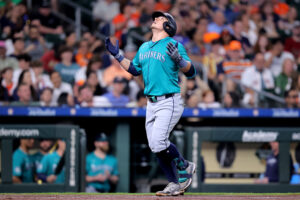
Urias spent the 2024 season with the Mariners but fared poorly in a platoon setup with Josh Rojas. In just 109 big league plate appearances, the former Padres top prospect hit .191/.303/.394. That was the second straight season with a sub-.200 average for Urias. He was an above-average producer in a near full-time role with the Brewers from 2021-22, hitting .244/.340/.426 with 39 homers in 1042 plate appearances, but Urias has seen his strikeout, ground-ball and pop-up rates spike in the two years since that solid run.
Defensively, Urias has more than 1000 innings of big league experience at each of second base, shortstop and third base. Metrics like Defensive Runs Saved and Outs Above Average cast him as a substantially below-average defender at short, however, and the Brewers clearly agreed, moving him off the position permanently back in 2022. He’s been average at second per both DRS and OAA, while the former metric pegs him as plus at third base to the latter’s slightly negative review.
That versatility could also line Urias up to fill a traditional utility role. The A’s currently have light-hitting Max Schuemann and prospect Darell Hernaiz as options for that role on the 40-man roster. Neither has hit in the majors, however, and both have just a year of big league time under their belts (slightly less for Hernaiz, actually) — despite the fact that Schuemann is only eight days younger than Urias.
Martin Gallegos of MLB.com first reported that Urias was in the A’s clubhouse. Ari Alexander of KPRC 2 had the salary and bonuses.
A’s, Mark Kotsay Agree To Extension
9:52am: The A’s announced Kotsay’s extension.
9:42am: The A’s and manager Mark Kotsay have agreed to a three-year contract extension, reports Martin Gallegos of MLB.com. The new contract spans the 2026-28 seasons and gives the A’s a club option over the 2029 campaign. The A’s exercised a 2025 club option on Kotsay back in November, but he was unsigned beyond the current season prior to this new agreement.
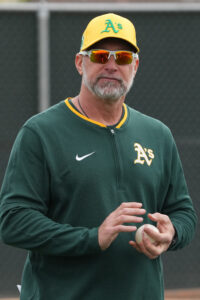
Kotsay, 49, has helmed the A’s since 2022 and was the team’s bench coach and quality control coach for the five prior seasons. He also spent four seasons of 17-year major league career in green and gold — including perhaps the best season of his career, in 2004, when he hit .314/.370/.459 as the Athletics’ everyday center fielder.
Though Kotsay’s managerial record is an ugly 179-307, win-loss records rarely tell the full tale of a manager’s success (or lack thereof). That’s all the more true of a rebuilding club. The A’s have made virtually no effort to field a competitive roster throughout Kotsay’s tenure. The focus has been on culling payroll, acquiring/developing young players and, from a bigger picture standpoint, finalizing the relocation process that’s currently landed them in West Sacramento. The idea is to move to Las Vegas for the 2028 season, which would be Kotsay’s final guaranteed year on the current contract.
Expectations for Kotsay will rise during his second contract with the club. The A’s have spent more on the 2025 roster than at any point in recent seasons, due in part to foster interest with a new temporary fanbase in Sacramento but more so due to the threat of having their status as a revenue-sharing recipient revoked for the second time in the past decade. The A’s have signed Luis Severino, Jose Leclerc, Gio Urshela, T.J. McFarland and apparently Luis Urias in free agency, and they swung a trade to bring left-hander Jeffrey Springs over from Tampa Bay as well. Those acquisitions, plus a five-year extension for slugger Brent Rooker, have added $162MM in new long-term money to the team’s books, including more than $45MM for the upcoming 2025 season.
While the Athletics’ roughly $74MM payroll and $106MM luxury-tax number still sit at or near the bottom of the league overall, it’s still a small uptick from recent seasons; from 2022-24, the A’s ran payrolls between $50-65MM and never reached even an $85MM CBT number.
The new additions will join a burgeoning core of interesting young hitters. The late-blooming Rooker is the Athletics’ lineup cornerstone, but outfielders JJ Bleday and Lawrence Butler have blossomed at the plate, while prospects Jacob Wilson, Zack Gelof and Tyler Soderstrom have shown varying flashes of upside at shortstop, second base and first base, respectively. Shea Langeliers doesn’t get on base much, but his 29 homers in 2024 were second among all major league catchers, trailing only division-rival Cal Raleigh (34) up in Seattle. On the pitching side of things, lefty JP Sears looks like a solid innings eater at the very least, while closer Mason Miller has emerged as one of the game’s premier bullpen arms.
The A’s won’t enter the 2025 season as a favorite in the AL West by any stretch of the word, but they’re in a better position that any point since their latest rebuild kicked off — even though the slate of trades shipping out Matt Olson, Matt Chapman, Sean Manaea, Frankie Montas, Chris Bassitt, A.J. Puk, Lou Trivino and others hasn’t actually yielded many of the club’s current core contributors. (Langeliers came over in the Olson swap; Bleday was acquired for Puk.)
For the time being, the focus in West Sacramento will largely be on coaxing further development from Butler, Bleday, Wilson, Gelof, Soderstrom and looming first baseman of the future Nick Kurtz. Before long, however, the A’s will likely be expected to take a legitimate step forward — particularly if payroll continues to rise ahead of the planned move to the Las Vegas Strip. Ownership has clearly determined that Kotsay is the right person to spearhead those efforts and that such continuity will yield similar gains to the ones enjoyed in 2024, when the A’s improved by 19 games over their 2023 record due largely to improvements from players already in house.
Which Teams Should Still Sign A Free Agent Starter?
Spring training is beginning to kick off around the league, and as is perennially the case, there are a handful of notable free agents still looking for homes. That's of particular importance for the group of starting pitchers who still remain unsigned. Over the years, we've typically (not always) seen late-signing hitters struggle less than late-signing pitchers. Starting pitchers, in particular, seem to benefit from a full, gradual ramp-up rather than the sort of accelerated build that inherently comes with a mid-March signing.
Nick Pivetta stands as the most notable starter who's yet to find a landing spot. He's surely been impacted by the qualifying offer that's hanging over his head. Any team other than the incumbent Red Sox would need to forfeit at least one draft pick (possibly two, depending on CBT status) in order to sign the longtime Boston righty. Others still on the market include veteran mid-rotation or back-end starters Andrew Heaney, Jose Quintana, Kyle Gibson, Cal Quantrill, Ross Stripling, Lance Lynn and Patrick Corbin -- just to name some. (A full list can be seen here.)
This time of year, there's plenty of talk about teams that still need to add an arm. That can take different shapes, however. I wrote about the Mets' rotation for Trade Rumors Front Office subscribers last week, but the Mets aren't necessarily the type of team that needs to go out and add an innings eater to step into the fourth or fifth spot in the rotation. They have myriad options there already. Any addition for them, presumably, would be a clear-cut playoff starter. It's a similar situation with the Orioles, Cubs, Blue Jays and many other postseason hopefuls. Other clubs, like the Tigers and Pirates, have a mostly set group with a bevy of interesting young, MLB-ready top prospects knocking on the door. Signing Quintana or Gibson to eat innings likely isn't in the cards for teams in either of these groups.
At this stage of the offseason, some of those available free agents might need to wait for a spring injury or a trade to create the opportunity they seek. But there are still teams around the league that are rather clearly in need of some steady innings in the Nos. 3-5 spots in the rotation. Let's run through some clubs that have the need and, as crucially, the budget (or lack thereof) to add an established veteran arm to the back of the staff.
Unlock Subscriber-Exclusive Articles Like This One With a Trade Rumors Front Office Subscription
- Access weekly subscriber-only articles by Tim Dierkes, Steve Adams, and Anthony Franco.
- Join exclusive weekly live chats with Anthony.
- Remove ads and support our writers.
- Access GM-caliber tools like our MLB Contract Tracker
The Athletics’ Rotation Options
The A’s entered the offseason with virtually no certainty in their rotation. Despite a host of trades aimed at acquiring pitching help throughout the course of their most recent rebuild, lefty JP Sears was the only prospect acquired who’s stepped up, stayed healthy, and pitched well enough to lock down a rotation job. Sears has hardly been an ace, but 64 starts and 353 innings of 4.46 ERA ball over the past two seasons will play. He’s not an exciting arm, necessarily, but Sears looks like a volume-based fourth starter with good command who’ll average 5 2/3 innings per outing and keep his club in the game more often than not. He’s a starting point.
In the months that have unfolded since, the Sacramento-bound A’s have made a pair of meaningful additions. Luis Severino signed a three-year, $67MM contract and immediately became the team’s top rotation arm upon doing so. Left-hander Jeffrey Springs came over from the Rays not long after, in a trade sending righty Joe Boyle, minor leaguers Jacob Watters and Will Simpson, and a competitive balance draft pick back to the Rays. There’s injury risk with both players — Severino averaged 42 innings per year from 2019-23; Springs missed most of 2024 recovering from UCL surgery — but both are quality arms when healthy. Springs, in particular, quietly turned in ace-caliber results in Tampa Bay from 2021-24.
That pair of additions gives the A’s a set top-three in the rotation, albeit somewhat by default at the moment. General manager David Forst has said he’s open to further additions and is hopeful of adding another starter. That comment came just over a month ago, however, and nothing has come to fruition (nor have there been any real rumblings connecting the A’s to available pitchers).
The A’s very much should add to this group if they’re intent on playing the role of a surprise contender, as many of their offseason dealings suggest. There are still several solid veteran arms available, both via free agency and trade. As things stand, it seems likelier by the day that they stick with what they have in-house. Let’s run through the options.
The Rule 5 Favorite
Mitch Spence, RHP: Spence might not have turned many heads with last year’s performance, but there aren’t too many Rule 5 picks who even make it through a whole season — let alone put themselves into legitimate competition for a rotation job the following year. Spence has done just that. The 26-year-old (27 in May) opened the 2024 season in a long relief role but pushed his way into rotation consideration with a nice start. He wound up making 24 starts and 11 long relief outings, working a total of 151 1/3 innings. Spence turned in a 4.58 ERA with a below-average 19.4% strikeout rate but strong walk and ground-ball rates of 6.8% and 48.4%, respectively.
Unlike many rookie pitchers, Spence didn’t fade down the stretch; he got stronger. That’s surely due in part to the fact that he tossed a hearty 163 innings of Triple-A ball in 2023 prior to being taken by the A’s in the Rule 5. But Spence came out strong in the second half of the 2024 season, looking like a pitcher who’d found his footing. From July 20 through Sept. 17, Spence made 11 starts with a 3.66 ERA. His strikeout and walk rates didn’t make any huge gains, but he was throwing more sinkers and curveballs and getting far more grounders (and yielding fewer homers) as a result. He allowed nine runs in his final nine innings — a sour ending note — but Spence in many ways looked like a right-handed version of Spears.
What’s left of the Rebuild Arms
Ryan Cusick, RHP: The A’s moved Cusick to the bullpen last year and watched him rattle off a 1.73 ERA and 31-to-4 K/BB ratio over his final 26 innings of the season. He’s likely bullpen-bound again, both due to that success and his struggles in the rotation. He’s unlikely to factor into the starting mix this year, but based on his past usage, we’ll include him in case they reverse course. Cusick had a 4.95 ERA, 20.9% strikeout rate and dismal 15.2% walk rate in 100 innings as a starter in 2023.
Joey Estes, RHP: Estes held a rotation spot the vast majority of the 2024 season, making 24 big league starts in addition to one relief appearance. The results weren’t great, though. The former Braves draftee (acquired alongside Cusick, Shea Langeliers and Cristian Pache for Matt Olson) logged a 5.01 ERA with below-average velocity and subpar strikeout, ground-ball and home run rates. Homers have been a problem for Estes even in the minors, but he’s limited walks nicely and at the very least proven himself to be a pretty durable arm. He still has two minor league options remaining.
J.T. Ginn, RHP: Ginn was the more notable of the two prospects the Mets sent to Oakland for Chris Bassitt a few years back. The former second-rounder posted a 4.24 ERA in 34 innings during last year’s MLB debut but has posted an ERA north of 5.00 in all three of his minor league seasons with the A’s. Ginn averaged what these days is a pedestrian 92.9 mph on his sinker and did log a solid 47.4% ground-ball rate while displaying solid command. Even with the trio of rough minor league seasons an lackluster debut, Baseball America ranks him 11th in the A’s system and calls him a potential back-end starter with a high floor but limited ceiling.
Gunnar Hoglund, RHP: Yet to make his big league debut, Hoglund was the headline prospect in the trade sending Matt Chapman to the Blue Jays. He only has five starts above the Double-A level, coming late last year, and they didn’t go that well. His Double-A work was outstanding, however. The former first-rounder pitched 104 2/3 innings with a 2.84 earned run average, 23.4% strikeout rate, 6.3% walk rate, 40% grounder rate and 1.03 HR/9. His stock is down quite a ways since he was the No. 19 overall pick, and he’s unlikely to be in the mix for an Opening Day job — but he could make his debut sometime this summer.
Others on the 40-Man Roster
Brady Basso, LHP: The Athletics’ 16th-round pick in 2019, Basso signed for $75K and has never landed inside the team’s top-20 prospects at Baseball America. They rank him 25th this year after he debuted in 2024 and pitched 22 1/3 innings with a 4.03 ERA, sub-par strikeout numbers, strong command and an average ground-ball rate. Basso dominated Double-A opponents last year before being hit hard in Triple-A and posting middle-of-the-road numbers in a brief MLB debut. Basso, who averaged 92.2 mph on his fastball this past season, still has two minor league option years remaining.
Osvaldo Bido, RHP: Bido made his big league debut as a 27-year-old with the 2023 Pirates and was cut loose after logging a 5.86 ERA in 50 2/3 innings. The A’s signed him to a major league contract last winter, and in 63 1/3 frames he logged a 3.41 ERA with an above-average 24.3% strikeout rate but a rough-looking 10% walk rate. Bido misses bats and induces chases at lower rates than his raw strikeout percentage would suggest. He posted a 4.50 ERA in 10 Triple-A outings last year. He could be a swingman or a fifth starter and has a minor league option remaining.
Jacob Lopez, LHP: Acquired alongside Springs in the Athletics’ trade with the Rays, Lopez will turn 27 in March. He’s a soft-tossing lefty a low arm slot who relies more on deception than on power stuff. Righties have hit him better than lefties but haven’t exactly torched him (.218/.319/.391 in 2024; .197/.316/.343 in 2023). Baseball America ranked him 28th among Rays prospects last year and likened him to a Ryan Yarbrough type of bulk pitcher (behind an opener) or multi-inning reliever.
Hogan Harris, LHP: The A’s took Harris with the No. 85 pick back in 2018. He’s pitched in three Triple-A seasons and posted an ERA north of 6.00 in each. He made his big league debut in 2023 and was similarly rocked for a 7.14 ERA in 63 innings. Ouch. Las year, however, Harris found his most success since he posted a sub-2.00 ERA between High-A and Double-A back in 2022. The 6’3″, 230-pound southpaw posted a terrific 2.86 ERA in 21 big league appearances — nine of them starts — totaling 72 1/3 frames. His 20% strikeout rate, 10.8% walk rate and 37.3% grounder rate were all worse than average. Harris thrived in part due to some good fortune on home runs (8.5% HR/FB) and a 78.9% strand rate he’s not likely to sustain.
Down-the-Road Considerations
Mason Barnett, acquired from the Royals as part of last summer’s Lucas Erceg swap, was outstanding in Double-A post-trade and has become one of the system’s top arms. He could debut this summer but isn’t likely to break camp on the club. Jack Perkins, the Athletics’ 2022 fifth-rounder, hasn’t advanced beyond Double-A but posted a sub-3.00 ERA there last year. He’s a fastball/slider-heavy right-hander with shaky command, evidenced by a huge 32% strikeout rate but 11% walk rate last year.
Left-hander Ken Waldichuk and righty Luis Medina are both technically on the 40-man roster, but not for long. They both had Tommy John surgery midseason — Waldichuk in May, Medina in August — and will be on the 60-day IL when the A’s need roster spots. Waldichuk could make it back late this season. That’s unlikely for Medina.
—
It’s not necessarily a bad collection of depth arms, and names like Barnett, Hoglund, Ginn and Perkins create varying levels of legitimate MLB rotation upside. However, the Athletics’ current contingent of big league arms carries plenty of injury risk, most notably in Severino and Springs, who both recently had notable arm troubles. One injury in the top three, and the group looks increasingly questionable. Between that and the fact that a number of the 40-man options profile best as fifth starters, it’s understandable that the A’s are open to adding some veteran stability and arguable that they should be aggressively seeking it.
The free agent market still has Andrew Heaney, Kyle Gibson, Lance Lynn, Jose Quintana, Spencer Turnbull, Cal Quantrill and — if the A’s can stomach surrendering another draft pick — Nick Pivetta. The trade market includes Marcus Stroman, Jordan Montgomery Taijuan Walker and (to a lesser extent) Steven Matz as salary dump candidates. Chris Paddack could perhaps be had for a modest return.
Poll: Who’s Winning The Offseason In The AL West?
The calendar has flipped to February and the start of spring is just a matter of days away. While some notable free agents (including seven of MLBTR’s Top 50) remain unsigned, most clubs have already done the heavy lifting in terms of preparing their roster for the 2025 season. In the coming days, we’ll be taking a look around the league at which clubs have had the strongest offseason to this point. After the Mets, Cubs, and Dodgers have decisively won the polls covering the National League’s three divisions, the focus now shifts to the American League starting with the AL West.
The junior circuit’s west coast teams have been busy for the most part, perhaps reflecting the division’s tightly contested nature. A three-way race for the AL West came down to the final day of the 2023 season, and despite the Astros’ division title, the Rangers were the ones to be crowned World Series champions. In 2024, Houston’s long reign over the division started showing signs of cracks as they struggled out of the gate, won “just” 88 games (down by their standards) and were bounced from the playoffs in the AL Wild Card Series.
Which team has done the best job setting themselves up for 2024? Teams are listed in order of their 2024 record:
Houston Astros
The winds of change are blowing through Houston, and they’ll enter 2025 with a significantly reshaped roster. The most notable move this winter was to ship star outfielder Kyle Tucker to Chicago ahead of his final season under team control. Losing a player of Tucker’s caliber is always a brutal blow, but Houston did fairly well in the trade. They not only added a new top prospect in third baseman Cam Smith, but they also managed to bring in All-Star third baseman Isaac Paredes and bolster their rotation depth with right-hander Hayden Wesneski.
The additions of Paredes and Wesneski have patched holes left by the departures of Alex Bregman and Justin Verlander in free agency, though the club has apparently not completely closed the door on a reunion with Bregman. Meanwhile, the need at first base caused by Jose Abreu‘s dramatic decline was filled by the addition of three-time Gold Glove winner Christian Walker. Solid as those moves have been, though, the Astros have subtracted more than they’ve added. Ryan Pressly, Yusei Kikuchi, and Jose Urquidy are no longer with the club, and the Astros’ replacement for Tucker as a left-handed outfield bat to this point appears to be a reunion with journeyman Ben Gamel.
Seattle Mariners
Seattle has had the quietest offseason in the division despite typically being one of the most active teams on the trade market. Rumors of a Luis Castillo deal have not come to fruition, and trade targets to bolster the club’s lackluster infield such as Nico Hoerner, Alec Bohm, and Triston Casas have all remained with their current teams. The Mariners’ lack of activity on the trade market has led them to make mostly ancillary moves. As ownership has scaled back the budget substantially, the Mariners have re-signed Jorge Polanco and added Donovan Solano for a combined $11.25MM. Their only other additions have been minor trades for players with minimal big league experience like Austin Shenton and Miles Mastrobuoni.
Texas Rangers
The Rangers’ front office has had a tall order placed in front of them this winter: navigate under the luxury tax while supplementing an offense that struggled last year and completely rebuilding a pitching staff that saw seven major pieces reach free agency. They’ve most succeeded in those goals. Robert Garcia, Chris Martin, Jacob Webb, Shawn Armstrong, and Hoby Milner were all brought in to help patch up one of the league’s weaker bullpens. The club parted with first baseman Nathaniel Lowe to bring Garcia into the fold, but his bat has been effectively swapped out for free agent pickup Joc Pederson and trade acquisition Jake Burger in trade.
Meanwhile, the club added some pop behind the plate by pairing Kyle Higashioka with Jonah Heim after Heim struggled through a down season offensively last year. The Rangers managed to keep Nathan Eovaldi on a three-year deal despite the soaring cost of starting pitching. Whether these additions will be enough to make up for the losses of Lowe, Kirby Yates, David Robertson, Jose Leclerc, Andrew Heaney and Max Scherzer remains to be seen.
Athletics
After shuttering the Coliseum and departing Oakland for a temporary stay in West Sacramento, the A’s have begun to spend more aggressively than they have in years. The club locked up breakout slugger Brent Rooker for the next five seasons on a $60MM extension and has been active both the trade and free agent markets. The A’s signed Luis Severino to a club-record three-year, $67MM deal while also agreeing to deals with third baseman Gio Urshela, former Rangers closer Jose Leclerc and lefty T.J. McFarland. On the trade market, they added southpaws Jeffrey Springs and Jacob Lopez in a deal with the Rays that saw them surrender Joe Boyle, their Competitive Balance Round A pick, and two prospects.
Los Angeles Angels
After narrowly avoiding the first 100-loss season in franchise history, the Angels were heavily active in the early stages of the offseason. They acquired slugger Jorge Soler in a trade with the Braves on day one of the offseason, surrendering only non-tender candidate Griffin Canning. They added Scott Kingery in a cash swap with the Phillies shortly thereafter. The early days of free agency brought deals for Yusei Kikuchi, Travis d’Arnaud, Kyle Hendricks, and Kevin Newman.
Things have been mostly quiet in Anaheim since that flurry of moves back in November, and it will surely take a strong, healthy season from Mike Trout in addition to steps forward for multiple youngsters if the Angels are going to contend for the postseason in 2025.
__________________________________________________________
The AL West appears to have moved towards parity somewhat this winter. The Astros have sacrificed maximizing their immediate odds at continued dominance in the name of longer-term stability. The Mariners opted to keep their elite rotation together rather than risk breaking up the group to strengthen a mediocre lineup. The Rangers have been very active in reshaping their roster in hopes of recapturing the glory of 2023, while the fourth- and fifth-place A’s and Angels have been surprisingly aggressive in their efforts to separate themselves from the AL’s cellar dwellers.
Of the five AL West clubs, which one has had the strongest offseason so far? Have your say in the poll below:
Which AL West team has had the best offseason so far?
-
The Athletics 30% (2,576)
-
Texas Rangers 28% (2,391)
-
Houston Astros 19% (1,601)
-
Los Angeles Angels 15% (1,242)
-
Seattle Mariners 8% (643)
Total votes: 8,453