
Mets Claim Drew Romo, Designate Brandon Waddell
The Mets have claimed catcher Drew Romo off waivers from the Orioles and, in a corresponding move, designated left-hander Brandon Waddell for assignment, per a team announcement. Baltimore designated Romo for assignment last week.
The 24-year-old Romo was the No. 35 overall draft pick by the Rockies back in 2020 and previously ranked not only as one of Colorado’s best prospects but one of the top 100 prospects in Major League Baseball. He’s a well-regarded defender with a cannon of an arm, but Romo’s bat stalled out after a solid 2023 season split mostly between High-A and Double-A. His offensive output has declined in consecutive seasons. After a league-average offensive showing at Triple-A in 2024, his bat dwindled in 2025 as his strikeout rate ballooned from 17.8% to 25.8%.
Romo has gotten some brief looks in the majors with the Rox but has just 56 plate appearances under his belt. He’s a .167/.196/.222 hitter with a 37.5% strikeout rate in that minuscule sample. Romo carries a solid-looking .286/.337/.466 slash in parts of three Triple-A seasons, but that’s propped up a bit by his stronger 2024 performance. In 2025, he hit .264/.329/.409 with the Rockies’ top affiliate. Again, that looks solid on the surface, but given the immensely hitter-friendly environments in the Pacific Coast League — Albuquerque, in particular — Romo was actually 25% worse than a league-average hitter, by measure of wRC+.
Romo still has a pair of minor league option years remaining, so he’ll give the Mets some flexible depth behind the plate. He has a long way to go in terms of offensive development, but a good defender with a plus arm is a nice third or fourth catcher to be able to stash in Triple-A alongside Hayden Senger. Francisco Alvarez, of course, is the starter in Queens and is slated to be backed up by journeyman Luis Torrens in 2026.
Waddell, 31, tossed 31 1/3 innings with the Mets in 2025 — his first big league look since 2021. That came on the back of a three-year stint with the Doosan Bears of the Korea Baseball Organization, where he generally pitched well out of the Bears’ rotation. Waddell’s MLB return produced a nice 3.45 ERA, though his poor strikeout rate (16.4%), good-not-great command (8.2% walk rate) and good fortune in terms of both strand rate (82%) and balls in play (.260 BABIP) caused metrics like SIERA (4.64) and FIP (4.54) to take a more bearish outlook.
Waddell is out of minor league options. He sat 90.7 mph with his four-seamer last year and coupled the pitch with a sinker of comparable velocity and a changeup and slider in the low 80s. The former fifth-rounder out of the University of Virginia tossed 244 2/3 innings of 2.98 ERA ball during his time in the KBO and also had a nice 12-start run in Taiwan’s CPBL in 2023. He’s spent parts of five seasons pitching in Triple-A and has an ERA north of 5.00 there, although that was skewed by a 2019 season in which he yielded 59 runs in 61 frames. He’s posted a 4.22 ERA at the Triple-A level since.
Waddell will be traded to another club or placed on outright waivers within the next five days. Waivers are a 48-hour process. His DFA will be resolved within a week’s time.
Poll: Should The Mets Trade Mark Vientos?
After losing Pete Alonso to the Orioles in free agency and trading Brandon Nimmo to the Rangers, the Mets will need to reconfigure their lineup in a big way this winter. They’ve already added some of the pieces with which they’ll try to do that, bringing in Marcus Semien as the return for Nimmo and following that up by signing Jorge Polanco, but there’s clearly more work to do. It’s with that backdrop that reporting yesterday indicated the Mets could look to trade infielder Mark Vientos this winter, perhaps while eyeing the addition of a big bat to the lineup.
Trading Vientos certainly has some merit. The 26-year-old was a merely league average hitter by the numbers this year, with a 97 wRC+ thanks to his 40 extra-base hits (including 17 homers) propping up a paltry .289 on-base percentage. That sort of production won’t cut it for a poor defensive third baseman who figures to get the majority of his playing time at first base or DH next year, but his youth and power potential could still be enough to catch the eye of some teams in need of right-handed pop in their lineup, with the Mets perhaps getting some pitching back in return.
With that being said, trading Vientos wouldn’t come without risk. Still in his mid-20s, Vientos has already demonstrated the ability to potentially be an All-Star caliber bat. In 2024, he slashed .266/.322/.516 (132 wRC+) with 27 homers in 111 games. It was a strong enough performance to play as a regular at first base or overlook his defensive deficiencies at the hot corner. If the youngster can rediscover that form, he would offer the Mets a major boost. After all, the Mets themselves need additional righty pop in the lineup after losing Alonso. Letting their veteran slugger walk was already tough for fans to stomach and it would surely get even worse if Alonso’s heir apparent was traded away and broke out somewhere else.
How likely is a return to form for Vientos? The underlying metrics are mixed. Vientos didn’t live up to his expected numbers last year, which could be a sign that some positive regression is on the way. He actually lowered his strikeout rate substantially, dropping from 29.7% in 2024 to just 24.8% this year. Those are good signs and his .277 BABIP this season seems likely to improve going forward. With all of that being said, however, there are certainly some red flags. While his BABIP is likely to improve from last year, it’s unlikely to reach the level of his .324 mark from 2024. While his strikeout rate dropped by nearly five points, his once-elite barrel rate dropped by nearly three. In all likelihood, his true talent level lies somewhere between his weak 2025 and his impressive 2024.
The question then becomes about which side of the spectrum Vientos is more likely to fall on. If he figures to offer a bat with a wRC+ of 120 or greater on a consistent basis going forward, that would be hard to part with for a team in need of right-handed power like the Mets. With that said, if Vientos is more likely to be just a touch better than league average this year, it would be fair to wonder if the Mets would be better off focusing on adding a more impactful player like Kazuma Okamoto and Munetaka Murakami to the first base/DH mix.
Perhaps going with a free agent hitter in Vientos’s place and turning Vientos into a trade chip for pitching would be a smart call. Despite his uneven performance, other clubs would surely be interested in him, especially since he’s cheap. He has not yet qualified for arbitration and can be controlled for four full seasons before he’s slated for free agency.
With that said, it’s also worth considering how a more expensive addition like Okamoto or Murakami could impact the Mets’ ability to pursue an impactful outfielder. Cody Bellinger has been tied to the Mets frequently this winter, and while the rumors connecting the club to Kyle Tucker haven’t been nearly as ubiquitous, the possibility of a deal there is worth considering given the club’s need for outfield help and the small numbers of teams that could realistically meet his rumored asking price. If sticking with Vientos gave the Mets a better shot to land a big outfield bat, then perhaps the club would be better off keeping Vientos in the fold and trying to deal other young players and prospects for pitching help.
How do MLBTR readers think the Mets should proceed with Vientos? Should they keep him, risking an underwhelming 2026 season in order to keep their focus on improving the outfield in free agency? Or should they trade him and risk a breakout elsewhere in order to add more certainty to the lineup? Have your say in the poll below:
Should The Mets Trade Mark Vientos This Winter?
-
Yes 62% (3,506)
-
No 38% (2,172)
Total votes: 5,678
MLBTR Podcast: The Mets Sign Jorge Polanco, And The Braves, Blue Jays And Royals Make Moves
The latest episode of the MLB Trade Rumors Podcast is now live on Spotify, Apple Podcasts, and wherever you get your podcasts! Make sure you subscribe as well! You can also use the player at this link to listen, if you don’t use Spotify or Apple for podcasts.
This week, host Darragh McDonald is joined by Steve Adams of MLB Trade Rumors to discuss…
- The Mets signing Jorge Polanco (2:40)
- The Braves making three signings: Robert Suarez, Mike Yastrzemski and Ha-Seong Kim (17:15)
- The Blue Jays signing Tyler Rogers and Cody Ponce (31:40)
- The Royals extending Maikel Garcia, signing Lane Thomas and trading Ángel Zerpa to the Brewers for Isaac Collins and Nick Mears (46:10)
- The Tigers making three signings: Kenley Jansen, Kyle Finnegan and Drew Anderson (57:25)
Check out our past episodes!
- Winter Meetings Recap – listen here
- An Agent’s Perspective with B.B. Abbott – Also, Cease, Williams, Helsley, And Gray – listen here
- Some “Classic Baseball Trades,” Nimmo For Semien, And Ward For Rodriguez – listen here
The podcast intro and outro song “So Long” is provided courtesy of the band Showoff. Check out their Facebook page here!
Photo courtesy of Nick Turchiaro, Imagn Images
Mets Sign Jorge Polanco
December 16th: The Mets have now officially announced the Polanco deal.
December 13th: The Mets and free agent infielder Jorge Polanco have agreed to a two-year contract, The Athletic’s Will Sammon reports (multiple links). The deal is worth $40MM, according to ESPN’s Jeff Passan. Polanco is represented by the Octagon Agency.
It’s a big strike for a Mets team that lost Pete Alonso and Edwin Diaz to free agency just within the last week, not to mention last month’s trade that sent another longtime Met in Brandon Nimmo to Texas. New York acquired Marcus Semien in the Nimmo deal, and while Polanco also has a long history of playing second base, Passan writes that the Mets will deploy Polanco primarily as a first baseman and DH. Polanco could also potentially chip in at third base, though it looks as it the Mets view Polanco a piece of the puzzle in replacing Alonso at first base.
The 32-year-old Polanco hit .265/.326/.495 with 26 home runs over 524 plate appearances for the Mariners last season, playing a huge role for a Seattle team that won the AL West and fell just short of reaching the World Series. It was a fine bounce-back performance for Polanco after a down year in 2024, which still resulted in a one-year guarantee to return to the Mariners in 2025. That deal paid Polanco $7.75MM in guaranteed money, and he made enough plate appearances to turn an $8MM mutual option for 2026 into a $6MM player option, and Polanco unsurprisingly rejected that player option to re-enter the market after his much improved platform year.
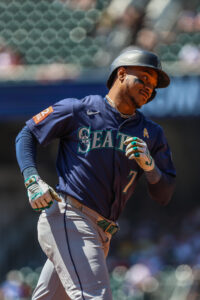
The 132 wRC+ Polanco posted in 2025 was the highest of his career, and he drastically cut back on his strikeouts after seeing his K% balloon in each of the previous four seasons. While Polanco walked less than usual, his 45.8% hard-hit ball rate was a career best. Overall, the advanced metrics suggest that Polanco’s resurgence in 2025 was legitimate, and if anything, his .269 BABIP indicates that he perhaps deserved even better numbers.
One concern within Polanco’s otherwise strong year was that he made 89 appearances as a designated hitter, after amassing only 45 DH days over his 11 previous big league seasons. Polanco sustained an oblique injury early in the 2025 season that wasn’t quite serious enough to merit a trip to the injured list, but the Mariners compensated by using Polanco less frequently in the field, and cut back on the switch-hitter’s usage against left-handed pitching.
While there hasn’t been any concern that Polanco will be similarly limited going forward, the Mets’ plan to use him as a first baseman may also reflect Polanco’s age, his modest defensive numbers as a second or third baseman, and the fact that a stellar fielder like Semien is already in place at the keystone. Throughout his long pro career, Polanco has made exactly one career appearance as a first baseman, and it was just a late-game cameo for a single at-bat in Seattle’s 5-4 loss to the Giants last April 6.
Polanco is an experienced enough infielder that the Mets obviously feel he’ll be able to learn the position in due course. For all of Alonso’s pluses at the plate, he was a poor enough fielder that Polanco will be a defensive upgrade even if he’s just an average first baseman. Because the DH spot is open and because Polanco could also be utilized at third base, this signing also doesn’t necessarily close the door on the Mets’ chances of signing other known targets like Cody Bellinger or even a more first base-specific player like the Cardinals’ Willson Contreras.
Between losing both Alonso and Nimmo, the Mets’ offense has taken a hit by essentially replacing the duo with Polanco and Semien, given how Semien struggled in 2025. Run prevention has been a stated goal for Mets president of operations David Stearns, and upgrading the defense is another way of making the lineup better, even if the team will still need to add some more pop as the offseason develops.
MLB Trade Rumors ranked Polanco 23rd on our list of the offseason’s top 50 free agents, and projected a three-year, $42MM deal for the veteran. Polanco ended up just about matching that dollar figure on a two-year deal, as he opted for the higher average annual value rather than the extra security of the three-plus years he was seeking in his next deal.
The shorter term lines Polanco up for another free agent bid when he’s 34, and some continued production could line him up for another lucrative shorter-term pact. Stearns is known to prefer shorter-term commitments for free agents, so this also aligns with the PBO’s ideal method of roster-building.
The Pirates and Red Sox were known to have interest in Polanco this winter, and the infielder was also drawing a lot of attention from the Mariners about a possible reunion. Adam Jude of the Seattle Times hears from a source that the Mariners’ last offer to Polanco was also a two-year contract, and was “very competitive” price-wise with the Mets’ $40MM offer.
Seattle achieved its top offseason priority of re-signing Josh Naylor, and the team’s plan was then to explore Polanco and Eugenio Suarez as candidates to return. With Polanco now in Queens, the Mariners could turn to Suarez as a DH candidate and part-time third baseman, or explore some other infield options on the free agent or trade fronts. With plenty of internal candidates for third base, the M’s have been primarily looking at second basemen during their infield pursuits this winter.
Inset picture courtesy of Jordan Godfree — Imagn Images
Mets Making Mark Vientos Available In Trade Talks
The Mets are informing teams that corner infielder/designated hitter Mark Vientos is available in trade conversations, writes Jorge Castillo of ESPN. That aligns with reporting from Will Sammon of The Athletic, who wrote last night that the Mets were willing to discuss each of Vientos, Ronny Mauricio and Luisangel Acuña.
Vientos looked like a lineup building block at this time last year. The righty-hitting infielder was coming off a 27-homer season in which he’d hit .266/.322/.516 across 454 regular season plate appearances. He was even better in the playoffs, blasting five homers and a pair of doubles while hitting .327 across 13 games. Vientos was a huge reason the Mets made it to the 2024 NL Championship Series. He would have been the heir apparent at first base had Pete Alonso found a robust enough market to price him out of Queens.
Instead, Alonso returned on a short-term deal. That came shortly after the Mets had re-signed Jesse Winker as their designated hitter against right-handed pitching. Vientos moved back to third base, where he has never been a good defender. The numbers were predictably ugly. Defensive Runs Saved had him 10 runs below average in just 556 innings. Statcast had him at six runs below par.
Defensive struggles were to be expected. More surprising is that Vientos’ bat also significantly regressed. He only hit 17 homers with a .233/.289/.413 slash line in a similar amount of playing time as he had in 2024. The underlying numbers were more encouraging. Vientos made hard contact (an exit velocity of 95 MPH or higher) on half his batted balls. He cut his strikeout rate by five percentage points from an alarming 29.7% clip.
He probably didn’t change all that much as a hitter, but the regression suggested his ’24 level of play wasn’t sustainable either. Vientos had a career-high .324 average on balls in play that year. Among hitters with 400+ plate appearances, only Aaron Judge and Shohei Ohtani had seen a higher percentage of their fly balls clear the fences. Vientos has big power but was unlikely to keep that kind of company. As is often the case, his true talent likely lies somewhere in between his numbers of the last two years. He’s an annual threat for 25+ home runs but has a worrying enough plate discipline and contact profile that he’s not going to post strong on-base percentages.
Alonso’s free agent departure opens the door for Vientos to carve out regular first base or DH reps with the Mets. He shouldn’t get much playing time at third base anymore, as the Marcus Semien acquisition pushed Brett Baty firmly to the hot corner. The Mets are in agreement with Jorge Polanco on a two-year, $40MM contract and intend to play him mostly at first base. Polanco’s history of knee issues suggests he’ll probably need a decent number of DH at-bats. They could keep Vientos and have him split playing time with Polanco between those positions.
However, Sammon wrote last night that the Mets are kicking around possibilities to add another bat-first player. Acquiring a left fielder might not impact Vientos’ path to playing time, but bringing in a traditional first baseman or DH would push him out of the projected lineup. He’s out of minor league options, so a trade would seem almost inevitable at that point.
The Mets reportedly discussed Vientos with teams going back to the trade deadline. He was linked to the White Sox as the Mets kicked the tires on Luis Robert Jr., though New York balked at that framework. Robert suffered another injury shortly after the deadline and is now set to make $20MM. It’d be a surprise if the Mets give up four years of control over Vientos for him, even though they could still use a better center fielder than Tyrone Taylor to bridge the gap to prospect Carson Benge.
Acuña and Mauricio have also found themselves in trade rumors for months. Both players’ stocks are down. Acuña, 24 in March, is a good defensive infielder but owns a .248/.299/.341 line in 233 MLB plate appearances. He hasn’t hit much at the Triple-A level either and is out of options. Maybe another team thinks he’d be a Gold Glove caliber shortstop who can fit at the bottom of a lineup, but he increasingly looks like a utility player.
Mauricio is approaching his 25th birthday and coming off a .226/.293/.369 showing over 184 plate appearances. He’s a switch-hitting infielder with huge power but significant plate discipline questions. Mauricio debuted at the end of the 2023 season and missed the entire ’24 campaign after tearing his right ACL in winter ball. He still has an option remaining and is a boom or bust player who probably fits better on a non-contending team that can live with inconsistency at the plate.
Dodgers Sign Edwin Diaz
December 15th: The deal also contains a condition club option for 2029, reports Jon Heyman of The New York Post. That option has a $6.5MM base, with Diaz able to earn an extra $750K for 45 games finished and 50 games finished, plus another $1MM for 55 games finished. The specific conditions for the option aren’t known but Alden González of ESPN reports that it would be available to the Dodgers if Diaz spends a certain amount of time on the injured list.
December 12th: The Dodgers officially announced the signing today.
December 9th: For the second straight offseason, the Dodgers are signing the top relief arm on the market. They’ve reportedly agreed to a three-year, $69MM contract with now-former Mets closer Edwin Diaz. It’s a record-setting annual value for a reliever, breaking the $20.4MM record that Diaz himself already held. Diaz’s contract with the Dodgers contains $4.5MM in deferred salary annually. The net-present value, for luxury tax purposes, is roughly $21.1MM.

Diaz, a Wasserman client, returned to the open market this winter when he opted out of the final two seasons of the precedent-setting five-year, $102MM contract he signed with the Mets the last time he was a free agent. The right-hander had been guaranteed $38MM over the final two seasons of that contract, so by opting out and testing the market, he secured himself an additional one year and $31MM in guarantees. The Mets, according to Joel Sherman of the New York Post, offered Diaz a three-year, $66MM deal with “slight” deferrals.
The 31-year-old Diaz (32 in March) has spent the past seven years in Queens and, after a rocky first campaign, has turned in a collective 2.36 ERA (2.12 SIERA, 2.15 FIP) with a mammoth 40.8% strikeout rate and 8.9% walk rate. He’s piled up 144 saves in 332 appearances as a Met.
For the Dodgers, Diaz represents the most on-the-nose means of addressing a problem that nearly doomed them in the postseason: a lack of reliable bullpen help. Injuries to Evan Phillips, Tanner Scott, Brusdar Graterol and others left the Dodgers with a thin enough stock of trustworthy relievers that L.A. turned to Blake Snell, Tyler Glasnow and Yoshinobu Yamamoto (one day after he threw nearly 100 pitches) in pivotal high-leverage settings during their World Series run. That they even progressed to the World Series was largely attributable to historic performances from starters Yamamoto, Snell, Glasnow and Shohei Ohtani in the postseason’s earlier rounds.
The Dodgers have now signed the top reliever on the market in consecutive offseasons. They inked Tanner Scott to a four-year, $72MM pact last winter, though that deal contained $21MM worth of deferred money, thus knocking down the present value. Scott’s first year in L.A. didn’t go at all as hoped; he limped to a 4.74 ERA with improved command but lesser velocity and strikeout rates. After yielding 11 home runs in the 2022-24 seasons combined, Scott served up 11 round-trippers in his first season as a Dodger.
Certainly, they’ll hope for better results with Diaz, whose track record is lengthier and steadier than that of Scott. While he’s naturally had some year-to-year variance in his earned run averages — as is the case for any reliever — Diaz has been at 3.52 or better in each of the past five seasons, including three sub-2.00 campaigns. He’s punched out at least 34.6% of his opponents each season along the way, and since a shaky walk rate in 2021, he’s sat between 7.7% and 9.3% in that regard for four straight seasons.
That’s not to say there aren’t any red flags at all with regard to Diaz. His average fastball velocity has dipped in two consecutive seasons. While this past season’s average of 97.2 mph was still well above average, it’s also two miles per hour shy of Diaz’s 2022 peak. He also gave up considerably more hard contact. Diaz’s 88.5 mph average exit velocity and 39.7% hard-hit rate were both the second-highest marks of his career, trailing only his disastrous 2019 season (his first as a Met). Neither is a glaring issue, particularly considering Diaz maintained elite strikeout and swinging-strike rates (38% and 18%, respectively), but he’ll want to avoid allowing those negative trends to continue, however slight they may currently be.
Diaz will slot into the ninth inning, pushing Scott to a setup role alongside Alex Vesia, Blake Treinen, Anthony Banda, Brock Stewart and Graterol. Will Klein, Ben Casparius and Jack Dreyer all had solid or better seasons in 2025, but if everyone is healthy — far from a given — there’s only room for one of that trio in the final bullpen spot. Of course, injuries will inevitably create opportunities for many of the Dodgers’ overqualified depth arms, and each of Klein, Casparius, Dreyer and Edgardo Henriquez have minor league options remaining.
The Dodgers have paid the luxury tax in (more than) three consecutive seasons and are more than $60MM over the $244MM first-tier luxury threshold, meaning they’ll pay a 110% tax on the AAV on Diaz’s contract. However the annual salaries break down, he’ll cost them an additional $25.3MM in taxes alone. Assuming an evenly distributed $23MM per season, RosterResource, now projects next year’s Dodgers payroll at just over $359MM (although that does not account for substantial deferrals to Ohtani, Scott, Freddie Freeman, etc.).
The Mets would have been subject to those same penalties had they matched or topped this offer. Diaz reportedly entered the market seeking a five-year contract. When that didn’t materialize, he clearly pivoted to a record-setting, shorter-term arrangement. The extent of the deferrals in New York’s offer aren’t yet clear, but there’s no indication (yet, anyway) that the Dodgers’ offer includes any deferred money.
While New York couldn’t have known when signing Devin Williams to a three-year, $51MM pact that Diaz would also sign for three years and a total of $18MM more, the results from those two high-end relievers will now be carefully watched by Mets fans for the next three seasons. If Williams returns to form, it’ll look like a savvy pivot to get a comparable reliever at a lesser rate. If not, there will be plenty of second-guessing and criticism from the fan base.
Of course, owner Steve Cohen also clearly has the resources to have simply won the bidding on both relievers, but that’s ultimately not the route the front office chose. They’ll now look to other avenues as they seek to continue adding to the bullpen. The Mets were open to re-signing Diaz even after adding Williams, and while this deal clearly went past their comfort zone, there are other high-end arms still available — Robert Suarez, most notably. Choosing to let Diaz walk also frees up further resources for a potential re-signing of Pete Alonso or perhaps a run at another target of note.
The Mets bid farewell to Diaz, who rejected a $22.025MM qualifying offer, with only minimal compensation for his departure. Due to their status as luxury tax payors, they’ll receive a compensatory draft pick after the fourth round of next summer’s draft. The Dodgers, meanwhile, will surrender their second- and fifth-highest selections in next year’s draft. The league-allotted cap on their personal spending pool for international amateur free agents will also be reduced by $1MM.
Such considerations tend to be ancillary for the market’s top-spending clubs. Perennial luxury payors consider them the cost of doing business in the deepest waters of the free agent pool. The Dodgers have punted draft picks to sign Shohei Ohtani and Freddie Freeman (among others) in recent seasons. For them, the allure of adding a closer with nearly unrivaled dominance takes precedence as they try to assemble a roster capable of winning three consecutive World Series for the first time since the 1998-2000 Yankees.
The Athletic’s Will Sammon first reported the agreement. Sammon and colleague Ken Rosenthal were also the first to report the three-year term. ESPN’s Jeff Passan broke the total guarantee. Joel Sherman and Jon Heyman of the New York Post reported the Dodgers’ emerging interest in Diaz shortly before the agreement became public. Sherman reported on the deferrals.
Mets, Cristian Pache Agree To Minor League Deal
The Mets have agreed to a minor league contract with outfielder Cristian Pache, reports Pat Ragazzo of Mets On SI. He’ll be in major league camp as a non-roster invitee next spring. Pache is represented by the MVP Sports Group.
Pache, 27, was once considered one of the sport’s top outfield prospects during his earlier days in the division-rival Braves organization. He’s long been touted as a plus-plus defender in center field — a rangy outfielder with good speed and solid raw power but a shaky hit tool that didn’t allow him to get to that pop often enough.
That lack of hit tool has indeed held Pache back. Atlanta traded him to the Athletics as one of four players in return for first baseman Matt Olson, and he’s since bounced to the Phillies, Orioles and Marlins organizations. Pache hasn’t hit in the majors during any of his stops. He’s taken 610 plate appearances at the MLB level and carries just a .181/.243/.275 batting line with a troublesome 30.8% strikeout rate. He has indeed strong defensive grades, but Pache hasn’t hit enough to even profile as a viable fourth outfielder in the majors.
Pache’s numbers in the upper minors have been better but are still lackluster, particularly considering how hitter-friendly most of the environments in which he’s played have been. In parts of five Triple-A seasons, Pache carries a .257/.332/.397 batting line. He spent the 2025 season with the D-backs’ top affiliate in Reno, hitting .251/.351/.389 in 288 plate appearances. That looks decent on the surface, but in that exorbitantly hitter-friendly setting, it’s actually about 20% worse than league-average production, by measure of wRC+.
In many ways, Pache is an even more extreme version of Tyrone Taylor, who’s already on the Mets’ big league roster. Both are right-handed hitting center fielders with questionable bats and strong gloves, but while Pache is the better defender of the two, his bat is even lighter than that of Taylor (who hit .223/.279/.319 with the Mets in 2025).
Pache is out of minor league options, so if he’s added to the big league roster at any point, he’d need to stick or else be designated for assignment and passed through waivers. He gives the Mets some versatile outfield depth, but there are enough offensive question marks surrounding him that he profiles mainly as glove-first insurance in the event of multiple injuries at the big league level.
Phillies, Mets, Padres, Pirates Interested In Luis Robert Jr.
TODAY: The Phillies also had recent interest in Robert, as per The Athletic’s Ken Rosenthal and Will Sammon, continuing Philadelphia’s explorations in a Robert deal back at the trade deadline. Robert’s right-handed bat would be a nice complement to lefty-swingers Brandon Marsh and Justin Crawford in the Philadelphia outfield, and having an experienced center field option like Robert provides the Phillies cover if Crawford isn’t quite ready for prime time as he makes his MLB debut.
DECEMBER 13: Last month, the White Sox picked up their $20MM option on Luis Robert Jr. General manager Chris Getz signaled that the club planned on Robert being their starting center fielder in 2026. That has not stopped clubs from inquiring on his availability in trade talks, as Francys Romero of Beisbol FR reports that the Mets, Padres, and Pirates have expressed interest in acquiring Robert.
The 28-year-old batted .223/.297/.364 with an 84 wRC+ across 110 games for the White Sox this year. His first half was particularly brutal, as he only hit .185/.270/.313 with a 63 wRC+ in 70 games through June 25, when he incurred a left hamstring strain that would send him to the injured list a few days later. Robert was striking out in 30.9% of his plate appearances, only marginally improved from his 33.2% rate last year. He did have a 10.2% walk rate, but for the most part, he was continuing an offensive decline that started with an 84 wRC+ season in 2024.
His second half was a clear improvement. Robert returned from the IL on July 8 and batted .293/.349/.459 with a 124 wRC+ in his next 146 plate appearances. After experiencing poor batted ball luck in the first half of the season (.245 BABIP), he benefited from positive regression upon his return (.317 BABIP). He also dropped his strikeout rate to 16.4% in the second half, bringing that mark down to 26.0% on the season. His rebound was enough for the White Sox to hold onto Robert at the deadline, despite interest from several clubs. Unfortunately, he suffered another left hamstring strain and was placed on the IL in late August, which ultimately ended his season.
The end result was a season worth 1.3 WAR according to FanGraphs. Looking at the bigger picture, it’s clear that Robert has fallen from the height of his 2023 season, when he posted a 129 wRC+ and hit 38 home runs in a career-high 145 games while earning an All-Star nod. That was the fourth season of a six-year, $50MM extension that Robert had signed in January 2020, which was then a record for a player who had not yet debuted in the majors. Robert’s production from 2020-23 made it look like a good deal, but his drop-off in 2024-25 (second-half rebound notwithstanding) made the $20MM club option for 2026 look a lot more expensive.
In the end, the team picked up the option in lieu of paying Robert a $2MM buyout. On the surface, that $18MM net amount was a lot for an injury-prone player who had posted below-average offense for two years, especially for a rebuilding club. The move may have been motivated by the lack of standout center fielders in free agency. Trent Grisham had a strong year in 2025 but accepted the qualifying offer rather than test the market. Cody Bellinger is still available, but he is a corner outfielder at this stage of his career. Harrison Bader is an exceptional defender and will do well on a multi-year deal, although his career-best offensive showing in 2025 was partly the product of good batted ball fortune (.359).
The club is hoping that Robert will have a decent offensive showing in 2026, which would make him a solid trade candidate at next year’s deadline. Still, it’s not surprising to see teams doing their due diligence now, despite Getz’s earlier comments. Eight teams were interested in Robert at this year’s deadline, including the Mets and Padres. The Mets mostly used Tyrone Taylor in center in 2025, but he only posted a 70 wRC+ in 341 plate appearances. They attempted to upgrade by trading for Cedric Mullins, but he himself posted a 66 wRC+ in 143 plate appearances and departed for the Rays in free agency. The club has prospect Carson Benge knocking on the door. A trade for Robert would be affordable for a high-payroll club and would give them an everyday center fielder if they want to ease Benge into the majors.
The Padres and Pirates are more curious fits. The former has Jackson Merrill firmly entrenched in center. He is coming off a 3.0 fWAR season and signed an extension in April that will guarantee him $135MM through 2034. Robert could be an upgrade at DH, but that wouldn’t be the best use of him since he is still a solid defender, posting 7 OAA in center in 2025. RosterResource currently pegs San Diego for a $201MM payroll in 2026, compared to $211MM this year. Team chairman John Seidler recently indicated that the team will operate at around the same level of payroll. They would need the White Sox to cover at least half of Robert’s salary to facilitate an offseason trade, and that’s before leaving room for other additions.
Meanwhile, the Pirates have shown an increased willingness to spend this offseason. They made an $80MM offer to Josh Naylor and were willing to pay Kyle Schwarber $120-$125MM before he re-upped with the Phillies. That said, Robert is obviously not on the same level as Naylor or Schwarber. Pittsburgh also has Oneil Cruz under control through 2028. Like Robert, Cruz had a below-average offensive showing in 2025 (86 wRC+), but Cruz is much more affordable, with a projected $3.6MM salary in his first turn through arbitration compared to Robert’s guaranteed $20MM. Pittsburgh may just be doing their due diligence, though the likeliest outcome is that Robert stays put in Chicago through the offseason.
Photo courtesy of Matt Marton, Imagn Images
Mets Sign Daniel Duarte To Minor League Contract
The Mets signed right-hander Daniel Duarte to a minor league deal, as first noted on Duarte’s MLB.com profile page earlier this week. Duarte spent the 2025 season on a minors contract with the Twins but didn’t pitch while recovering from a May 2024 UCL revision surgery.
A veteran of three MLB seasons, the bulk of Duarte’s 38 1/3 career innings came as a member of the Reds bullpen in 2023, when he tossed 31 2/3 frames across 31 games. Duarte has a respectable 3.99 ERA across his limited time in the Show, though with only a 17% strikeout rate and a troublingly comparable 14.5% walk rate. An extreme groundball pitcher early in his minor league career, Duarte still has a 47.3% grounder rate in the majors, but batters have capitalized when they’ve been able to get the ball in the air — Duarte has given up seven homers across his 38 1/3 career innings.
It remains to be seen how Duarte will look after such a long absence, though his return to the mound in Mexican winter league play this offseason has resulted in 19 2/3 scoreless innings. A 5.71 BB% and 21.43% strikeout rate are further steps in the right direction.
New York was impressed enough to extend a contract to the 29-year-old, and Duarte will get a chance to show the team his progress first-hand during Spring Training. There’s no risk for the Mets in bringing Duarte and several other pitchers to camp on minors deals, and there figures to be plenty of opportunity given how the Mets so often cycle relievers up and down between Triple-A and the active roster. Duarte has a minor league option year remaining, so this gives up some advantage over out-of-options players in the competition for roster spots.
Mets’ Trade Talks With Padres Involve Nick Pivetta, Ramon Laureano, Mason Miller
The Mets and Padres have been discussing the possibility of a trade that would send established talent to New York while San Diego obtained MLB-ready younger talent and some salary relief. According to The Athletic’s Ken Rosenthal, Dennis Lin, and Will Sammon, right-hander Nick Pivetta, outfielder Ramon Laureano, and star relievers Mason Miller, Adrian Morejon and Jeremiah Estrada are players of interest for New York. The Padres have shown interest in the Mets’ “young major leaguers and all of their top prospects, both pitchers and position players,” including Nolan McLean, Brandon Sproat, and Jonah Tong.
The Athletic’s reporters made a point of noting that Francisco Lindor, Fernando Tatis Jr. and Jake Cronenworth weren’t brought up in these negotiations. This only somewhat lessens the blockbuster potential here given all of the high-profile names already under discussion, though it is also possible that the talks remain somewhat exploratory in nature. As Rosenthal/Lin/Sammon note, San Diego president of baseball operations A.J. Preller is always “weighing a dizzying number of possible moves and contingency plans,” and Mets PBO David Stearns is likewise no stranger to major trade concepts.
Pivetta’s name surfaced in trade rumors earlier this week, and Preller recently downplayed the idea that the Padres would trade any of their top bullpen arms. San Diego had an elite relief corps in 2025, but one major name from that group is already gone since closer Robert Suarez left for the Braves in free agency. The depleted nature of the Friars’ rotation also puts more pressure on the bullpen to pick up more of the run-prevention slack, and by that same token, makes it seemingly less likely that the Padres would trade Pivetta and further diminish the starting staff.
That said, Pivetta can opt out of his contract following the 2026 season. The backloaded four-year, $55MM contract Pivetta signed last season still has $51MM remaining, which breaks down as $19MM in 2026, a $14MM player option for 2027, and an $18MM player option for 2028 if Pivetta chooses to remain in San Diego next winter. The 2027 player option turns into a club option in the event of a long-term injury, but if Pivetta has the same kind of healthy and very effective season that he posted in 2025, he’ll surely trigger his opt-out.
If Preller could turn Pivetta into multiple controllable players who can still help the Padres win in 2026, that would be quite a way of threading the needle for the long-time executive. The Mets wouldn’t have much interest in giving up one of their top young talents for what might well be just one year of Pivetta’s services, and McLean might not be available at any price — the Athletic trio write that “McLean is thought to be untouchable, or close to it.” The New York Post’s Jon Heyman adds that outfield prospect Carson Benge is also considered to be virtually unavailable in trade talks.
By comparison, the likes of Tong, Sproat, and Jett Williams may be more available, though Stearns has been naturally hesitant about trading away any top minor leaguers. A trade package of Pivetta, Laureano as a short-term outfield add for 2026, and a reliever with four seasons of control like Miller or Estrada might well convince Stearns to part ways with some premium prospect talent, but on the other hand, that would be a lot for the Padres to move in a single trade.
The Athletic’s writers note that the Padres might get a greater overall return by sending Pivetta, Laureano, etc. elsewhere in individual deals, so it would take a gigantic trade package for the club to include multiple trade chips into a single swap. For Miller in particular, San Diego would want a ton back, given how much the Padres had to give up to land the closer from the A’s just last July.
Getting Pivetta’s salary off the books is one way for the Padres to shake up the roster given the team’s limited payroll flexibility, while short-term commitments to Pivetta and Laureano probably hold more appeal to Stearns than signing free agents to longer-term contracts. The sky is the limit when two creative executives like Preller and Stearns are cooking up trade scenarios, so this is certainly a situation worth monitoring as the offseason progresses.