
Poll: Choose Your Franchise Catcher
Although potential Hall of Famers Buster Posey and Yadier Molina are among the most decorated catchers in baseball history, it appears the two 30-somethings have given way to a new guard at the position. J.T. Realmuto, Gary Sanchez and Willson Contreras stand out as the most valuable behind-the-plate building blocks in today’s game, owing to performance, age and affordable control. The Brewers’ Yasmani Grandal also belongs in the current class of elite backstops, but the fact that he’s 30 years old, expensive and only signed through this season works against him in comparison to Realmuto, Contreras and Sanchez.
Among those three, the longest big league track record belongs to the Phillies’ Realmuto, who’s in his age-28 season. The athletic Realmuto broke out with the Marlins in 2016 and proceeded to rack up 11.3 fWAR through last year, trailing only Posey and Grandal at his position. He’s fresh off back-to-back 4.0-fWAR seasons and is on a similar pace in his first year as a Phillie.
So far in his new digs, Realmuto has accounted for 2.0 fWAR through 208 plate appearances. While Realmuto’s offensive production has dropped from where it was over the previous three seasons (115 wRC+), his 102 wRC+ remains far above average for his position (89). He’s also an all-world defensive player who possesses far more speed than you’d expect a catcher to have. If there’s one check against Realmuto, it’s that he’s only under control for another season after this one, in which he’s earning $5.9MM.
No full-time catcher has fared better at the plate this season than the hard-hitting Sanchez, whose 154 wRC+ ranks 18th among all players with at least 100 PA. The 26-year-old has mashed 17 home runs, good for a fifth-place tie, to put an uninspiring 2018 behind him. Sanchez combined for 7.5 fWAR from 2016-17, his first two seasons, but fell to 1.7 in ’18 and sits well behind Realmuto this season (1.2). Although Sanchez has a big arm, he’s not in Realmuto’s stratosphere as an overall defender. However, Sanchez is making barely over the league minimum this year and comes with three more seasons of control via arbitration.
Contreras, who turned 27 on May 13, has been a revelation at the plate since he debuted in 2016. Dating back to then, Contreras’ 119 wRC+ ranks second among backstops (only Sanchez’s 128 has been better), while his 7.5 fWAR is eighth. He’s at 152 and 1.7 in those categories this year, having swatted 12 homers and gotten on base at a 40 percent clip. Although Contreras has not gotten rave reviews behind the plate this season or for most of his career, his offense, age and affordability are all huge pluses. Like Sanchez, he’s in his final pre-arb season and controllable through 2022.
Considering all of the above factors, which of these three catchers would you want to build a team around?
(poll link for app users)
Choose Your Franchise Catcher
-
J.T. Realmuto 40% (5,316)
-
Gary Sanchez 31% (4,139)
-
Willson Contreras 29% (3,947)
Total votes: 13,402
Poll: Mike Minor’s Future In Texas
The Rangers’ surprising flirtation with the .500 mark and the American League Wild Card race — they’re currently 27-26 on the season and a half game from the second Wild Card spot — make them one of the more surprising teams of the year. Texas tried to patch together an entire rotation behind holdover Mike Minor this past offseason, trading for Drew Smyly, adding Edinson Volquez to the big league roster (he’d been on a two-year minor league deal) and signing the duo of Lance Lynn and Shelby Miller. With the Astros owning the division for the past several seasons and the A’s coming off a 97-win campaign of their own, there wasn’t much hope that Texas would contend for much of anything.
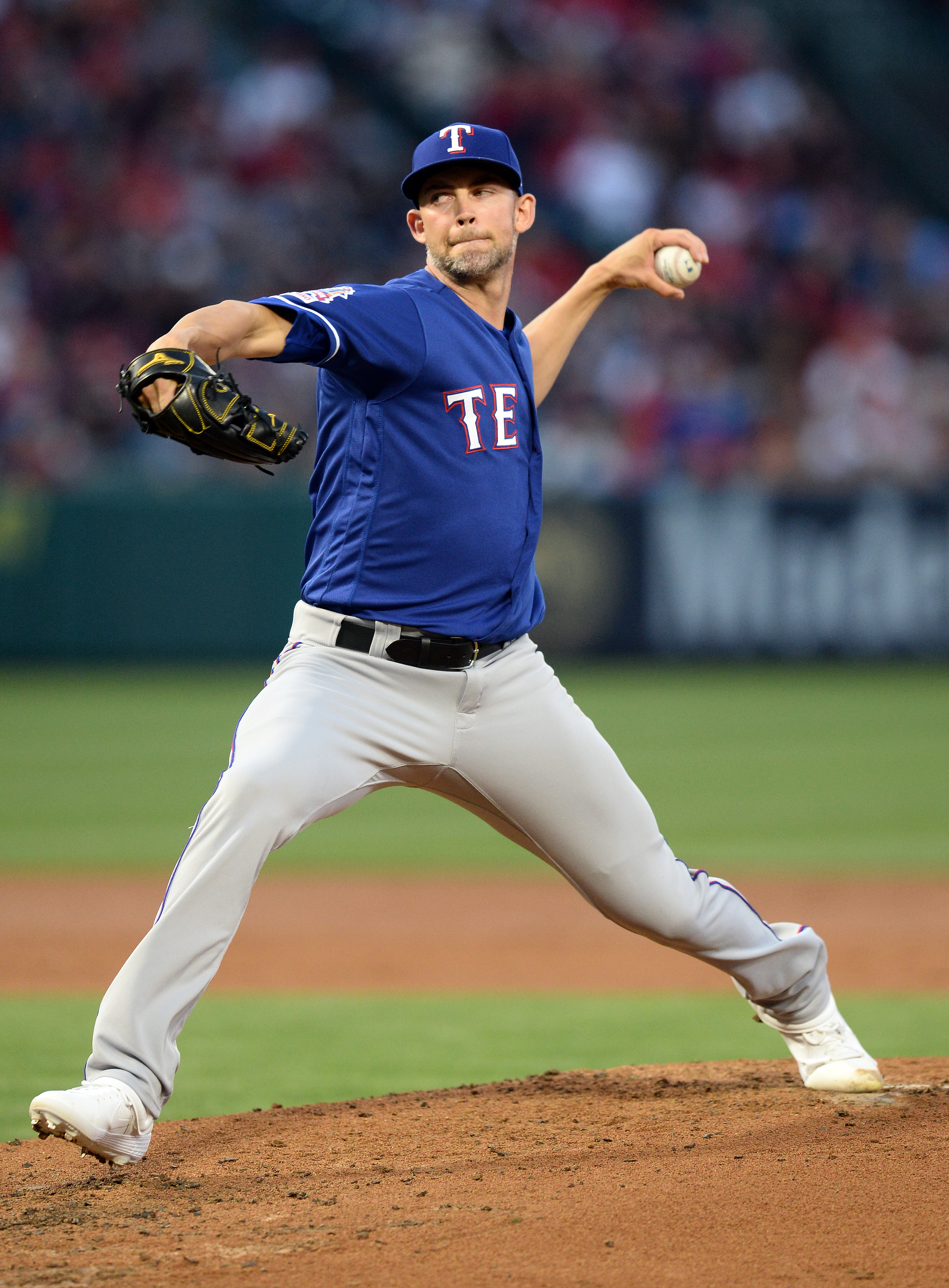
That may ultimately prove to be the case in the end, but at the moment the team is in better standing than most would’ve expected at the (nearly) one-third mark of the season. At the very least, it’s created some interesting questions moving forward — with Minor’s own future in the organization perhaps chief among them. The Athletic’s Jayson Stark tweeted yesterday that Minor’s potential presence on the summer trade market is a frequent topic of discussion among rival front offices, while his colleague, Ken Rosenthal, touched on the subject as the lead-in to his latest notes column.
Minor, indeed, seems like he’d be a highly coveted asset should the Rangers shop him this July. Starting pitching is always in heavy demand and short supply on the summer trade market — particularly when you’re discussing options that are more than pure rentals. Minor is earning $9.5MM in 2019 (with about $6.28MM yet to be paid out), and he’s guaranteed that same salary in 2020 under the three-year, $28MM contract he signed with Texas prior to the 2018 season. Considering his performance, that looks eminently reasonable.
The Rangers were surely pleased with the 4.18 ERA that Minor authored over 157 innings out of the rotation in 2018, especially given that it was his first work as a starting pitcher since 2014 with the Braves. Texas signed him on the heels of a terrific run out of the Royals’ bullpen, and the organization’s decision to put him back in a starting rotation looked justified based on that alone.
In 2019, Minor has taken things a step further. He’s pitched 70 2/3 innings of 2.55 ERA ball with improvements in his strikeout rate, ground-ball rate and swinging-strike rate. He’s been less prone to home runs as well, averaging 0.89 per nine innings pitched despite the launching pad in which he pitches his home games. Fielding-independent pitching metrics forecast a bit of regression on his excellent ERA but still are generally bullish on him as a solid mid-rotation arm. As is the case every summer, solid mid-rotation arms will likely be hard to come by this year, and Minor’s contractual status only enhances his appeal.
Back on Opening Day, it would’ve been simpler to see those numbers and expect that Minor would be among the top assets on the trade market. The overall team performance at least makes that thought more debatable, though. The question the Rangers have to ask themselves is whether the current club can conquer its obvious shortcomings enough to remain in the race. And, even if that’s not in the cards, whether Minor could be part of a more legitimate contender a year from now. Their defense is porous based on Defensive Runs Saved (-25) and UZR/150 (-2.8). Their bullpen, headlined by a terrible start from closer Jose Leclerc, has pitched poorly. The rotation is top-heavy and lacks depth. The chances of a postseason berth, even with Minor on board, appear thin, and the team is lacking in upper-level pitching talent — the type that could be netted in a Minor deal.
On the flipside of the coin, the Rangers rank third in the Majors in runs scored. Texas also has just $85MM committed to the next year’s payroll and a tiny arbitration class where only Joey Gallo and Nomar Mazara project for raises of note. For a team whose Opening Day payroll was $165MM as recently as 2017, there’ll be ample room to supplement the current roster. That will mean filling multiple holes, as the Rangers are currently enjoying production from one-year stopgaps like Logan Forsythe and Hunter Pence, but they’ll have plenty of budget room — particularly with Shin-Soo Choo finally off the books after 2020.
The Minor contract has turned into a success for the Rangers, but it now also leaves them with a bit of a decision on their hands. How should they proceed?
What should the Rangers do with Mike Minor this summer?
-
Trade him to bolster the farm. 64% (3,355)
-
Extend him. He's part of their next winning club. 20% (1,025)
-
Hang onto him in hopes of a Wild Card run and shop him in the offseason if they miss. 16% (838)
Total votes: 5,218
Poll: Anthony Rendon’s Future
Nationals third baseman Anthony Rendon has been among the majors’ most valuable players since his first full season, 2014, having recorded the league’s eighth-highest fWAR (26.4). The 28-year-old is now enjoying another magnificent campaign, one that may end with career-best offensive numbers, as he has slashed .331/.416/.669 (181 wRC+) with eight home runs in 137 plate appearances. At 19-27, the Nationals haven’t been able to capitalize on Rendon’s excellence this season – nor have they even won a playoff series during his career – and time may be running out for the club to take advantage of his presence.
Rendon is one of the game’s premier impending free agents, a player who’s likely on a collision course with a nine-figure payday over the next few months, and is far from certain to remain in Washington. Rendon has expressed interest in continuing with the Nationals, who have made an effort to extend him, but the team hasn’t been able to close the gap with the Boras Corporation client thus far. With Rendon still not under contract beyond this season and the July 31 trade deadline inching closer, the Nationals may have to decide soon whether to keep the homegrown star or deal him.
If the Nationals rebound from their shaky start and emerge as contenders over the next two months, chances are they won’t consider moving an unsigned Rendon. Otherwise, should the Nats’ woes continue, general manager Mike Rizzo could think about parting with him. The executive was in a similar position last year with Bryce Harper, whom he elected not to give up during the summer even though Washington was treading water and the outfielder was approaching free agency. Rizzo spurned interest from the Astros, Indians and Dodgers (and perhaps other unreported teams), in part because he wanted to continue working toward a long-term deal with Harper. In the end, though, the Nationals neither prevented Harper from testing the market – where he secured the largest contract ever for a free agent (13 years, $330MM) – nor exiting D.C.
Harper joined the division-rival Phillies this past offseason and all the Nationals got for their trouble was a draft pick after the fourth round, given that they exceeded the luxury tax in 2018 and he rejected their qualifying offer. This time, if the Nationals retain Rendon through the season and he walks in free agency in lieu of accepting a QO, they’re likely to receive a more appealing pick (a selection after Competitive Balance Round B). While the Nationals are only $3MM-plus under the $206MM tax threshold, ownership does not want to surpass that mark this season.
Whether draft compensation for Rendon’s departure would be worth more than the package the Nats would acquire for him in a trade is something Rizzo will have to determine. But it’s possible Rendon would be to this season’s deadline what Manny Machado was to last year’s. Machado’s then-team, the Orioles, oversaw a bidding war for the impending free agent and wound up accepting an offer of five young players from the Dodgers. Ideally for the Nationals, they’ll do what the Orioles couldn’t and lock up their top position player in advance of the deadline. If not, though, Rizzo may have an important choice to make by then.
(Poll link for app users)
What should the Nationals do if they don't extend Rendon?
-
Trade him by the deadline if they're not in contention 80% (5,701)
-
Keep him through the season no matter what 20% (1,443)
Total votes: 7,144
MLBTR Poll: Is It Time For Nats To Make A Managerial Change?
You’re amply familiar by now with the narratives surrounding the Nationals’ managerial situation. Four skippers have presided over the past eight seasons, dating back to the team’s breakout 2012 campaign. The drama goes back further, but it’s most remarkable that the Nats have managed not to stick with a single manager for very long even as they’ve churned out winning campaigns.
For all the disappointing seasons and heartbreaking postseason showings, the Nats have arguably never faced a situation as dire as the present one since they began their winning ways. After barely topping .500 last year, the first under manager Dave Martinez, the team has limped to a 14-22 start in 2019.
It wasn’t long ago that the Nationals sat at an uninspiring 11-11 record — just 1.5 games out of first place in a packed division and hardly cause for concern in and of itself. The bullpen was a mess, but otherwise the club was getting along well enough. The vibe has changed since, as the Nats have managed only two wins out of their past 13 contests while injury issues mount. Martinez’s charges have a negative-34 run differential in that brief span. Pitching coach Derek Lilliquist was canned a week ago.
There are many different ways to interpret these results. It’d be foolish to lay all the blame on Martinez; veteran Ryan Zimmerman said as much today in support of the sophomore-year skipper. President of baseball operations Mike Rizzo has been unequivocal in his support, saying that Martinez is “doing a great job” in the wake of the Lilliquist firing.
At the same time, it’s hard to deny that the results have fallen well short of expectations since Martinez came aboard. He was hired only after the club parted with Dusty Baker over the failure to advance in the postseason. The premise was that the talented outfit would thrive all the more under new leadership. For whatever reason, Martinez’s efforts haven’t translated to this point. There are complaints over his bullpen management and strategic decisionmaking, though that’s a common refrain for many managers. Even if Martinez isn’t truly doing a poor job, it’s arguably time for the club to receive a real jolt.
So, readers, where do you come down on the matter? (Link to poll for app users; response order randomized.)
Should the Nationals fire Dave Martinez?
-
He's doing a poor job and needs to go. 31% (2,021)
-
He's not the problem and should be retained. 28% (1,811)
-
He's not the problem, but a managerial change is still needed. 26% (1,699)
-
He's doing a poor job, but it's not the right time for a change. 14% (922)
Total votes: 6,453
13 Early Contenders For American League Rookie Of The Year
Before the 2019 season, it was preordained that Vladimir Guerrero Jr. would take home the American League Rookie of the Year trophy, and everyone else was just fighting for second place. That may yet be the case, but eight games into the prodigy’s career, it’s clear he has some catching up to do. Here’s a look at the top contenders.
- Vladimir Guerrero Jr., Blue Jays – The game’s best prospect in years, Guerrero strained an oblique during Spring Training, providing Blue Jays a little bit of cover in their plan to keep him in the minors long enough to gain a seventh year of control. Just 34 plate appearances into his career, Vlad Jr. is fully expected to rake over the remainder of the season.
- Eloy Jimenez, White Sox – Jimenez was allowed on Chicago’s Opening Day roster after signing a $43MM contract, and he started to come around at the plate in his final 15 games before suffering an ankle sprain. He’s close to a rehab assignment and still has plenty of time to demonstrate why he was the typical prediction as the second-place AL ROY finisher.
- Brandon Lowe, Rays – Lowe owns a 153 wRC+ in 121 plate appearances, mostly as the Rays’ second baseman. His 1.5 WAR is tops among AL rookies. Lowe also enjoys the comfort of a $24MM contract signed back in March.
- Michael Chavis, Red Sox – Mostly playing second base for the Red Sox, Chavis made his big league debut on April 20th and has already smacked six home runs. Chavis may eventually be squeezed for playing time once Dustin Pedroia and Brock Holt return, though not if he keeps hitting anything like this.
- Spencer Turnbull, Tigers – If Vogelbach is the league’s most surprising rookie hitter, the 26-year-old Turnbull deserves that designation for pitchers. Rated just a 40-grade prospect by Baseball America prior to the season, the righty claimed the Tigers’ last rotation spot out of Spring Training and never looked back. He’s rocking a 2.31 ERA in seven starts, and even if that can’t last he’s shown himself a capable big league starter. Having tallied 135 2/3 innings last year and 112 in 2017, it seems unlikely Turnbull will be allowed to keep his current 200-inning pace.
- Yusei Kikuchi, Mariners – Kikuchi owns a 3.98 ERA in eight starts, including a gem last time out in Cleveland. Having made a large investment in Kikuchi, the Mariners have a plan to periodically give him a one-inning start, which so far happened in his seventh outing. That approach still might get him around 150 innings, so Kikuchi has a shot at the award.
- Ty Buttrey, Angels – It’s hard to ignore what the 26-year-old Buttrey has done out of the Angels’ bullpen so far. He’s posted a 1.06 ERA with 21 punchouts and just three walks in 17 innings and has been pitching in high leverage situations all year. Buttrey, who has touched 100 with his fastball, looks like the Angels’ closer of the future.
- Trent Thornton, Blue Jays – Thornton, 25, was traded by the Astros to the Blue Jays for Aledmys Diaz in November. According to Baseball America, his curveball features one of the highest spin rates in baseball, and he “has the stuff and control to fit as a No. 4 starter with a chance for more.” So far he has a 4.08 ERA and 9.7 K/9 in seven starts.
- Rowdy Tellez, Blue Jays – The Jays’ DH/first baseman has popped six home runs in the early going. If Tellez is able to approach 30 bombs in a lost season for the Jays, he’ll be in the Rookie of the Year conversation.
- Jesus Luzardo, Athletics and Forrest Whitley, Astros – Luzardo’s impressive spring and rotation bid was cut short by a shoulder injury, though the top prospect could return to game action in June. It seems unlikely he’ll get enough innings with the A’s to compete for the award. Whitley, meanwhile, has been knocked around in two of his four starts at Triple-A and may also have a half-season at best in the Majors this year.
- Danny Jansen, Blue Jays – Jansen has started about two-thirds of the Jays’ games behind the plate, but has been awful as a hitter through 90 plate appearances. Luke Maile hasn’t been any better, so Jansen should have a chance to shake off his April and finish as the league average hitter he was projected to be.
- Christin Stewart, Tigers – Stewart was off to a decent start as the Tigers’ left fielder before going down with a quad injury. He’s currently on a minor league rehab assignment and has the plus power to make some noise in the ROY race.
A correction has been made to this post, thanks to a comment from reader txtgab. We have confirmed that Dwight Smith Jr. is in fact not rookie eligible. Additionally, reader tieran711 has kindly pointed me to this tweet from Larry Stone of the Seattle Times, which indicates that Daniel Vogelbach is also not rookie eligible. Both players have been removed from the post.
Let us know what you think in our poll! App users can click here.
Who will win the AL ROY?
-
Vladimir Guerrero Jr. 29% (1,976)
-
Brandon Lowe 20% (1,359)
-
Michael Chavis 19% (1,274)
-
Eloy Jimenez 10% (706)
-
Spencer Turnbull 7% (450)
-
Yusei Kikuchi 5% (316)
-
Ty Buttrey 4% (299)
-
Rowdy Tellez 2% (147)
-
Christin Stewart 1% (92)
-
Jesus Luzardo 1% (77)
-
Trent Thornton 1% (63)
-
Forrest Whitley 1% (54)
-
Danny Jansen 0% (30)
Total votes: 6,843
MLBTR Poll: Who’ll Sign Gio Gonzalez?
Last night, we examined the market landscape for Gio Gonzalez, who’s back on the open market after exercising an opt-out clause in his now-defunct deal with the Yankees. As we explained there, the veteran lefty has a variety of plausible landing spots.
There’s indication that multiple clubs have already extended offers to Gonzalez, as MLB.com’s Mark Feinsand recently tweeted. While a deal isn’t imminent, it seems reasonable to think he could put pen to paper at any time. Having already built up his pitch count, Gonzalez ought to be ready to jump in and make a start at a moment’s notice.
If you’re interested in revisiting the breakdowns of each team’s situation vis-a-vis Gio, then check out the above-linked post. We’ll only list the teams that we pegged as the likeliest suitors in the poll below. Let’s see how the MLBTR readership expects things to shake out. (Response order randomized; link for app users.)
Predict The Landing Spot For Gio Gonzalez
-
Brewers 62% (3,273)
-
Mets 13% (693)
-
Other Team 9% (481)
-
Angels 4% (220)
-
Padres 3% (177)
-
Cardinals 3% (175)
-
Athletics 3% (170)
-
Mariners 2% (107)
Total votes: 5,296
Poll: Which Early-Season Surprises Are For Real?
As we approach the one-month mark of the young 2019 season, the MLB standings are starting to take shape, with fast starters trying to separate from the pack and rebuilding teams falling behind. With that said, the current slate of division leaders features some surprises. Notably, preseason favorites like the Yankees and Red Sox have encountered considerable adversity, while juggernauts like the Dodgers and Astros have thus far met expectations. Meanwhile, a number of teams that received less attention as potential contenders have found themselves climbing MLB’s rankings. Power surges in Seattle and Minnesota have carried the Mariners and Twins to the top of AL’s West and Central divisions, respectively. Elite run prevention in Pittsburgh has allowed the Pirates to flourish in the hyper-competitive NL Central. An injection of youthful energy has driven the Padres to within striking distance of the powerhouse Dodgers. Let’s examine these upstart clubs and look ahead to their outlook for the rest of the season.
The Mariners made headlines throughout the offseason, but often for the wrong reasons. General manager Jerry Dipoto spent the winter shipping off nearly every Major Leaguer with value, and now fields a team that only vaguely resembles the one that won 89 games in 2018. Edwin Diaz, Robinson Cano, Jean Segura, and James Paxton were all dealt to the East Coast. Last season’s iteration of the Mariners was notorious for its unsustainable first-half performance, repeatedly winning one-run games, often thanks to the heroics of Edwin Diaz. In 2019, the story is of a different flavor, though skeptics may once again challenge the sustainability of April’s returns. This year’s team is slugging home runs at a historic rate, including a streak of 20 games in which the team hit at least one round-tripper. The 2019 Mariners have belted 56 home runs, 12 more than the next closest team, the Dodgers. Tim Beckham and Domingo Santana are churning out extra-base hits, and Mitch Haniger is rising to stardom. Still, the Astros are looming, and a spot in the AL Wild Card will not come easy, with sleeping giants in the AL East working through early adversity–to say nothing of the undeniable Rays.
In a division that has all the makings of a bloodbath, many might have counted out the Pirates after an uninspired offseason: whereas rivals’ offseasons were highlighted by flashy additions like Paul Goldschmidt, Yasiel Puig, and Yasmani Grandal, the Pirates were quiet in the winter, with names like Lonnie Chisenhall and Erik Gonzalez headlining the team’s moves. However, it has quickly become clear that the 12-7 Pirates boast one of the Majors’ best pitching staffs. Behind Jameson Taillon, Trevor Williams has emerged as an automatic quality start every outing. Meanwhile, Joe Musgrove is showing off the dynamic stuff that made him the centerpiece in the Gerrit Cole trade, and Jordan Lyles has been a pleasant surprise to round out the rotation. Felipe Vazquez is dynamite in the late innings, and Richard Rodriguez showed promise last season as a high-leverage option, though the bullpen is somewhat shaky beyond that combination. On offense, things are less peachy, but Josh Bell is turning heads by coupling prodigious power with a keen batting eye. Again, the NL Central will provide no shortage of resistance, but a starting rotation of this caliber should keep the Pirates in more than their fair share of games.
With the last three seasons resembling a roller coaster ride, the Twins entered the offseason hoping to turn a corner. Derek Falvey and Thad Levine set out with essentially blank future payroll, capitalizing on that flexibility by bringing aboard veterans like Nelson Cruz, Marwin Gonzalez, and Jonathan Schoop to bolster a group of young position players that the Twins hope will be galvanized by rookie manager Rocco Baldelli. Jorge Polanco, fresh off a spring contract extension, has provided encouraging production from the shortstop position, and Eddie Rosario is blasting home runs at an impressive rate. Byron Buxton appears to have unlocked the potential that made him a top prospect, and Jose Berrios is entering bona fide ace territory. The pitching appears much improved from years’ past, with a bullpen headed by Taylor Rogers, who belongs in conversations with the league’s elite relief arms. This team may have the most attainable path to October baseball, playing in a weak division where their primary competition is the Indians, a team that has at times appeared vulnerable in 2019.
The Padres thrust themselves into the conversation for the postseason when general manager A.J. Preller and company added Manny Machado to the mix in a franchise-altering move. The team doubled down when the front office broke the mold by breaking camp with top prospects Fernando Tatis Jr. and Chris Paddack on the Opening Day roster. Those moves have paid massive dividends thus far, with Tatis forcing his way into the national spotlight, displaying a five-tool skillset. The club’s rotation of young outfielders is launching homers, and the anonymous bullpen has quietly been one of the best in baseball dating back to last season. Meanwhile, with a host of young starters comprising the rotation, the possibility of a Dallas Keuchel addition remains on the table–a move that would emphatically declare the Friars’ intention to make a postseason push. At the top of the NL West, the Dodgers represent a daunting giant to topple, and the rest of the National League features no shortage of contending teams, but the Padres’ spunk might lead to meaningful autumn baseball for the first time in nearly a decade.
While there are months of baseball left to play, trades to be made, injuries to work around, and breakouts to emerge, the games played in March and April are no less important than those in September. Early-season results can lay the groundwork for what’s to come. Which of the aforementioned blossoming clubs are best positioned to sustain their success and exceed expectations?
(Poll link for app users)
Which Early-Season Surprises Are For Real?
-
Minnesota Twins 32% (6,351)
-
San Diego Padres 27% (5,446)
-
Seattle Mariners 25% (4,953)
-
Pittsburgh Pirates 16% (3,080)
Total votes: 19,830
Poll: Slow-Starting Playoff Contenders
The Red Sox, Yankees, Cubs and Rockies were among the majors’ most successful clubs in 2018, when the quartet comprised 40 percent of the league’s playoff bracket. No one was better than the Red Sox, who rolled to 108 regular-season wins before steamrolling the Yankees, Astros and Dodgers in the postseason en route to their latest World Series title. The Yankees, despite their loss to archrival Boston, enjoyed a more-than-respectable year in which they notched 100 victories. And Colorado knocked out Chicago in the National League wild-card game, a battle of two 90-plus-win teams, before succumbing to Milwaukee in the divisional round.
Given the excellence those clubs displayed last year, it would have been fair to expect each of them to earn playoff berths again in 2019. Instead, while we’re just a couple weeks into the season, all of those teams have tripped out of the starting block, having combined for 19 wins in 58 games. They’re the only members of last year’s playoff field that are under .500 at this point.
Boston, whose roster is almost the same as its title-winning version (sans relievers Craig Kimbrel and Joe Kelly), dropped a game to the lowly Orioles on Saturday. Fifteen contests into the season, the Red Sox have already lost 10 times – something they didn’t do until Game 35 a year ago. Neither their all-world offense nor their high-end pitching staff from 2018 have come close to replicating those performances thus far, and questions have swirled around ace Chris Sale. Signed to a five-year, $145MM extension before the season, Sale’s velocity – which began dropping amid an injury-limited 2018 – has continued to plummet. Unsurprisingly, the 30-year-old’s effectiveness has waned as his fastball has lost power. Not only has Sale allowed an earned run per inning across 13 frames, but one of baseball’s all-time strikeout artists has fanned just eight batters.
Maybe Sale is battling a physical issue, but the Yankees are dealing with plenty of their own. Eleven of their players, including standouts Luis Severino, Giancarlo Stanton, Gary Sanchez, Didi Gregorius, Miguel Andujar, Aaron Hicks and Dellin Betances are on the IL. The majority of that group won’t be back in the near future – or perhaps until 2020 in the case of Andujar – while Severino, Gregorius, Hicks and Betances haven’t suited up yet this year. With so many integral contributors unavailable, the Yankees have started 6-8. That would be less concerning if not for their inability to capitalize on an easy early season schedule. The Yankees have played 11 games against the Orioles, Tigers and White Sox, all of whom are regarded as bottom feeders, and only won six of those matchups. The AL East rival Rays (11-4) have taken advantage, evidenced by their 4.5-game lead on New York and their six-game edge over Boston.
Over in the NL, the Cubs – on the heels of a widely panned offseason – have sputtered to a 5-9 showing and a four-game deficit in the Central, which could be one of the majors’ most competitive divisions. Although cornerstone hitters Kris Bryant, Javier Baez, Anthony Rizzo and Kyle Schwarber haven’t resembled their best selves, the Cubs’ offense has still done well statistically. Their pitching has been abysmal, on the other hand. Yu Darvish, who’s in Year 2 of a huge contract, continues to perform nothing like the pitcher he was pre-Chicago, while the bullpen the Cubs did little to bolster over the winter has looked predictably vulnerable.
Speaking of vulnerable, the Rockies have christened their season with the majors’ worst record (3-12) and its last-ranked run differential (minus-36). If the Rockies are going to overcome their horrific start to pick up their third straight playoff appearance, they’ll need far more from their position players. Their hitters have put together a woeful 37 wRC+ and minus-2.6 fWAR, both of which easily rank last in the game. Injuries have played a part, as regulars David Dahl, Daniel Murphy and Ryan McMahon are all on the IL. Meanwhile, the Rockies’ primary offensive catalysts – Nolan Arenado, Trevor Story and Charlie Blackmon – have all been duds so far. Those three won’t stay down forever, though, and Colorado’s starting staff also has the talent to rebound from its early season mediocrity. But the Rockies can’t afford to let this skid continue to fester, especially considering they’re stuck in a division with the perennial champion Dodgers. Realistically, it’s wild card or bust for the Rockies, but rallying to steal one of those two spots in a crowded NL won’t be easy.
While it would be unwise to panic on April 13, there are more reasons for concern than expected in all of these teams’ cases. Then again, the same was said last year about the Dodgers, who began 16-26 on their way to 92 wins and another pennant. The Red Sox, Yankees, Cubs and Rockies can take solace in that, perhaps, but do you believe any of them are already in serious trouble?
(poll link for app users)
Are any of these slow starters in real trouble?
-
Rockies 26% (3,683)
-
Cubs 25% (3,529)
-
No, it's too early 20% (2,822)
-
Red Sox 19% (2,687)
-
Yankees 11% (1,508)
Total votes: 14,229
Poll: When Will Kimbrel & Keuchel Sign?
The season is now well underway, and there’s still no evidence that free agent hurlers Craig Kimbrel and Dallas Keuchel are close to inking new deals. It has mostly been crickets on the markets for both.
Kimbrel’s slate of potential suitors isn’t any clearer now than it was when we examined his market situation in early March. Neither has anything of significance occurred since we took a look at the possible Keuchel suitors about a week ago.
Those accomplished hurlers have to this point evidently not been willing to settle for pillow deals. It’s hard to blame them for that stance. It also makes it that much harder to guess how things will turn out — and when there’ll be a resolution.
Teams are continuing to make long-term investments in existing players through contract extensions, so it’s not as if they aren’t willing or able to consider future commitments at this stage of the season. But the ongoing insistence on multiple years seemingly makes it likelier that talks will continue to drag.
Waiting until after the June draft would allow the players to shed draft compensation requirements. When last we saw players approaching this caliber languish on the market into the season, one (Stephen Drew) inked in May while the other (Kendrys Morales) waited until just after the draft. Both settled for single-season deals.
When do you think Kimbrel will end up signing? (Link for app users.)
When will Craig Kimbrel sign?
-
Just after the draft in June (no more draft compensation) 44% (9,828)
-
By the end of April 26% (5,801)
-
Sometime in May 17% (3,776)
-
Won't sign this season 10% (2,172)
-
July or August 3% (736)
-
September (not postseason-eligible) 0% (46)
Total votes: 22,359
And how about Keuchel? (Link for app users.)
When will Dallas Keuchel sign?
-
Just after the draft in June (no more draft compensation) 44% (7,863)
-
By the end of April 25% (4,450)
-
Sometime in May 19% (3,334)
-
Won't sign this season 9% (1,559)
-
July or August 4% (672)
-
September (not postseason-eligible) 0% (71)
Total votes: 17,949
Poll: Which Team Should Splurge On Kimbrel?
We have examined the free agent market from just about every angle imaginable over the course of a long signing period. We’re largely shifting our focus here at MLBTR to analyzing the offseason (through our Offseason In Review series), but there is still work to be done in free agency.
MLBTR’s Steve Adams took a look at the market for ace reliever Craig Kimbrel, focusing on the financial situations of various teams that might conceivably consider splurging at this late stage of the offseason. If you’re interested in understanding things from that angle and haven’t done so already, give that post a read. The teams broken out there aren’t the only ones that arguably can and should still be in on Kimbrel; as Steve explained, he did not give a detailed look at some clubs given the stances they took throughout the winter.
For purposes of today’s poll, we’ll open the door a bit wider. In theory, at least, every organization that hopes to be competitive now or even in 2020 ought to have given some amount of thought to what it would pay to secure the services of one of the game’s elite relievers. We know that no team has met Kimbrel’s initial asking price of a record-breaking, long-term deal. Otherwise, the behind-the-scenes market development has been murky.
Clearly, something has to give. Kimbrel will settle for a deal he’s less than enthused about and/or an organization will go beyond its comfort zone. We’ll focus here on the team-side motivation and throw things wide open, removing only a few organizations from the poll. Which of the following clubs do you think ought to be most willing — given its near-term competitive outlook, roster needs, and other commitments — to splurge a bit to land Kimbrel?
(Response order randomized. Link for app users.)
Which team should be most motivated to sign Craig Kimbrel?
-
Braves 15% (4,660)
-
Red Sox 12% (3,731)
-
Cubs 11% (3,169)
-
Phillies 9% (2,592)
-
Cardinals 6% (1,826)
-
Dodgers 5% (1,531)
-
Twins 5% (1,481)
-
Nationals 4% (1,266)
-
Yankees 3% (1,020)
-
Mets 3% (987)
-
Rays 3% (984)
-
Brewers 3% (970)
-
Angels 3% (837)
-
Padres 2% (669)
-
Astros 2% (646)
-
Reds 2% (591)
-
Indians 2% (583)
-
White Sox 1% (424)
-
Blue Jays 1% (418)
-
Giants 1% (376)
-
Mariners 1% (331)
-
Pirates 1% (277)
-
Athletics 1% (249)
-
Rockies 1% (187)
-
Rangers 1% (154)
-
Diamondbacks 0% (137)
Total votes: 30,096