
MLBTR Poll: Who Will Win The ALCS?
The Yankees knocked off the Guardians by a 5-1 margin this evening, taking two elimination games to advance past Cleveland. New York is back in the AL Championship Series for the first time since 2019.
Awaiting them tomorrow: an Astros juggernaut that has had one of the better runs of playoff success in recent history. Houston has gotten to the ALCS in six straight seasons. The first of those seasons was their now-infamous run to a World Series that was later revealed to be aided by a sign-stealing operation. Houston has barely missed a beat in the half-decade since then, though, playing for the pennant every year. The Astros claimed the pennant in both 2019 and 2021 (eliminating the Yankees during the former season), and while they’ve not managed to win a World Series since 2017, they’ve joined the 1990’s Braves as the only teams to reach six consecutive Championship Series.
Houston has home field advantage after a 106-win regular season, claiming the AL’s top seed in the second half after an historically great first few months by the Yankees. The ‘Stros swept their division-rival Mariners last week, earning three off days in the process. Their pitching staff should essentially be lined up as desired, and they’ll turn to presumptive Cy Young favorite Justin Verlander tomorrow evening. The Yankees will answer with Jameson Taillon for Game One after using top two starters Gerrit Cole and Nestor Cortes on Sunday and today, respectively, to survive the Guardians.
The Yankees, anchored by an all-time great season from Aaron Judge, led all American League teams with 807 runs scored. Houston finished third in that category, plating 737 runs. New York finished second in the Junior Circuit behind the Blue Jays in on-base percentage at .325, while the Astros placed fourth at .319. The Yankees finished second in slugging (again behind Toronto) at .426, while Houston was just behind at .424.
While New York had a slight advantage offensively, the Astros were clearly the best pitching team in the American League. They led the league with a 2.95 rotation ERA, a half-run better than the second-place Rays. New York came in third at 3.51. Astros and Yankees starters each fanned 24.8% of opponents (with the Astros leading the league by a fraction of a percentage point). Houston’s bullpen was also number one in strikeout percentage at 28.3%, while the Yankees checked in sixth at 24.2%. Houston (2.80) and New York (2.97) finished first and second, respectively, in bullpen ERA.
It’s a battle of the two teams that have looked to be the best in the American League, in some order, from start to finish. Yesterday, MLBTR readers weighed in on an NLCS that took the exact opposite form. In a battle of the Senior Circuit’s fifth and sixth seeds, the readership gave a 56-44 edge to the Padres over the Phillies. We’ll now put forth the same question for the American League. Which team is headed to the World Series: Astros or Yankees?
(poll link for app users)
Who Will Win The AL Championship Series?
-
Astros 68% (6,594)
-
Yankees 32% (3,113)
Total votes: 9,707
MLBTR Poll: Who Will Win The NLCS?
There were plenty of times this season when it was unclear whether or not either of the Phillies or Padres would even reach the postseason, and even when the playoffs began, Philadelphia vs. San Diego seemed like a very unlikely scenario. And yet, this is the matchup heading into the National League Championship Series, as both the Phils and Friars have upended the baseball world with four upsets.
The Phillies looked in deep trouble heading into the ninth inning of Game 1 of their Wild Card Series matchup with the Cardinals, but Philadelphia overcame a 2-0 deficit with a six-run outburst in the top of the ninth, en route to a 6-3 victory. An Aaron Nola gem helped shut out the Cardinals in Game 2, clinching the series and setting the Phillies up for a date with their NL East rivals, the defending World Series-champion Braves. Splitting the first two games in Atlanta, the Phillies lineup was seemingly buoyed by a raucous Citizens Bank Park crowd, outscoring the Braves by a 17-4 margin in Games 3 and 4 to move deeper into October.
Reigning NL MVP Bryce Harper has carried the offense, hitting .435/.480/.957 over his 26 plate appearances in the playoffs. Jean Segura and Brandon Marsh have also been on fire at the plate, and while other Philadelphia batters have been generally less consistent, multiple players have delivered at least one big hit — for instance, Rhys Hoskins‘ three-run homer in Game 3 of the NLDS, or J.T. Realmuto‘s inside-the-park homer in Game 4. On the pitching side, Nola has led the way with 12 2/3 scoreless innings of work, while the much-maligned Phillies bullpen has done its job in protecting leads.
The Padres are getting much of their offense from a superstar (Manny Machado), but also from the back end of their lineup, as Trent Grisham, Austin Nola, and Jurickson Profar have combined for 23 of San Diego’s 56 hits in the postseason. Grisham has also been an unexpected power source, hitting three home runs in the playoffs after delivering only a .341 slugging percentage in the regular season. Joe Musgrove, Yu Darvish, and Blake Snell have all pitched well in the rotation, and the bullpen has been almost untouchable. Apart from a disastrous Adrian Morejon outing that saw him charged with four runs without a single out, the rest of San Diego’s relievers have a cumulative 0.73 ERA over 24 2/3 innings.
This well-rounded attack helped the Padres outlast the Mets in the Wild Card Series, as San Diego beat up on Mets ace Max Scherzer in Game 1, and Musgrove and the bullpen held New York to just a single hit in a 6-0 win in the Game 3 clincher. Moving into the NLDS, the Padres exorcised years of demons by defeating the arch-rival Dodgers in four games, winning the final three contests after Los Angeles won Game 1. The Dodgers also held a 3-0 lead heading into the bottom of the seventh inning of Game 4, but the Padres launched a five-run outburst to take the lead and finally claim some bragging rights in the SoCal rivalry.
This is the first-ever postseason meeting between the two franchises. Philadelphia last reached the NLCS in 2010 (and hadn’t been in the playoffs altogether since 2011), while San Diego’s last NLCS trip came all the way back in 1998. There isn’t a ton of shared history between the two teams, though some bad blood surfaced in June when Snell hit Harper with a pitch, fracturing the outfielder’s thumb and sending Harper to the injured list for two months.
Who is your pick to win this battle of the Nola brothers, and battle of the NL underdogs?
(poll link for app users)
Who Will Win The NL Championship Series?
-
Padres 56% (6,636)
-
Phillies 44% (5,234)
Total votes: 11,870
Poll: National League Rookie Of The Year
This year’s National League Rookie of the Year voting will be a particularly fun one because the two front-runners happen to be teammates. Braves right-hander Spencer Strider and center fielder Michael Harris II both burst onto the scene in 2022 and both cemented themselves as building blocks in Atlanta. Wins above replacement is far, far from the be-all and end-all in ascertaining player value, but it’s still telling that Strider and Harris are both north of four WAR on the season (per both Baseball-Reference and FanGraphs), while no other NL rookie has even three wins above replacement per either version of the metric.
Harris and Strider have both played at an All-Star level this season, though neither actually made the All-Star team this summer. That’s due largely to the fact that Strider began the season in the bullpen and Harris didn’t make his debut until late May. Given their play in 2022, that could change as early as next summer.
There’s still a bit of time for the bottom line to change, although with Strider on the 15-day injured list due to an oblique strain, his regular season is likely over. Harris will have another nine games to build his case, pending any off-days or an untimely injury of his own. Let’s take a quick look at each player’s candidacy.
A Quick Case for Strider
Dominant this season as both a reliever (2.22 ERA in 24 1/3 innings) and a starter (2.77 ERA, 107 1/3 innings), Strider leads all National League rookies with 131 2/3 innings pitched. Cincinnati’s Hunter Greene, a popular ROY pick prior to the season, is a distant second place at 113 2/3 innings. Strider’s gaudy 38.3% strikeout rate isn’t just the best among rookie pitchers in 2022 — it’s the best among all Major League pitchers who have thrown at least 100 innings. Shane McClanahan is the only pitcher in Major League Baseball (again, min. 100 innings pitched) who has induced swinging strikes at a higher clip than Strider’s 15.5%.
Strider’s overall numbers — 131 2/3 innings, 2.67 ERA, 38.3% strikeout rate, 8.5% walk rate — are so dominant that if he had a few more innings on his resume, he’d be in the mix for some down-ballot Cy Young votes. (He may still get a handful, but he’s not going to stack up alongside the current leaders.)
A common argument against Strider is that he shouldn’t be favored because he plays less often than an everyday player (e.g. Harris). Firstly, unlike most of even the fringe ROY candidates, Strider broke camp with the Braves this year. He’s been on the roster since Opening Day, which Harris and others can’t claim.
Secondly, Strider has faced 528 batters this season and, were it not for the oblique injury, would’ve pushed that number close to 600. Even that 528 mark is greater than the total number of plate appearances for any National League rookie hitter. Strider (and pitchers in general) may appear in a fewer number of their team’s overall games, but as a pitcher, he has more direct influence on the outcome of every single plate appearance than any of the defenders behind him. On average, he faced 21.7 hitters per start. That’s nearly a week’s worth of plate appearances for a position player.
Put more succinctly, the counter-argument to that common knock on Strider is that hitters play a smaller role in determining the outcome of a large number of their team’s games; pitchers play a larger role in determining the outcome of a small number of their team’s games.
A Quick Case for Harris
In terms of wins above replacement, Harris trails only Julio Rodriguez for the rookie lead, per FanGraphs (4.8), and only Rodriguez and Cleveland’ Steven Kwan, per Baseball-Reference (5.1). He’s a dynamic player in all facets of the game, hitting .305/.346/.535 with 19 home runs and 19 steals apiece. Harris doesn’t walk much (4.7%) and strikes out a bit more than average (23.8%), but that hasn’t stopped him from being 43% better than the average hitter, by measure of wRC+ (or 42%, per OPS+).
Defensively, Harris looks like a future Gold Glover. He might not win one this season, as his cumulative defensive contributions are impacted by the fact that he spent nearly two months in the minors, but every publicly available metric is in agreement that he’s a plus, if not elite defender. In 949 innings of center field work, Harris has received standout marks from Defensive Runs Saved (7), Ultimate Zone Rating (3.9) and Statcast (6 Outs Above Average, 5 Runs Above Average), to name a few. Harris ranks in the 92nd percentile of Statcast’s Outs Above Average, the 87th percentile for his jumps on balls hit to the outfield, and in 94th percentile for pure sprint speed.
It’s true that Strider has more batters faced than Harris has plate appearances, but Harris has fielded far more balls in play in center field than Strider has on the mound. His value as a defensive player is far superior, particularly given his elite results in 2022. Harris also provides baserunning value that Strider doesn’t have the ability (or even the opportunity) to match. Despite appearing in just 106 games so far, Harris ranks 17th among all big leaguers in baserunning runs above average, per FanGraphs’ — a cumulative stat that incorporates more than just his impressive 19-for-21 showing in stolen bases.
—
There’s really no wrong answer; both players have had sensational starts to their career and both have been absolutely vital pieces of a Braves team that trails the Mets by 1.5 games for the National League East lead. Still, only one of the two is going to take home Rookie of the Year honors in November. Who should it be?
Who should win National League Rookie of the Year honors?
-
Spencer Strider 50% (4,563)
-
Michael Harris II 44% (3,954)
-
Someone else (specify in comments) 6% (547)
Total votes: 9,064
MLBTR Poll: Predicting The NL East Winner
As the regular season nears its conclusion, the playoff picture has mostly come into focus. Of the 12 teams currently in playoff position, 10 have a cushion of at least 4 1/2 games. The Padres and Phillies are working to hold off the Brewers for the final two Wild Card spots in the National League, but the rest of the teams currently in playoff position have put themselves in a great spot to reach the postseason barring a major collapse. There’s an outside shot the White Sox track down the Guardians in the AL Central or the Orioles get back into the AL Wild Card race, but it’d take a major turn of events over the next two weeks.
There’s a similar lack of intrigue in most of the division races. The Astros and Dodgers have already clinched their respective divisions. The Yankees, Guardians and Cardinals all hold leads of six-plus games in theirs. The only division race that promises plenty of intrigue down the stretch: the battle for the NL East.
Both the Mets and Braves are already guaranteed to make the postseason. They’re each likely to surpass 100 wins. Yet one of those teams will come up just shy of a division title, leaving them as the #4 seed in the National League. That means a three-game series against the #5 seed in a first-round Wild Card set under the playoff format introduced in this spring’s collective bargaining agreement. Obviously, both teams would much prefer to secure the division title (and almost certainly the NL’s #2 seed and accompanying first-round bye). Which one is the frontrunner for the division crown? Let’s take a look at the remaining road for each and their current health outlook.
Mets (95-56 record, +147 run differential)
Remaining schedule: at Oakland (three games), vs. Miami (two games), at Atlanta (three games), vs. Washington (three games)
The Mets have 11 games remaining. Eight of them are against teams 28 games or more below .500. The other three: a crucial series next weekend in Atlanta. New York welcomed back Max Scherzer from a brief injured list stint on Monday. He came out with six perfect innings against the Brewers, striking out nine, before being lifted due to a pitch count limitation. The Mets rotation is at full strength at the right time, pushing players like Tylor Megill and David Peterson into the bullpen.
The biggest current injury for the Mets is on the position player side. Right fielder Starling Marte has yet to return after suffering a non-displaced fracture in his right middle finger two weeks back. Anthony DiComo of MLB.com tweeted this afternoon that the All-Star outfielder is hopeful he’ll be back in time for next weekend’s series with the Braves. Center fielder Brandon Nimmo, meanwhile, left today’s game with left quad soreness. Mike Puma of the New York Post relays that he’s likely to go for imaging tomorrow but Nimmo downplayed the severity of the issue postgame.
Braves (93-56 record, +171 run differential)
Remaining schedule: at Philadelphia (four games), at Washington (three games), vs. Mets (three games), at Miami (three games)
The defending champions dug themselves an early hole with a mediocre first two months, but they’ve been incredible since the calendar flipped to June. They’re a staggering 70-28 over the past three and a half months, nearly erasing a deficit that was once as high as 10 1/2 games in the process. They’ve pulled even with the Mets in the loss column but have two fewer wins, leaving them with a bit more work to do to get ahead in the standings.
The Braves kick off a four-game set with the Phillies tomorrow. That’s a much more difficult series than any the Mets will play (aside from the Braves themselves), but Atlanta just swept Philly last weekend.
Like the Mets, Atlanta doesn’t have any key starting pitchers currently on the injured list. Rookie star Spencer Strider is battling some oblique soreness and had today’s scheduled start pushed back slightly, but there’s no indication an IL stint is currently under consideration. As with New York, Atlanta is down one star position player thanks to a fractured finger though. The Braves lost Ozzie Albies to a right pinky fracture over the weekend. There’s a chance he returns in the postseason but he’s not expected back before the end of the regular season. Rookie Vaughn Grissom filled in well in recent weeks while Albies was rehabbing a broken foot; he’ll be asked to do the same for the stretch run.
Tiebreaker procedure
The final three games between the Mets and Braves obviously loom as the largest remaining on the schedule for both clubs. Not only are they the most directly impactful in the standings, they also carry implications for the tiebreaker. The new CBA did away with the traditional Game 163 in favor of a tiebreaker system. If two clubs finish the season with the same record, the team with the better head-to-head mark gets the nod in the standings. The Mets lead this year’s season series 9-7, meaning Atlanta would need to sweep their final meeting to secure the tiebreaker.
How does the MLBTR readership expect things to play out? Which team will celebrate an NL East crown two weeks from now?
(poll link for app users)
Which Team Will Win The NL East?
-
Mets 53% (6,340)
-
Braves 47% (5,574)
Total votes: 11,914
Nick Martinez’s Looming Opt-Out Decision
When the 2021-22 offseason commenced, Nick Martinez wasn’t even on the radar for most MLB fans. The right-hander had stumbled through an uninspiring four-year run with the Rangers from 2014-17, and while a big showing in Japan put him back on the radar of MLB clubs, it was still a shock to see him sign the 14th-largest contract of any pitcher last offseason. Martinez not only secured an eye-opening four-year term and $25.5MM guarantee from the Padres — he was also promised the opportunity to opt out of his contract after each season of the deal.
It’s an upside-laden contract for the player. Annual opt-outs of that nature tend to go to coveted free agents settling for shorter-term deals than they might otherwise prefer (e.g. Carlos Correa in Minnesota). It’s not an entirely new concept — Scott Kazmir got that treatment from the Dodgers as far back as 2015 when signing his three-year, $48MM deal — and it’s one that Padres president of baseball ops has now used to lure in a pair of players he played a role in signing and developing during his time with Texas; Jurickson Profar‘s three-year, $21MM contract also contained an opt-out after each of the first two seasons.
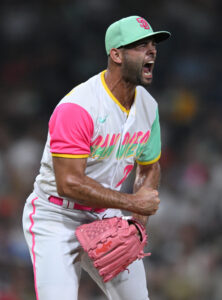
Martinez’s four-year deal pays him a $2MM signing bonus and a $4MM salary in 2022. All three of his player options are valued at $6.5MM, and he’d receive a $1.5MM buyout if he decided to turn an option down and test free agency. In other words, Martinez’s upcoming option effectively is a net $18MM decision. The signing bonus, 2022 salary and option buyout are all but banked. The question for him is one of whether he can top $18MM in free agency this winter.
It’s fair to question whether that can be called a given. On the surface, Martinez’s 3.22 ERA in 100 1/3 innings has to be considered a roaring success. He entered the 2022 season with a career 4.77 ERA in 415 1/3 innings, all coming in that prior run with the Rangers — one that concluded with consecutive ERAs north of 5.50.
At the same time, Martinez hasn’t exactly dominated opponents. His 20.9% strikeout rate is below the 22.3% league average, while his 8.6% walk rate is ever so slightly higher than the 8.2% league average. Martinez induces grounders at an above-average clip (46.7% compared to 42.2%) but also surrenders home runs more frequently than the average pitcher (1.25 HR/9 compared to 1.10 HR/9).
The role — or rather, the roles — that Martinez has filled this year don’t necessarily help his cause, either. He opened the year as the Padres’ fifth starter but was part of a six-man rotation by May and was moved to the bullpen full-time in mid-June, after 10 solid but unspectacular starts (52 1/3 innings, 4.30 ERA, 20.4 K%, 11.7 BB%).
In the bullpen, things have gone better. Martinez has tallied 48 1/3 innings in relief and worked to a 2.05 ERA. His 21.5% strikeout rate in the ‘pen is only moderately higher than it was out of the rotation, but to his credit, Martinez’s 4.7% walk rate as a reliever is miles better than it was coming out of the rotation. (Whether teams deem that to be sustainable is another open question.) He’s picked up eight saves and six holds for the Friars, but early on, the majority of his work came in lower-leverage situations. Even three of those eight saves were of the three-inning variety in long relief. He’s been used in later, higher-leverage spots as the summer has worn on, but Martinez will likely finish the season having spent only a couple months working in the critical leverage spots for which teams tend to pay top dollar.
There are other elements to consider, too. Martinez rates well in terms of his overall average exit velocity, yielding just an 86.6 mph average to his opponents. That checks into the 87th percentile among MLB pitchers. He also boasts above-average spin on his fastball and curveball alike, and Martinez has excelled at inducing chases on pitches off the plate. However, Martinez’s 37.2% hard-hit rate is barely better than the league-average, and the 8.2% barrel rate he’s yielded is well shy of league average (32nd percentile). Basically, when he does allow contact, he’s been much more prone to loud contact than one would expect when looking the mean results.
Martinez’s case is an interesting one. He didn’t thrive in a rotation role, even when facing hitters the first time through the order (.282/.311/.447). As is typically the case, those numbers worsened the second and third time he faced an opponent in a game. He’s been excellent the first trip through the lineup as a reliever, however (.201/.261/.289), even though he didn’t completely overhaul his pitch arsenal when shifting to bullpen work. At a time when relievers and even some starters are gravitating toward focusing on two plus pitches, Martinez’s approach is uncommon: he’s the rare reliever who deploys a five-pitch mix (four-seamer, cutter, sinker, curve, changeup).
MLBTR’s Anthony Franco wrote a few weeks ago that Martinez appears unlikely to opt out of the remaining three years on his contract, as it’s a stretch to envision him topping that remaining guarantee. There’s merit to that line of thinking. Martinez was unexciting in a brief run as a starter, has impressed but not dominated as a reliever, and doesn’t have the type of elite velocity, spin rate or whiff rate that serve as the portent to a breakout.
On the spectrum of outcomes, his 2022 season hasn’t been a best-case scenario but has been better than average. A 90th percentile outcome or better might have seen Martinez play a prominent role and pitch toward the top of the San Diego rotation; giving 10 serviceable starts before moving to the ‘pen and slowly climbing into a leverage role has to rank somewhere in the 60th to 75th percentile of outcomes. The Padres are surely happy with the year-one results.
Martinez’s decision is made difficult because the very nature of the contract he signed sat outside the norms of conventional contract structures for typical MLB free agents. Generally speaking, free agents very rarely sign three- and four-year deals with average annual values in the $6-7MM range. Even back-end starters will crack the $8-10MM range on one- and two-year deals. It’s not uncommon to see a setup reliever sign a multi-year deal in this AAV range, but most recent examples have been of the two-year variety.
If Martinez hopes to beat the net $18MM on his contract, he’d need a team to value him in the $10MM range over a two-year span or an $8-9MM range over a three-year span. In the case of the former, that’d likely mean a team believing he can function as a starter on a full-time basis. The latter structure is typically reserved for some of the market’s most highly desirable relievers (e.g. Kendall Graveman‘s three-year deal with the White Sox, Joe Kelly‘s three-year deal with the Dodgers). It’s hard to include Martinez in that same category.
Still, there’s a logical disconnect between the idea that the market produced a $25.5MM guarantee for Martinez a year ago, when he was a total wild card, but might not produce better than an $18MM guarantee now that he’s proven himself capable of providing legitimate value to a contending MLB club. The source of that disconnect may simply be the allure of the unknown. There may yet be room for Martinez to take his game to another level, but some of the perceived upside stemming from the 1.60 ERA, 25% strikeout rate and 6.9% walk rate he posted in his final NPB campaign has perhaps dwindled. That’s not to say he’s not a valuable big league pitcher — he certainly has been — but now that he’s more of an established commodity, that same upside might not be baked into a potential new contract.
Suffice it to say, Martinez’s opt-out looks like something of a borderline case. He can fill multiple roles, has shined out of the ‘pen, held his own in the rotation but hasn’t dominated opponents at any step along the way. He’d need to be confident teams will view him as at least $9-10MM per year pitcher in order to opt out, because even though a $7-8MM AAV over a three-year term would be a win for him, that’s tougher to come by when you’re selling your age-32 through age-34 seasons.
If he sticks with the Padres, they’ll be happy to have him. Mike Clevinger and Sean Manaea are free agents at season’s end, and the Friars traded MacKenzie Gore to the Nationals in the Juan Soto deal. Their 2023 rotation depth is not as sound as this year’s was and is. In the bullpen, each of Robert Suarez, Pierce Johnson and Craig Stammen can become a free agent. Martinez provides some valuable substance to both groups. The $18MM question is whether that value is significant enough that he’ll again test his luck on the open market.
We can close this one out with a poll…
Will Nick Martinez opt out of his contract with the Padres?
-
No, he'll stay. He can always consider opting out again next winter. 78% (1,197)
-
Yes, he should be able to expect better offers in free agency. 22% (346)
Total votes: 1,543
MLBTR Poll: Justin Verlander’s Next Contract
Last winter, Max Scherzer hit the open market as one of the more unique free agents in recent memory. While most baseball players, and athletes of all kinds, generally decline in quality as they get farther from their 20s, Scherzer was 37 and still playing at an elite level. Though last year was his age-36 season, he turned 37 years old on July 27th. (A player’s age on July 1 is generally considered to be their age for the year.) In that year, he threw 179 1/3 innings and somehow registered a career-best 2.46 ERA. Though he got ground balls at a below-average 33.5% clip, his 34.1% strikeout rate and 5.2% walk rate were both much better than the mean. He also added 16 1/2 innings of 2.16 ERA ball in the postseason, just for a little icing on the cake.
So, how do you value an elite pitcher who is 37 years old? The answer from the market was high salary over a short term. Scherzer received a three-year deal covering his age-37 through age-39 seasons, with Scherzer turning 40 in the last year of the deal. The deal comes with a $130MM guarantee, spread out evenly with a $43.33MM salary in each year. That AAV shattered the previous record, which was Gerrit Cole’s $36MM. Scherzer can also opt out of the deal after the second year.
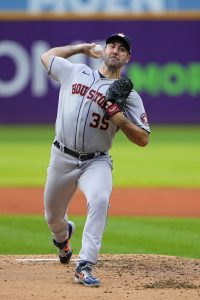
This winter might feature a similar but perhaps more extreme free agent. Justin Verlander threw only six innings in 2020 before Tommy John surgery wiped out the rest of that season and all of 2021. After returning to health, he held a showcase for interested teams, eventually re-signing for the Astros. The contract guaranteed him $25MM for 2022, despite having barely pitched for two years. It also came with a $25MM player option for 2023, conditional on Verlander reaching 130 innings pitched this year. Verlander has already surpassed that mark, allowing him to cash in another $25MM salary next year.
However, he’s pitching so well this season that he’s likely to decline his option and return to the open market in search of a larger payday. Through exactly 130 innings coming into tonight, he has a 1.73 ERA with a 25.5% strikeout rate, 4.6% walk rate and 37.4% ground ball rate. The strikeouts aren’t as high as Scherzer’s were last season, but his ERA is significantly better, with a lower walk rate and better ground ball rate.
Verlander is older than Scherzer, having turned 39 years old in February. However, if he got an annual average value of $25MM after two lost seasons, what would he get after a Cy Young-caliber campaign, even if he is one year older? It will be a fascinating and unprecedented experiment. Verlander could rightly ask for a similar AAV to Scherzer, in the $40-45MM range, depending on how strong he finishes. But how much term will teams be willing to commit to a player about to enter his age-40 season? How many teams will be willing to go to two years? Will any go to three like they did for Scherzer?
But then what does Verlander want? Would he prefer something like a one-year, $50MM deal or try to land around $40MM annually spread out over three years? Verlander has previously said he wants to pitch into his mid-40s, perhaps pointing towards the latter option, but we can’t really know.
MLBTR readers, what do you think? Below are two polls, one for what kind of term you think Verlander will get and another for what kind of guarantee. Let us know your thoughts.
How many years will Justin Verlander get on his next contract?
-
2 55% (1,499)
-
3 36% (971)
-
1 5% (137)
-
4 4% (101)
Total votes: 2,708
(link to poll for Trade Rumors iOS/Android app users)
What total guarantee will Justin Verlander get on his next contract?
-
Between $50MM and $100MM 65% (1,375)
-
Over $100MM 22% (459)
-
Less than $50MM 14% (297)
Total votes: 2,131
(link to poll for Trade Rumors iOS/Android app users)
Image courtesy of USA Today Sports.
Poll: Has Your Lockout Prediction Changed Recently?
Just over a week ago, MLBTR ran a poll asking for your predictions on when the season would start. The most optimistic option, that the season would start on March 31st as scheduled, was selected by just over 16% of respondents. The next most optimistic choice, that the season would begin between April 1st and 15th, garnered just over 18% of the vote. That means that almost two-thirds of voters expected a delay of two weeks or more.
Whether the situation has meaningfully changed in that time is a matter of opinion. For those on the pessimistic side of the spectrum, they could point to the fact that the two sides remain far apart in their respective positions, the most recent meeting lasting just 15 minutes and MLB announcing that Spring Training games won’t begin until March 5th at the earliest.
For those looking for glimmers of hope, they could point to the fact that both sides are planning to meet with greater frequency, perhaps daily, perhaps as soon as tomorrow. Maybe the stall tactics have been exhausted and the time for serious engagement has begun. Ben Nicholson-Smith hears that the MLB is willing to be flexible on some issues and that the MLBPA has said that there won’t be expanded playoffs if a full season is not played. Given that the owners are known to be seeking the extra revenue from those added playoff games, perhaps this ticking clock scenario will finally provide the urgency needed to make real progress.
Are the sleeves getting rolled up? Or is this all just for show? Is the ice about to crack? Or are we just seeing PR moves? After almost three months of mostly wasted time, can the next five years of baseball be ironed out in the next week or two?
What say you? Are you drowning in despair or does your hope spring eternal? Let us know in the poll below.
How has your feeling about the end of the lockout changed in the past week?
-
My feelings haven't changed significantly. 29% (3,620)
-
I am much more pessimistic. 27% (3,379)
-
I am slightly more pessimistic. 27% (3,338)
-
I am slightly more optimistic. 13% (1,688)
-
I am much more optimistic. 4% (487)
Total votes: 12,512
(link to poll for Trade Rumors iOS/Android app users)
MLBTR Poll: Where Will Zack Greinke Sign?
The free agent starting pitching market moved very quickly in the early stages of the offseason. A few prominent starters remained unsigned heading into the lockout, though. Among them — Zack Greinke, whose market remains largely undefined.
Greinke is no longer the ace he was at his peak. The six-time All-Star is coming off a 4.16 ERA over 171 innings, his second straight season with an ERA a touch over 4.00. That’s still capable run prevention, but Greinke’s days of posting sub-3.00 marks are probably behind him. His swing-and-miss and strikeout rates regressed last year, and he dealt with some neck soreness down the stretch. Between his age and those trends, teams can’t reasonably expect Grienke to assume the role of Game 1 or Game 2 playoff starter next season.
That said, there aren’t many rotations he wouldn’t still upgrade. He’s still one of the game’s best command artists. Greinke has shown a knack for remaining successful even as his raw stuff has ticked down with age. Even if his production might now be closer to average on a rate basis, the former Cy Young Award winner has continued to soak up innings. He exceeded 200 frames each season from 2017-19, and he’s surpassed 150 innings every year since 2007 (excluding the shortened 2020 schedule).
Immediate contenders could certainly stand to plug Greinke into the middle or back of their starting staff. Rebuilding teams might view signing him as an opportunity to bring aboard a famously cerebral hurler with an elite track record as an example for their younger, controllable arms (although it remains to be seen if the 18-year MLB veteran would be open to signing with a team that doesn’t look like a surefire competitor).
To date, however, we’ve heard very little about where Greinke might end up. He’s not expected to re-sign with the Astros, a testament to their enviable collection of in-house rotation depth. Beyond that, there’s not been any substantive indication in which direction he might be leaning. At the start of the offseason, Bob Nightengale of USA Today tweeted that Greinke “(wanted) to continue pitching for an NL team.”
The rationale for that reported desire to return to the Senior Circuit is unclear. If it were about getting another chance to hit regularly — Grienke has won a pair of Silver Slugger Awards in his career — that’ll probably prove moot. Major League Baseball and the MLB Players Association seem to have mutual interest in implementing a universal designated hitter in the next collective bargaining agreement. If that comes into play, then there’ll be no difference in rules between the leagues. If Greinke just prefers certain National League cities or ballparks and is indifferent about an opportunity to hit, then that could give NL suitors an upper hand.
It’s also at least worth contemplating the possibility Greinke moves on from playing entirely. Nightengale’s report suggests he was planning to continue his career as of a few months ago. He’s still an effective pitcher, even if he’s no longer elite. There’s been no indication he’s not planning to play in 2022, so him stepping away seems unlikely. But Greinke turned 38 years old in October, so one seemingly can’t definitively rule out the possibility he retires until he speaks publicly about his future or puts pen to paper on a new contract.
Where does the MLBTR readership think Greinke will be in 2022? Will he continue playing, and if so, where will he sign?
(poll link for app users)
Where Will Zack Greinke Sign?
-
Cardinals 7% (914)
-
Mets 7% (900)
-
Braves 7% (889)
-
Dodgers 6% (820)
-
Giants 6% (812)
-
Angels 6% (747)
-
Blue Jays 4% (568)
-
Retirement 4% (567)
-
Astros 4% (538)
-
Royals 4% (515)
-
Rangers 4% (470)
-
Tigers 3% (436)
-
Twins 3% (424)
-
Mariners 3% (422)
-
Yankees 3% (418)
-
Cubs 3% (403)
-
Brewers 3% (385)
-
Red Sox 3% (363)
-
Phillies 3% (358)
-
Padres 3% (322)
-
White Sox 2% (320)
-
D-Backs 2% (217)
-
Rays 2% (208)
-
Orioles 1% (173)
-
Nationals 1% (150)
-
Pirates 1% (127)
-
A's 1% (120)
-
Reds 1% (109)
-
Guardians 1% (65)
-
Marlins 0% (53)
-
Rockies 0% (46)
Total votes: 12,859
Poll: Who Will Play First Base In The Bronx?
Following the 2020 season, first base didn’t look like it’d be an area of concern for the Yankees for the next few years. Luke Voit led the Majors with 22 home runs in the pandemic-shortened 2020 season, turning in a stout .277/.338/.610 batting line that was 53 percent better than the league-average hitter, by measure of wRC+. A series of injuries derailed much of Voit’s 2021 season, however, prompting the Yanks to trade for Anthony Rizzo at the deadline.
Fast forward several months, and Rizzo is a free agent, Voit is a possible trade candidate, and the Yankees have been linked to big-fish names like Oakland’s Matt Olson and even free agent Freddie Freeman, who has yet to put pen to paper on a new deal in Atlanta. Everyone’s wondering who’ll play shortstop at Yankee Stadium in 2022, but first base is a question mark in its own right, so let’s take a quick look at each of the most plausible possibilities.
Luke Voit: There’s certainly an argument for sticking with the status quo and giving Voit another go-around. Last year was blown up by a torn meniscus that required surgery, an oblique strain that wiped out another month, and then continued knee troubles in the season’s second half. Voit, who turned 31 just yesterday, managed just eight more plate appearances in 2021 than he did in the 60-game 2020 sprint.
When he was healthy, Voit was a solid hitter, slashing .239/.328/.437 (111 wRC+) with 11 long balls, seven doubles and a triple in 241 trips to the dish. However, he also saw his strikeout rate spike to a career-worst 30.7% as he struggled through those injuries, and that batting line is a far cry from his aforementioned dominance in 2020.
In the three seasons leading up to 2021, Voit batted a combined .278/.371/.541 with 58 home runs, an 11.6% walk rate and a 26.4% strikeout rate in 905 plate appearances. He grades out as a poor defender at first base, but it’s easier to overlook the glovework if he’s hitting like he did from 2018-20. If he’s hitting like he did in 2021, that defense becomes harder to hide. Voit is controlled three more seasons and projected by MLBTR contributor Matt Swartz to earn $5.4MM in 2022. He’s affordable and has plenty of upside with the bat — but there are red flags to consider as well. For his part, Voit told Dan Martin of the New York Post that he loves playing in New York and hopes to remain. He also acknowledged that a trade is possible.
DJ LeMahieu: The 33-year-old thrived with the 2019-20 Yankees, playing all over the infield and turning in a combined .336/.386/.536 showing with a tiny 12.7% strikeout rate. However, with a .268/.349/.362 batting line in 2021 (100 wRC+), LeMahieu had his own downturn at the plate this past season.
If LeMahieu were still hitting at his 2019-20 levels, that’d be more than enough offense even if he moved to first base on a full-time basis. If he’s “only” an average or slightly above-average hitter moving forward, then his versatility and ability to play other positions becomes more important.
The Yankees could still give LeMahieu the bulk of the work at first base in 2022, though it doesn’t seem like it’d be a top choice. It’s hard to see them doing so with Voit still on the roster, meaning they’d likely need to move Voit and spend the bulk of whatever resources they have remaining on other needs (shortstop, pitching, etc.).
Anthony Rizzo: Rizzo had a big start in New York, but by the time the season had run its course, his overall offensive production as a Yankee looked pretty similar to Voit’s 2021 output: .249/.340/.428 (113 wRC+). Rizzo was an offensive force with the Cubs from 2014-19, batting a collective .284/.388/.513 in that time and topping 30 home runs in four different seasons. He’s since settled in as more of a 20 to 25-homer threat who makes good contact (15.1% strikeout rate) and draws some walks but is no longer an MVP-caliber hitter.
Two points in Rizzo’s favor over Voit: he’d give the Yankees a left-handed bat to help further balance a lineup that skews heavily toward right-handed hitters, and he’s also generally considered to be a strong defender. Defensive metrics were down on Rizzo in 2021, but he still graded out better than Voit typically has. That’s also the only time in his career he’s ever drawn negative marks for his glovework at first base.
Rizzo would be a costlier option, even though his stock has dropped from the point at which the Cubs were offering him extensions to keep him beyond 2021. MLBTR predicted a three-year deal at a rate of $15MM per season heading into the offseason, and even that was in part due to some of the narrative building up Rizzo as a difference-making clubhouse presence and leader. Post-lockout, an even shorter deal can’t be completely ruled out. He’ll still cost quite a bit more than Voit, but he won’t break the bank relative to, say…
Freddie Freeman: Braves fans and pundits alike are still a bit surprised things have gotten to this point with Freeman, the homegrown Braves icon whom most onlookers considered a slam dunk to spend his entire career in Atlanta. It’s still wholly plausible that after a protracted set of contract negotiations, Freeman returns to anchor the lineup at Truist Park, settling in as a lifelong Brave. At the same time, there have been reports that the Yankees, Dodgers and perhaps the Blue Jays could at least try to pry Freeman from Atlanta by offering the lengthier deal and/or weightier annual salary he’s thought to seek.
Freeman, the 2020 National League MVP, shook off some early-season doldrums in 2021 and finished out the year with a pretty typical (for him) .300/.393/.503 slash through 695 plate appearances. These endpoints are completely arbitrary, so take them with a grain of salt, but on May 7, Freeman finished the day with a .195/.326/.407 slash. From that point forth he hit .324/.409/.526.
Freeman will turn 33 in September, so the always-prominent concerns about paying for a player’s decline phase exist here as well. It might take six years and an annual salary in the $30MM range to sign him (or at least a salary well north of $30MM on a five-year term). The Yankees obviously have the resources to do that — particularly if they take an affordable approach at shortstop, as has been rumored — but there’s plenty of long-term risk.
Matt Olson: Perhaps the most-speculated trade match of the entire offseason, Olson-to-the-Bronx makes a good deal of sense. He’s an elite fielding left-handed bat who broke out as one of the game’s most well-rounded offensive players in 2021. Always a 30-homer threat — he swatted 29 homers in 2018 and 36 in 2019 — Olson slashed his strikeout rate from 26.3% all the way to 16.8% this past season. He did so while maintaining a walk rate north of 13%, and the resulting .271/.371/.540 slash and 39 home runs were career-best marks.
The A’s control Olson through 2023, but he’s projected to earn $12MM in arbitration (via Swartz) at a time when the A’s are reportedly aiming to reduce payroll. He’d give the Yankees a clear upgrade for at least two years, coming with an affordable (for them) salary in both seasons. It’s always possible that the Yankees could look into a long-term deal in the aftermath of a trade, too.
That said, Olson’s going to come with one of the heftiest asking prices of any player on the trade market. Yankees fans are surely loath to even consider the possibility of including a headliner such as top shortstop prospect Anthony Volpe, but any trade scenario involving Olson is probably going to come at a prospect cost that upsets many fans. Olson will (or at least certainly should) command multiple players from the top echelon of any team’s farm system.
—
Those are just a few possibilities for the Yankees, but they seem to be the most plausible paths for GM Brian Cashman and his staff to tread. After Freeman and Rizzo, the free-agent market doesn’t offer a clear everyday option at first base who’d be an upgrade over Voit and LeMahieu. There are other speculative trade candidates to consider (e.g. Dominic Smith, Josh Bell), but none who promise the impact and clear upgrade that Olson would bring to the fold.
Let’s open this up for readers to discuss and to take their best guess (link to poll for Trade Rumors iOS/Android app users) …
Who will be the Yankees' starting first baseman in 2022?
-
Luke Voit 25% (3,052)
-
Anthony Rizzo 24% (2,937)
-
Matt Olson 22% (2,672)
-
Freddie Freeman 16% (1,973)
-
DJ LeMahieu 12% (1,503)
-
Other (specify in comments) 2% (272)
Total votes: 12,409
Poll: Will The Season Start On Time?
For the second time in three seasons, we’re faced with the possibility that Major League Baseball will fall shy of a full 162-game schedule. Unlike in 2020, when the truncated season was an inevitability due to the Covid-19 pandemic, the potential for missing games in 2022 is entirely of MLB and the MLBPA’s doing. The expiration of the 2016-21 collective bargaining agreement wasn’t some secret, and a second contentious set of negotiations between the league and union has been widely expected for quite some time — particularly since return-to-play talks went about as poorly as one could possibly imagine in 2020.
While there was some talk of proactive negotiations at times, discussions were infrequent, at best. The MLBPA made a core economics proposal back in May. The league countered in August, suggesting — among other major changes — that free agency be linked directly to a player’s age (29.5 years, in MLB’s proposal). The MLBPA, looking to young stars like Juan Soto, Vladimir Guerrero Jr., Fernando Tatis Jr. and many others who’ll reach free agency well before 29, considered age-based a non-starter. (The league’s proposal also contained a $100MM salary floor — but that came with a major reduction in the luxury-tax threshold, from the prior $210MM down to $180MM.)
A second iteration of the union’s economic plan was put forth on Nov. 5, with key points including a raised minimum salary, earlier arbitration, changes to the draft order (with an eye on eliminating tanking), changes the league’s revenue-sharing structure and earlier free agency for certain players. The league was nonplused.
The MLBPA’s second proposal was met with a counter the following week, wherein the league reportedly kept the age-based free agency requirement and also sought to replace the arbitration system entirely — instead awarding pre-free agent salaries according to a WAR-based algorithm. That came with its own fairly obvious set of issues, as explored here at the time of the offer.
As the CBA’s Dec. 1 expiration ticked nearer, it became clear a deal would not be reached. MLB and the MLBPA agreed to move the deadline to tender contracts to arbitration-eligible players (which had been set for Dec. 2) up to Nov. 30. A flurry of free-agent and (to a lesser extent) trade activity ensued in the week leading up to the CBA’s expiration, as a handful of motivated teams sought to get some of their offseason business done before the lockout.
Commissioner Rob Manfred announced in a letter to fans on Dec. 2 that the league had locked out the players. Manfred claimed to have been “forced” into a lockout, which he described as a “mechanism to protect the 2022 season” — one that would “jumpstart” negotiations with the MLBPA. The two sides did not return to the table until mid-January, just over six weeks later.
Major League Baseball has made one formal proposal since implementing the lockout. The MLBPA has made two and has now been awaiting a counter to that second offer for ten days. In the interim, MLB made a request for federal mediation; the MLBPA swiftly rejected, with players banding together to voice a desire for daily negotiations with MLB rather than turning things over to a third party. Daily negotiations (obviously) have not occurred.
Players are still seeking increased minimum salaries, a bonus pool to reward pre-arbitration players based on performance, an increased luxury-tax threshold and measures to eliminate tanking, among other items. An expanded playoff format and the associated spike in television/streaming/gate revenues is among the league’s top priorities, but owners are also pushing back heavily on the extent to which minimum salary should increase and to which pre-arbitration players should be compensated.
Manfred confirmed yesterday that the league will submit a new proposal Saturday. He also declined to announce a delay to the start of Spring Training (although that feels like an inevitability), called missing regular season games “a disastrous outcome for the industry,” and maintained optimism that the season will begin on March 31, as scheduled.
All of that sounds nice, but it’s increasingly difficult to believe the two parties will make swift progress, given the acrimonious nature of talks to date. It’s also worth noting that back in October, Manfred made similar comments about agreeing to a new CBA before Dec. 1, calling an agreement the league’s “number one priority” and expressing optimism a deal would be reached in time.
That rundown of where things stand out of the way, let’s open this up for (further) debate among readers with a poll…
Will the 2022 MLB season start on time?
-
No, it won't start until sometime in May. 24% (4,276)
-
No, it will start between April 15 and April 30. 24% (4,248)
-
No, it will start between April 1 and April 15. 19% (3,290)
-
Yes, it'll start on March 31 as scheduled. 16% (2,827)
-
At this rate, I don't think we'll have a 2022 season at all. 8% (1,383)
-
No, it won't start until sometime in June. 6% (1,053)
-
No, it won't start until after the All-Star break. 2% (421)
Total votes: 17,498