
Astros Activate Jose Urquidy From 60-Day IL
The Astros have activated right-hander Jose Urquidy from the 60-day injured list, as noted by The Athletic’s Chandler Rome. To make room for Urquidy on the 40-man and active rosters, the Astros optioned left-hander Parker Mushinski to Triple-A and designated right-hander Spenser Watkins for assignment.
Urquidy, 28, made just six starts this season prior to going on the injured list with what was initially described as shoulder discomfort at the beginning of May. Urquidy was initially expected to be ready around the All-Star break, but fell behind that timetable as he has spent the past three weeks on a minor league rehab assignment, during which time he has posted a 4.50 ERA across four starts at the Double-A and Triple-A levels. Prior to going on the shelf, Urquidy had struggled to open the 2023 campaign, with a 5.20 ERA, 5.62 FIP, and a diminished 18.7% strikeout rate across 27 2/3 innings of work.
Despite his struggles and injuries this season, Urquidy’s return is nonetheless surely a relief for the Astros. With Urquidy, Luis Garcia and Lance McCullers Jr. all on the shelf throughout the 2023 campaign to this point, the Astros have been forced to rely on youngsters like JP France, Brandon Bielak, and Ronel Blanco to fill in alongside regulars Framber Valdez and Cristian Javier. With the return of Justin Verlander at the trade deadline and now Urquidy’s return from the injured list, the club’s rotation of Valdez, Verlander, Javier, Urquidy and rookie Hunter Brown is now firing on all cylinders. The Astros currently hold an AL Wild Card spot and figure to attempt to catch the AL West-leading Rangers over the next two months, with 2.5 games separating the division rivals.
Clearing the way for Urquidy’s return to the active roster is Mushinski, who sports a 2.79 ERA in 9 2/3 innings of work out of the Astros’ bullpen this season. Going forward he’ll return to the club’s Triple-A affiliate in Sugar Land, where he sports a 2.86 ERA in 22 innings of work this season, as he awaits his next big league opportunity. Meanwhile, Watkins appears poised to exit the Astros organization just six weeks after the club acquired him in a cash deal with the Orioles. Watkins never made an appearance with the big league club in Houston, but he has previous big league experience in the form of 39 appearances (30 starts) with the Orioles between 2021 and 2022, during which he posted a 5.85 ERA and 4.97 FIP in 160 innings of work.
The Astros will now have seven days to waive or release Watkins, who they will have the option of assigning outright to Triple-A in the event he is successfully passed through waivers. That being said, it’s certainly possible a rival club in need of rotation depth could see value in Watkins as an optionable starter who can be stashed in the minors as a potential fill-in option down the stretch.
Astros Release Blake Taylor, Joe Perez
The Astros informed reporters (including Chandler Rome of the Athletic) that they’ve released reliever Blake Taylor and infielder Joe Perez. Both players had cleared outright waivers this afternoon. Rather than retain them at Triple-A Sugar Land, Houston elected to move on entirely.
Taylor made 92 appearances for Houston between 2020-22. The southpaw was generally successful at keeping runs off the board, working to a 3.06 ERA through 79 1/3 innings. Neither his 19.1% strikeout rate nor 12.6% walk percentage were particularly impressive, though, and Taylor had increasingly been pushed to low-leverage work.
He’d spent all of 2023 on optional assignment to Sugar Land. The 27-year-old carried a 5.15 ERA over 36 2/3 frames there, walking over 13% of batters faced against a modest 14.9% strikeout rate. He lost his roster spot earlier this week when Houston snagged Jake Cousins off waivers from Milwaukee.
Perez was the roster casualty from the Justin Verlander trade. The 23-year-old has one major league appearance, which came as a pinch-hitter last season. A former second-round pick, the righty-hitting Perez has a below-average .255/.328/.399 slash over 357 Triple-A plate appearances this year. Prospect evaluators have credited the 6’1″ corner infielder with promising raw power but swing-and-miss concerns. He’s gone down on strikes at a lofty 27.2% clip this season.
MLB Trade Rumors Podcast: Trade Deadline Recap
The latest episode of the MLB Trade Rumors Podcast is now live on Spotify, Apple Podcasts, and wherever you get your podcasts! Make sure you subscribe as well! You can also use the player at this link to listen, if you don’t use Spotify or Apple for podcasts.
This week, host Darragh McDonald is joined by Steve Adams of MLB Trade Rumors to discuss the happenings of the recent trade deadline, including:
- The Mets decided to sell and sell big, maybe even for 2024 (1:15)
- The AL West turned into an arms race, with the Astros getting Justin Verlander and the Rangers getting Max Scherzer, among other deals (15:15)
- The Padres decided to go for it, holding onto Blake Snell and Josh Hader, as well as acquiring others (23:25)
- Cubs also decide to go for it, holding onto Cody Bellinger and Marcus Stroman, acquiring Jeimer Candelario (26:55)
- The Reds were surprisingly quiet (29:35)
- The Twins also sat on their hands (33:40)
Check out our past episodes!
- The Angels Are All In, Lucas Giolito and Picking a Lane – listen here
- All Eyes on the Angels, Cardinals Trade Options and Buyers or Sellers – listen here
- Top Deadline Trade Candidates, Ohtani Trade Potential and the Slipping Rays – listen here
Astros Acquire Justin Verlander From Mets
Justin Verlander is back in Houston. The Astros re-acquired the defending Cy Young winner and cash for outfield prospects Drew Gilbert and Ryan Clifford. Houston designated infielder Joe Perez for assignment in a corresponding 40-man move.
The Mets are paying a combined $35MM of Verlander’s 2023-24 salary. They’d pay half of his $35MM salary in 2025 if his option vests. In all, they’re paying as much as $52.5MM of the nearly $93MM that could still be paid out on his deal, pending that option.
Verlander, 40, was with the Astros from 2017-22 and departed as a free agent this offseason to sign for a record-tying annual value in Queens. His two-year, $86.666MM contract tied his former Tigers teammate Max Scherzer‘s $43.333MM AAV on a three-year deal with the Mets, but the reunion between the two future Hall of Famers will only prove to last a few months before being spun into a rivalry. The Mets shipped Scherzer to the Rangers on Saturday and will now send Verlander to Texas’ top division rival.

The 2023 season began on a sour note for Verlander, who missed the first five weeks of the year after suffering a strained teres major near the end of spring training. He’s in the midst of yet another strong season, though his performance in 2023 isn’t to the same level as it was in 2022, when he stunned the baseball world by capturing his third Cy Young Award as a 39-year-old in his first season back from Tommy John surgery. Verlander logged a ridiculous 1.75 ERA with a 27.8% strikeout rate and 4.4% walk rate in 175 innings last season. He’s pitched to a 3.15 ERA with a 21% strikeout rate and 8% walk rate in 96 innings this year, and seen slight steps back in his average fastball (from 95.1 mph to 94.6mph), swinging-strike rate (11.6% to 10%) and opponents’ chase rate (36.9% to 35%).
That said, even if Verlander’s overall season numbers aren’t quite as dominant as in 2022, there’s little doubt that he’s a major upgrade to an Astros staff that has lost right-handers Lance McCullers Jr. and Luis Garcia for the season. Righty Cristian Javier also hit a wall recently and has been struggling, and the ‘Stros lost right-hander Jose Urquidy for three months due to shoulder troubles. Verlander’s return will add one of the most talented arms of the entire generation back to the front of a staff, where he’ll join Cy Young candidate Framber Valdez, standout rookie Hunter Brown, Javier and rookie J.P. France. When Urquidy returns in the near future, it’s possible the Astros will go to a six-man rotation to help monitor the workloads of Brown and France.
For the Mets, Verlander becomes the fourth notable veteran they’ve shipped out in the past week, joining Scherzer, David Robertson and Mark Canha. The Mets have picked up a strong package of prospects in doing so but also waved a white flag on a season in which their $350MM+ payroll was expected to make them legitimate World Series contenders. They’ve also completely wiped out their rotation, which now consists of Jose Quintana (a trade candidate himself), Carlos Carrasco, Kodai Senga and David Peterson. Tylor Megill and Joey Lucchesi are candidates to step back into the starting staff.
The only near-term pitching prospect the Mets added in that slate of deals was righty Justin Jarvis, who came over from the Brewers and had been ranked near the back of their top 30 prospects on most publications. Given Carrasco’s status as a pending free agent and the unproven nature of Peterson, Megill and Lucchesi, they’ll head into the offseason with an enormous amount of work to do in rounding out the rotation. It’s a deep crop of free agents, headlined by names like Shohei Ohtani, Lucas Giolito, Aaron Nola, Blake Snell, Julio Urias, Sonny Gray, Jordan Montgomery, Marcus Stroman and NPB ace Yoshinobu Yamamoto. If the Mets plan to compete in 2024 — hardly a sure thing in the wake of their deadline activity — they’ll need to aggressively pursue rotation additions via either that free-agent market or the trade market.
The acquisition of Gilbert and Clifford could both help if the Mets choose the latter. While it’s certainly possible that both newly acquired outfielders fit into the long-term puzzle, that’s no sure thing — particularly for a team so willing to splash around in free agency. Brandon Nimmo is already signed for another seven years, so there are only two real long-term vacancies in the outfield anyhow.
Gilbert, 22, is the more advanced of the two prospects and the one who’s garnered more national fanfare. The Astros’ top pick in the 2022 draft, he’s already ascended to the Double-A level in his first full season of pro ball. The University of Tennessee standout laid waste to High-A pitching early in the season, slashing .360/.421/.686 in 95 plate appearances before an aggressive promotion to Double-A. He’s been a bit below average in terms of his overall output there, batting .241/.342/.371 in 264 plate appearances. However, Gilbert has also shown an advanced approach, walking in 12.5% of his Double-A plate appearances against a lower-than-average 17.5% strikeout rate.
MLB.com ranks Gilbert as the game’s No. 68 overall prospect, and FanGraphs has him at No. 49 on their list. Both reports give Gilbert a chance to be in the big leagues by next season, touting his plus speed, plus arm, great approach at the plate and growing power. He has a chance to stick in center field, perhaps pushing Nimmo to a corner if the veteran’s defense slips as he ages into his mid-30s. If not, Gilbert projects as a plus defender in an outfield corner. Both FanGraphs and MLB.com make note of his fiery personality, which could win over hometown fans while grating on opponents.
As for Clifford, he was taken ten rounds later in the same 2022 draft not for lack of talent but for a strong commitment to Vanderbilt University. The Mets convinced him to sign rather than attend college, offering him a huge $1.25MM bonus in the 11th round after most teams had passed assuming he’d head to school.
Jim Callis of MLB.com tweets that Gilbert and Clifford would’ve been his No. 1 and No. 2 Astros prospects, respectively, on the reranking of their system he’s set to publish following the deadline. Clifford hit just .247 but posted a .426 OBP in 101 plate appearances during his pro debut last year, and his rate stats in 2023 are outstanding: .291/.399/.520 in 371 plate appearances between Class-A and High-A. He’s slugged 18 home runs and 16 doubles, walking at a hearty 12.4% clip against a 24% strikeout rate.
FanGraphs had already bumped Clifford to the Astros’ No. 2 prospect — he’s now eighth in the Mets’ system on their rankings — crediting him with the potential to grow into 70-grade raw power. He’s a corner outfielder/first baseman with below-average speed and above-average arm strength. So long as his bat and overall offensive approach continue on their current trajectories, he could be in an outfield corner with occasional first base and DH time for the Mets at some point in 2025.
The Mets have done a nice job adding to their system, acquiring at least a pair of top-100-caliber prospects (Acuna, Gilbert) and another (Clifford) who could get there before long. They’ve paid a steep price to do so, however, gutting their 2023 roster and paying down close to $71MM on the Scherzer and Verlander deals alone. They’ve also saved just over $86MM on the pair of trades, including both salary and luxury tax penalties. In the event Verlander’s option vests and he exercises it, those savings would jump to more than $119MM (while the dead money they’d paid down would rise to more than $86MM).
The Mets are so far into the fourth and final tier of luxury penalization, that short of getting a team to take on the entirety of the Verlander and Scherzer contracts, there was no real way of ducking back underneath that line. The Astros, meanwhile, have received enough cash from the Mets that they’ll likely come in under the luxury line. Roster Resource had them exceeding the $233MM first-tier threshold by only a margin of $1.7MM even when assuming the full freight of Verlander’s remaining money; that clearly won’t be the case now. That would’ve been the first time Houston had crossed into luxury territory, but they’ll now have Verlander for a total of $22.777MM for the remainder of this season and next — plus an additional $17.5MM in 2025 if that option vests and he picks it up.
Bob Nightengale of USA Today first reported the Astros were acquiring Verlander for two prospects. Mark Feinsand of MLB.com first reported Gilbert’s inclusion, while Nightengale was first on Clifford. Joel Sherman of the New York Post was first with the specific financial breakdown.
Orioles, Mets Have Discussed Justin Verlander
Despite possessing the American League’s best record, the Orioles have had a quiet deadline. They rolled the dice on Shintaro Fujinami‘s recent improvements and triple-digit heater, hoping to deepen an already strong bullpen, but the rotation — arguably their top need — has gone unaddressed. The O’s were linked to multiple starters who have since been traded elsewhere, but other targets (e.g. Michael Lorenzen, Rich Hill) remain available. And, Baltimore clearly hasn’t ruled out a much higher-profile addition. Ken Rosenthal of The Athletic writes that the O’s are “on the periphery” of the Justin Verlander market, and MLB Network’s Jon Morosi tweets that the O’s are among the teams with whom the Mets are actively discussing Verlander. Morosi adds that the Orioles and Tigers are also talking — presumably about Lorenzen and/or Eduardo Rodriguez.
At least on paper, it’s hard to find a better fit for Verlander than the Orioles. Baltimore has the American League’s best record, is as deep in young talent as virtually any team in the game, and has a blank slate when it comes to long-term payroll. Perhaps no contending club could more easily accommodate the remaining $14.444MM on Verlander’s 2023 salary and the $43.333MM he’s owed in 2024. His contract also contains a conditional $35MM player option for the 2025 season that would vest if Verlander throws 140 innings next year. That’s been an understandable hurdle in talks with multiple clubs; Verlander will pitch the 2025 season at age 42.
The only guaranteed contract on Baltimore’s books in 2024 is backup catcher James McCann, and the Mets are picking up all but $2.5MM of next year’s salary as part of the trade that sent him to the Orioles. Cedric Mullins, Anthony Santander, John Means, Tyler Wells, Austin Hays and Ryan Mountcastle are among the many notable members of the Orioles’ arbitration class, but it’s nonetheless as close to a pristine payroll outlook as you’ll find for a contending club.
Meanwhile, starting pitching has long been reported to be the Orioles’ top need. It’s easy enough to understand why. Good as the team’s overall record is, their rotation’s 4.48 ERA ranks 16th in the Majors. With the exception of veteran innings eater Kyle Gibson, the bulk of the Baltimore staff is approaching or has already exceeded 2023’s innings total. Dean Kremer is just 15 innings shy of last year’s total. Kyle Bradish is 36 innings shy of his own 2023 total. Wells and Grayson Rodriguez have already topped last season’s workloads.
The Mets traded one high-priced, future Hall of Famer over the weekend when they sent Max Scherzer to the Rangers, paid down all but $22.5MM of the salary he was still owed, and acquired top prospect Luisangel Acuna in return. They’re reported to hold Verlander in even higher regard, setting both a higher prospect asking price and showing less willingness to pay down significant money.
The Verlander market is generally thought to be accelerating, and there’s a real chance he’s traded today. SNY’s Andy Martino reports that the Mets’ Verlander talks “picked up steam” late last night with multiple clubs. The Astros, according to Martino, have made a formal offer. At least one other team has done the same, and there are two to three more clubs also involved. Jon Heyman of the New York Post dusted off a time-honored trade deadline favorite this morning, tweeting that there’s at least one “mystery team” beyond the previously reported Astros and Dodgers.
That, of course, could be the Orioles, but given Verlander’s status and the league-wide need for starting pitching, it’s only natural to assume others are involved. The Reds, Angels and D-backs have all been rumored to be in the market for varying levels of rotation help as well, and virtually no major name hits the trade market without the Padres throwing their hat into the ring as well. None of those teams has been directly connected to Verlander, to be clear, but the day is young.
Mets, Astros Continue To Discuss Justin Verlander
8:39pm: Andy Martino of SNY tweets that a deal between the Astros and Mets is not imminent, though it’s certainly possible talks could yet pick up steam.
7:14pm: The Astros and Mets continue to discuss possible Justin Verlander trades, reports Ken Rosenthal of the Athletic. Rosenthal writes that New York is trying to deal the future Hall of Famer before tomorrow evening’s deadline. Bob Nightengale of USA Today tweets that talks between Houston and the Mets have accelerated within the past day.
It’s unclear how likely a deal is to pull off. Nightengale notes the Dodgers remain in the picture, for one. There’s also the matter of Verlander’s hefty contract and full no-trade rights, although the reigning AL Cy Young winner is certainly plenty familiar with Houston. Astros GM Dana Brown said on MLB Network Radio this afternoon the club was no longer prioritizing adding to the rotation; Rosenthal writes that Houston owner Jim Crane could get involved in discussions to try to bring Verlander back though.
More broadly, Chandler Rome of the Athletic tweets that Houston is now again focused on the rotation. The Astros expect to welcome José Urquidy back from the 60-day injured list this week, reducing the need for a depth pickup. Of course, a Verlander acquisition would be far more than that.
It’s a fascinating situation two days after the Mets traded Max Scherzer to the Rangers. Verlander could well follow his former teammate out of Queens, and it seems there’s genuine interest on the Astros’ part in making them direct competitors for an AL West title. Verlander has a 3.15 ERA despite an average 21% strikeout rate through 16 starts. He’s making $43.333MM in each of the next two seasons and has a $35MM vesting/player option for the 2025 campaign. The Mets would certainly have to kick in some money, as they did with Scherzer, but figure to be open to doing so as they look to continue adding upside to the farm system.
Astros Claim Jake Cousins From Brewers, Designate Blake Taylor
The Astros have claimed right-hander Jake Cousins off waivers from the Brewers, reports Adam McCalvy of MLB.com. There had been no prior indication Cousins had been removed from Milwaukee’s 40-man roster, so this will drop their count to 39. The Astros have now announced the claim, with left-hander Blake Taylor designated for assignment in a corresponding move and Cousins optioned to Triple-A.
Cousins, 29, was first added to Milwaukee’s roster in June of 2021. He made 30 appearances for them the rest of the way, allowing 2.70 earned runs per nine innings. He struck out 35.2% of batters faced and kept 47.4% of balls in play on the ground, but also issued walks at a 15.2% clip. In 2022, he missed most of the year with a right elbow effusion, or a build up of fluid in the area. He was only able to make 12 appearances with the big league club.
Here in 2023, Cousins was frequently optioned to Triple-A and recalled for the first few months of the season. He made nine appearances with the big league club, posting a 4.82 ERA. He’s also made 13 Triple-A appearances with a 7.30 ERA, though a .533 batting average in balls in play and 58.3% strand rate are clearly inflating that number in the small sample.
The Brewers evidently tried to quietly sneak Cousins through waivers to open a roster spot, though the Astros swooped in to stop that from happening. He’s struck out 31.4% of major league hitters he’s faced in his career but has also walked 16.2% of them. They will surely try to help him better harness his stuff as he provides them with some bullpen depth. He has a pair of option years remaining, one of which he’s burning here in 2023, but can be sent to the minors for one more season in the future.
In order to take a shot on Cousins, the Astros are risking losing Taylor, who originally came to Houston in the 2019 trade that sent Jake Marisnick to the Mets. Taylor spent most of 2020 to 2022 with the big league club in Houston, making 92 appearances with a 3.06 ERA, 19.1% strikeout rate, 12.6% walk rate and 44.3% ground ball rate. Here in 2023, he began the season on the injured list due to a left elbow strain. He was activated in mid-April and immediately optioned to Triple-A. He’s made 35 appearances at that level with a 5.15 ERA. His 43.7% ground ball rate there has been solid but his 14.9% strikeout rate and 13.1% walk rate are both well worse than average.
The Astros will now have a week to trade Taylor or pass him through waivers, though the timeline on the trade option is much tighter with tomorrow’s deadline. Left-handed relief tends to always be in demand and Taylor still has an option year beyond this one, though time will tell if his poor results this year dampen the interest from rival clubs.
Latest On Justin Verlander
7:36PM: The Braves have also “checked” on Verlander but aren’t currently in talks with the Mets, MLB Network’s Jon Morosi tweets.
5:50PM: Following the Mets’ trade of Max Scherzer to the Rangers led to further increased speculation about a trade of fellow high-priced, multi-time Cy Young winner Justin Verlander. Several teams have been tied to the nine-time All-Star, including the Rangers, Astros and Dodgers. However, Andy Martino of SNY reports that the Mets value Verlander much differently than Scherzer. They’ve placed a higher asking price in terms of prospects and aren’t willing to pay down salary to the same extent they were in order to move Scherzer.
Astros fans may be hoping for a reunion with Verlander, who won his third career Cy Young Award in Houston last season, but it doesn’t appear that’s likely. Astros GM Dana Brown tells Jim Bowden of MLB Network Radio on SiriusXM that his team isn’t in the market for a starting pitcher right now and is instead focused more on the back of the bullpen and a left-handed bat (Twitter link). Per Martino, the Astros indeed checked in on Verlander, but the teams were “nowhere close” to agreeing on his value.
USA Today’s Bob Nightengale hears similarly, writing that while Houston and New York have indeed discussed a Verlander deal, an Astros source tells him they’d likely require the Mets to pay down a “significant” portion of Verlander’s salary this year and next. Verlander’s $35MM vesting option for the 2025 season, which triggers upon reaching 140 innings pitched next year, is another hang-up in a potential deal. All of that complicates a potential Verlander/Astros reunion, which clouds the water on a trade in general. Like Scherzer, Verlander has a full no-trade clause — and Ken Rosenthal of The Athletic writes that the Astros are “perhaps” the team for which he’s most willing to waive that protection.
Broadly speaking, everything will hinge on Verlander’s preferences. Via SNY’s Steve Gelbs (Twitter link, with video), the 40-year-old righty said following Sunday’s game that his openness to a trade “largely depends on how the organization views next year,” adding that he’s “committed to trying to win a championship” in Queens but would be more open to waiving his no-trade protection if Mets decision-makers feel it’s best to take a step back in 2024. The Mets will have plenty of rotation questions with Scherzer now in Arlington and Carlos Carrasco hitting free agency at season’s end. Presently, Verlander, Kodai Senga and Jose Quintana are the only surefire starters signed into 2024. Depth options like David Peterson, Tylor Megill, Joey Lucchesi and Jose Butto all remain on hand as well.
Early indications are that the Mets don’t view this as a large-scale teardown. GM Billy Eppler plainly said after yesterday’s Scherzer trade that he does not view the current step back as a rebuild (link via Anthony DiComo of MLB.com) They’ll have ample financial firepower to pursue new arms to fill out the rotation in the offseason — with a particularly deep crop of free agent starters available. Shohei Ohtani, Julio Urias, Lucas Giolito, Aaron Nola, Blake Snell, Sonny Gray, Marcus Stroman, Jordan Montgomery and NPB ace Yoshinobu Yamamoto are among the names in the upcoming class of free agent arms.
The Mets already have nearly $220MM in guaranteed money on next year’s books, per Roster Resource — a number that includes the $26.833MM they’ll pay Scherzer. (Texas is picking up a reported $16.5MM of next year’s salary.) That’s before factoring in Brooks Raley‘s $6.5MM club option or arbitration raises for a group of ten players, headlined by first baseman Pete Alonso. Owner Steve Cohen trotted out a record payroll of more than $350MM this season, so clearly the capacity for spending is there — it’ll just be a matter of whether the Mets want to spend to that extent again after this year’s efforts fell flat in notable fashion. Trading Verlander would radically lower that 2024 financial outlay, but it’d also only create another hole that the Mets would likely need to fill in the rotation (likely via free agency).
For now, they’ll have about 48 hours to see if anyone’s willing to meet their asking price on Verlander — and then to gauge whether the right-hander is amenable to the deal.
Latest On Justin Verlander
Few potential trade candidates are as notable as Justin Verlander. There are myriad complications that could stand in the way of a deal, but there’s been speculation over the past couple days about the chance of Verlander being on the move.
Mark Feinsand of MLB.com suggested Thursday night there was some industry sentiment the Mets would look to move him. Feinsand listed the Astros and Rangers as potential fits. Will Sammon and Tim Britton of the Athletic also indicated that the two Texas-based franchises had expressed some interest, writing that the Mets at least appear willing to genuinely consider offers on Verlander and Max Scherzer.
Still, it remains to be seen how aggressively other teams would pursue either player. Sammon and Britton characterize Texas’ interest in Verlander mostly as due diligence as they evaluate all their rotation possibilities. Evan Grant of the Dallas Morning News wrote yesterday that Texas would be open to surpassing the competitive balance tax threshold in a Verlander trade. However, he similarly indicated the Rangers are checking in on virtually every pitcher on the market, with nothing to suggest Verlander talks have gotten particularly advanced. Joel Sherman of the New York Post reports that Texas has also inquired on reliever Brooks Raley and corner outfielder Tommy Pham.
Texas has a luxury tax number around $224MM, as calculated by Roster Resource. They’re $9MM shy of the $233MM base threshold. Verlander is due around $15.4MM through season’s end, so an acquisition would push Texas past that marker unless the Mets paid down a significant chunk of the salary.
New York might be willing to do so. They paid down all of Eduardo Escobar’s deal and are reportedly willing to send cash in other trades, although they didn’t include any money in the David Robertson swap with Miami. There’s a ways to go to get to that point, though. New York would have to weigh the possible return against subtracting a key player who’s under contract for 2024, when the Mets surely envision a return to competitiveness.
That’s even before considering the players’ ability to block any deal. Both Verlander and Scherzer have complete no-trade rights. Understandably, neither has gone on record about whether they’d waive that provision. Verlander said a few days ago the Mets had not approached him about that possibility. Scherzer told the New York beat last night that he’d likely speak with the front office about the franchise’s direction over the next few days. Sherman indicates the Mets would only gauge the pitchers’ willingness to waive the no-trade clauses if they first find a potentially workable trade package.
Texas pursued Verlander as a free agent last winter. He reportedly wasn’t keen on joining the Rangers at the time, although that’s seemingly because he questioned how quickly they’d be competitive. That’s no longer in doubt with the Rangers topping the AL West by two games and motivated deadline buyers.
There’s plenty of familiarity between Verlander and the Astros, of course. Houston has been on the hunt for a starting pitcher for a few weeks. General manager Dana Brown downplayed the rotation need a bit after acquiring reliever Kendall Graveman yesterday, however. Brown indicated that while Houston was still open to adding a starter, the rotation is “not as high a priority as the bullpen was,” in part because of the loftier asking price teams are demanding to relinquish starting pitching (link via Chandler Rome of the Athletic).
Astros Acquire Kendall Graveman
Kendall Graveman is back with the Astros. Houston announced they acquired the right-hander in a one-for-one deal that sends young catcher Korey Lee to the White Sox.

It’s the second time in three years that the Astros are swinging a deadline trade to bring Graveman to Houston. The ‘Stros acquired Graveman and Rafael Montero from the Mariners prior to the 2021 deadline, sending Abraham Toro and Joe Smith to Seattle in that swap. Graveman shined down the stretch with Houston and parlayed his career-best season in ’21 into a three-year, $24MM deal with the White Sox. He’s currently in the second season of that contract, which pays him $8MM annually. He’s still owed about $2.84MM of that sum through season’s end, plus next year’s $8MM.
Graveman, now 32, is in the midst of a solid second campaign in Chicago. He’s sitting on a 3.48 ERA through 44 innings with eight saves and eight holds, regularly having worked in high-leverage spots for the South Siders. His 22.6% strikeout is down from his 27% peak in 2021 but is roughly in line with last year’s 23.2% mark and only a bit shy of the 23.7% league average for relievers.
That said, there are at least some red flags of note. Graveman has seen his typically excellent ground-ball rate wilt to 39.4%, and his walk rate has spiked in 2023, sitting at a career-worst 10.8%. He’s also plunked five batters — already exceeding last year’s total of three (in 65 innings).
Even if his command hasn’t been as sharp as in the past, Graveman has been generally effective against both right-handed and left-handed opponents. Lefties have mustered only a .182/.338/.291 output against him, and righties haven’t been much better at .221/.293/.404.
Graveman will add another experienced arm to an Astros setup corps featuring Hector Neris, Bryan Abreu, Phil Maton and Ryne Stanek. He and Neris both have closing experience, which gives Dusty Baker some options on days closer Ryan Pressly isn’t available. That Graveman is signed through 2024 surely appealed to Houston as well, given the fact that Stanek and Maton are both free agents at the end of the current season. Neris, meanwhile, has an $8.5MM player option (contingent on an end-of-season physical) for the 2024 season. He could very well turn it down, given his current 1.44 ERA and hearty 28.6% strikeout rate.
The addition of Graveman and his remaining salary takes the Astros’ payroll north of $195MM, per Roster Resource. In terms of luxury-tax calculations they’re now over $220MM, which still leaves them with plenty of breathing room underneath the $233MM first tier threshold. Houston now has $149MM in guarantees on next year’s payroll, before considering that option on Neris or what figures to be an expensive slate of arbitration-eligible players. Cy Young candidate Framber Valdez and star outfielder Kyle Tucker headline an arb class that also includes Jose Urquidy, Blake Taylor, Mauricio Dubon, Chas McCormick, Luis Garcia and the aforementioned Abreu. Valdez will be due a raise on this year’s $6.8MM salary. Tucker will get a bump from this season’s $5MM figure.
In exchange for a season-plus of Graveman, the Astros will part with the 25-year-old Lee, whom they selected with the No. 32 overall pick in the 2019 draft. The 23-year-old Lee made his MLB debut last year but appeared in just 12 games and logged only 26 plate appearances. He went 4-for-25 with a pair of doubles, a walk and nine punchouts during that time, though there’s little to be gleaned from such a small sample of work in his debut campaign.
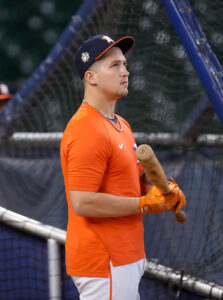
Lee has power but plenty of swing-and-miss in his game, both of which were on display in 2022 when he swatted 25 dingers but fanned in 28.5% of his plate appearances. He hasn’t hit for as much power in Triple-A this season (just five homers) but has lopped nearly four percentage points off that strikeout rate and is currently batting .283/.328/.406. In parts of three Triple-A seasons, he’s a .255/.313/.446 hitter.
Defensively, Lee draws praise for elite arm strength that’s helped him nab 32% of would-be base thieves to this point in his professional career. Baseball America’s latest scouting report, which pegged him seventh in Houston’s system, credits him with an 80-grade arm, average framing ability and above-average blocking skills. FanGraphs’ Eric Longenhagen currently ranks Lee as the game’s No. 75 prospect, putting a 70 grade on his arm strength and likening him to Austin Hedges earlier in his career (circa 2017-18) — an elite defender with enough power to offset a well below-average hit tool.
The White Sox have been relying on Yasmani Grandal as their primary catcher for the past four seasons, but he’s set to become a free agent at season’s end. Backup Seby Zavala posted a superficially strong .270/.347/.382 slash in 205 plate appearances last year, but that was buoyed by a .404 average on balls in play and accompanied by an alarming 31% strikeout rate. Predictably, that wasn’t a recipe for sustainable success; he’s regressed significantly in 2023, batting just .158/.202/.296 in 165 plate appearances. The system’s next most-advanced catcher, Carlos Perez, is having a down year in Triple-A (.248/.305/.429 — 77 wRC+).
Catching looked to be a clear area of need for the White Sox, but in a matter of 72 hours they’ve added an immediate big league option, Lee, and one of the game’s most highly regarded catching prospects in Edgar Quero, who came over from the Halos in the Lucas Giolito/Reynaldo Lopez deal. Lee and Quero will both get opportunities in the Majors in the near future, though Lee is the more immediate option of the two. He should get a look down the stretch, and a strong showing could put him in the mix to be the White Sox’s primary catcher as soon as next year.
Jeff Passan of ESPN first reported the White Sox and Astros were swapping Graveman and Lee. Bob Nightengale of USA Today confirmed it was a one-for-one deal.