
Red Sox Interested In Dalton Rushing
The Red Sox have interest in Dodgers catcher Dalton Rushing, according to a report from Sean McAdam of MassLive. McAdam also reports that the Dodgers have had a scouting presence at Boston’s High-A affiliate in Greenville to monitor shortstop prospect Franklin Arias and left-handed prospect Brandon Clarke. It’s unknown whether a deal between the two sides is close at this time or what the exact framework of a deal involving Rushing would look like.
Rushing, 24, was a second-round pick by the Dodgers in 2022 and entered the 2025 season as a consensus top-30 prospect in the sport. He slashed a sensational .308/.424/.514 in 31 games at Triple-A Oklahoma City for the Dodgers earlier this year before being promoted to the majors back in May. He’s struggled since that promotion while serving as the backup to Will Smith, with a .216/.280/.297 slash line across 27 games. He’s struck out in a worrisome 41.5% of his plate appearances, but has looked like a capable defensive catcher and has some impressive underlying power numbers including a 12.2% barrel rate.
While Rushing may not be an immediate impact player at this point, he’d be a long-term addition with plenty of upside for the Red Sox who could make up for the loss of Kyle Teel in this past winter’s Garrett Crochet deal. In the short-term, meanwhile, he would surely be an improvement over Connor Wong as the backup to Carlos Narvaez behind the plate in Boston. Wong has had a brutal season in 2025, hitting just .144/.228/.144 across 101 plate appearances. That’s 95% worse than league average by measure of wRC+, and his weak offense has been complemented by middling defense behind the plate. Rushing would provide as much or more defensive value as compared to Wong, with a modestly more valuable bat in the short-term and plenty of long-term room for growth behind the plate both offensively and defensively.
Both prospects McAdam reports the Dodgers have been scouting are extremely well-regarded. Following the graduations of Kristian Campbell, Roman Anthony, and Marcelo Mayer earlier this year, MLB Pipeline rates Arias as the top prospect in Boston’s system while Clarke clocks in as the system’s fourth-best prospect. Baseball America, meanwhile, places Arias fourth and Clarke sixth in the system on a ranking that still includes both Anthony and Mayer. Arias is ranked 34th overall in Pipeline’s top 100 while Clarke is unranked. BA is lower on Franklin (55th overall) but views Clarke as a top-100 talent in his own right as he’s 72nd on their list.
That pair of prospects would be a substantial return if the Dodgers were able to land them both in exchange for Rushing’s services, particularly considering the fact that Rushing is largely blocked by the presence of Smith on a long-term deal. Catching talent is highly sought-after around the league, however, and with other catching-hungry teams like the Rays, Nationals, Guardians, and Mets all potentially on the lookout for help behind the plate it would surely be a competitive market if the Dodgers were to make Rushing available.
That L.A. is scouting some of Boston’s high-end prospects should not necessarily be taken as a sign that a deal is close or especially likely. McAdam suggests that the Dodgers might not be motivated to part with a player on their major league roster to acquire prospects far away from the majors. It wouldn’t be a shock if a club that was willing to offer L.A. immediate help of significance was better positioned to land Rushing, and the Guardians in particular have intriguing pieces they could dangle such as closer Emmanuel Clase and outfielder Steven Kwan, both of whom could make plenty of sense for a Dodgers club that is on the prowl for bullpen help and has gotten minimal production from Michael Conforto in left field. That’s a largely speculative connection, of course, and Rushing by himself surely wouldn’t be enough to land either one of those players.
All that said, it wouldn’t be the first time the Dodgers have dealt a blocked top prospect in exchange for long-term pieces. Prior to the 2024 season, L.A. swapped Michael Busch (and right-hander Yency Almonte) to the Cubs in a deal that landed them outfield prospect Zyhir Hope and left-handed pitching prospect Jackson Ferris. That pair of prospects were not yet consensus top-100 talents and were even farther from the majors then than Arias and Clarke are now, but the deal has certainly paid off for the Dodgers given that Hope is rated as the sport’s #31 prospect by Pipeline while Ferris clocks in at #97. Of course, it must be noted that the Busch trade was an offseason deal, and the urgency associated with the trade deadline could make the Dodgers less incentivized to focus on bolstering their farm system when they’re in the midst of defending their title as the reigning World Series champions.
Red Sox Unlikely To Trade Jarren Duran This Summer
With a 55-49 record and a seat at the Wild Card table, the Red Sox have seemingly played themselves out of selling this summer even after trading former franchise face Rafael Devers to the Giants last month. There’s been plenty of speculation about the possibility that they could trade from their glut of outfield talent and move Jarren Duran, but it seems as though that might not be in the cards—for now, at least. ESPN’s Jeff Passan recently wrote that the Red Sox might more or less stand pat this summer, while Jon Heyman of the New York Post noted that Boston is “believed” to be unlikely to move Duran despite considerable interest from the Padres.
Sean McAdam of MassLive provides further details on the situation surrounding Duran. He suggests that while a deal involving Duran is “likely” at some point, the Red Sox are inclined to hold off on making such a deal until the offseason. McAdam then goes on to note that the Padres offered Boston a three-player package of right-hander Dylan Cease, top catching prospect Ethan Salas, and an additional prospect not named Leo De Vries that was “quickly rejected.” That’s a fairly significant offer, particularly given the fact that the Red Sox had reportedly expressed interest in Cease previously in conversations with San Diego this summer.
Duran’s in the midst of a decent season but has taken a massive step back from his All-Star 2024 campaign that ended with an eighth place finish in a crowded NL MVP race. This year, Duran has hit just .254/.321/.428 with a wRC+ of 104 and below average defense in the outfield. While the Padres clearly still believe in the upside they saw when he put together a 6.8 fWAR, 8.7 bWAR season last year given their offer of a longtime top prospect and a front-of-the-rotation rental, it’s possible that the Red Sox are hoping for a strong second half from Duran that can raise his value headed into the offseason and potentially get the attention of other clubs besides San Diego.
Perhaps the Red Sox were willing to reject that offer from San Diego in part because the players they’d be acquiring are in the midst of down seasons themselves. Cease has long been viewed as one of the sport’s most talented pitchers, but he’s posted a 4.59 ERA that’s actually 10% worse than league average by ERA+ across 21 starts this year. His peripheral numbers remain strong and some of his poor season-long numbers can be attributed to a nine-run, four-inning implosion at Sutter Health Park in West Sacramento back in April. Even so, Cease doesn’t carry the same surefire ace pedigree he would have had even one season ago. Salas is in no better shape, having been sidelined by a stress fracture in his back for most of 2025 following a tough season at the High-A level last year.
While the Padres have been frequently connected to Duran for quite some time now, they’re far from the only team for whom he’d be an excellent fit. The Phillies have a major hole in left field, the Astros are in desperate need of a left-handed bat to help balance their lineup, the Royals are in clear need of help all around the outfield, and even non-contending clubs in need of offense like the Pirates could make sense as a suitor for Duran given that he won’t reach free agency until after the 2028 season. That’s hardly an exhaustive list of teams that could make sense as a fit for Duran, as his combination of upside and long period of team control could make him attractive for virtually any team that isn’t already stacked with outfield talent themselves.
Blue Jays, Rays Among Teams Showing Interest In Dylan Cease
Earlier this week, ESPN’s Buster Olney reported that the Padres had discussed Dylan Cease with multiple AL East teams in addition to the Mets and Cubs. It seems the interest from the AL East has come from every contending club in that division. Jon Heyman of The New York Post reports that the Blue Jays, Rays, Red Sox and Yankees have all checked in with the Friars to express interest.
The Cease rumors have picked up steam over the past few days. It’d be unconventional for a team that presently occupies the National League’s final playoff spot to trade one of its two best healthy starters. President of baseball operations A.J. Preller has never shied away from big swings, though, and they’re seemingly considering the idea of trading Cease for young talent while reallocating payroll room and prospects to different available starters. Dennis Lin of The Athletic reported last night that they’re among the teams that have been in touch with the Marlins regarding Sandy Alcantara, for instance.
Cease is an impending free agent who is playing on a $13.75MM salary. He’s a lock to receive and reject a qualifying offer if the Padres hold him all season. As a luxury tax payor, they’d only receive a compensatory pick after the fourth round in the 2026 draft. That’s worth far less than they’d receive if they traded him, though they need to balance that against the hit it’d deal to the rotation for the stretch run.
The 29-year-old Cease is incredibly durable and has pitched at a top-of-the-rotation level in previous seasons. His near-30% strikeout rate and 97 MPH average fastball still point to that ceiling, but he hasn’t managed particularly strong results this year. He carries a 4.59 earned run average across 113 2/3 innings. Some of that can be traced to a nine-run drubbing at the hands of the A’s in their extremely hitter-friendly park in Sacramento back in April. That’s hardly the sole factor, though. Cease got on a decent run after that outing but has allowed a 5.21 ERA over his most recent seven starts.
Even if this hasn’t been a banner year, Cease’s track record and stuff would make him an extremely desirable trade target. He’d be the best rental rotation arm available, and teams would still view him as a surefire playoff starter. The Yankees, Red Sox and Blue Jays are all known to be in the starting pitching market. New York has a strong 1-2 in Max Fried and Carlos Rodón, but Luis Gil is a health question mark and they lost Clarke Schmidt to Tommy John surgery. Boston would certainly benefit from adding another high-end starter to pair with Cease’s former White Sox teammate, Garrett Crochet. Toronto’s veteran-laden rotation lacks a true top-end starter, and they’ve already been tied to some of the higher upside trade candidates like Edward Cabrera and Mitch Keller.
The Rays would be the most surprising entrant into this group, though Tampa Bay tends to at least kick the tires on big names even if they don’t often land them. They’re a game and a half back of Boston in the Wild Card race. They’d have little hope of re-signing Cease, and a big push for a rental when they’re a bubble team seems unlikely. Tampa Bay could trade a starter like Taj Bradley or Zack Littell in the coming days; they’re also hopeful of getting Shane McClanahan back in the final two months.
San Diego awaits the return of one of their own top starters. Michael King has been out for more than two months with a nerve injury in his shoulder. He’s targeting a mid-August comeback. As of now, he’d team with Cease, Nick Pivetta and potentially Yu Darvish in a playoff rotation. That’s not a terrible group, but both Cease and King are months from free agency. Pivetta can opt out after next season, and Darvish is approaching his 39th birthday. Even with Joe Musgrove returning from Tommy John surgery next year, the long-term rotation picture is cloudy. They could try to thread the needle of acquiring a controllable arm while shipping Cease out.
MLBTR Podcast: David Robertson, Trade Chips For The O’s and A’s, And What The Rangers Could Do
The latest episode of the MLB Trade Rumors Podcast is now live on Spotify, Apple Podcasts, and wherever you get your podcasts! Make sure you subscribe as well! You can also use the player at this link to listen, if you don’t use Spotify or Apple for podcasts.
This week, host Darragh McDonald is joined by Anthony Franco of MLB Trade Rumors to discuss…
- The Phillies signing David Robertson (1:40)
- Orioles general manager Mike Elias basically admitting they will be selling (7:00)
- The Athletics listening on their starters but not Mason Miller (16:05)
- The Rangers flipping Dane Dunning and hanging around the Wild Card race (23:35)
Plus, we answer your questions, including…
- What about a Duran Duran trade? Jarren Duran of the Red Sox for Jhoan Durán of the Twins? (29:55)
- Should the Angels be buying? (37:30)
- If the Cardinals are sellers, who should be untouchable? (44:50)
Check out our past episodes!
- Rays’ Ownership, The Phillies Target Bullpen Help, And Bubble Teams – listen here
- Firings in Washington, Bad Braves, And An AL East Shake-Up – listen here
- Depleted Mets’ Pitching, The Pirates Are Open For Business, And More! – listen here
The podcast intro and outro song “So Long” is provided courtesy of the band Showoff. Check out their Facebook page here!
Photo courtesy of Jerome Miron, Imagn Images
Daniel Bard Retires
Veteran reliever Daniel Bard is ending his comeback bid and will retire, reports WEEI’s Rob Bradford. The 40-year-old Bard signed a minor league contract with the Mariners earlier this summer and had pitched well in a limited look with Seattle’s Triple-A affiliate in Tacoma, allowing two runs on six hits and a walk with nine punchouts in 5 2/3 innings.
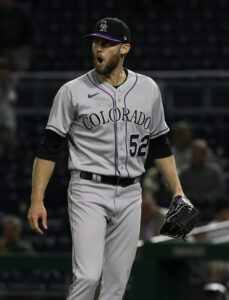
Originally a first-round pick by the Red Sox back in 2006, Bard made his big league debut in 2009 and quickly became a star reliever in Boston. In his first three seasons, the righty pitched 197 innings of 2.88 ERA ball and piled up 79 holds and five saves. Along the way, he fanned nearly 27% of his opponents. That’d be a strong mark even in today’s game, but at the time, the league-average strikeout rate sat around 18% (compared to this year’s 21.9%). Bard ranked 21st among all relievers in strikeout rate over that three-year period and, despite not debuting until mid-May in ’09, tallied the third-most holds in MLB from ’09-’11.
In 2012, the Red Sox tried moving Bard into the rotation, hoping some of that single-inning dominance would carry over to lengthier stretches. It didn’t pan out. Bard made ten starts and was hit hard, yielding a 5.30 ERA in 54 1/3 innings and showing some alarming command troubles. The lanky right-hander walked more hitters (36) than he struck out (34) and plunked eight batters. He was moved back into the bullpen later in the season.
Bard’s command struggles had actually begun in September of 2011. They continued in 2012 during that shift to the rotation, and reached a tipping point the following season. Bard pitched just one major league inning in 2013, plus another 15 1/3 frames in the minors — during which he walked one-third of the batters he faced and threw 11 wild pitches. Bard would eventually learn that he’d also been pitching with an undiagnosed case of thoracic outlet syndrome — he underwent surgery in 2014 — and he’s also been candid throughout his career about his ongoing battle with anxiety.
A series of minor league deals with the Rangers, Cubs, Pirates, Cardinals and Mets didn’t pan out, and by 2017 Bard had opted to call it a career and move onto the next phase of his baseball journey. He took a job with the D-backs, serving as a player mentor/mental skills coach who worked with young players throughout the organization. Bard held that position for a couple years but found that with some time off, his velocity, command and desire to pitch all returned. He worked out for clubs ahead of the 2020 season, signed a minor league deal with the Rockies and embarked on one of the more improbable comebacks in recent memory.
Bard was heading into his age-35 season and hadn’t pitched in the majors for seven years when he went to camp with the Rockies. He wound up not only earning a spot on the roster in the shortened 2020 season — he was named National League Comeback Player of the Year. Bard pitched 24 2/3 innings with the Rockies that season and logged a 3.65 ERA with a 25.5% strikeout rate, 9.4% walk rate, six saves and two holds. His fastball, which had sat 93-94 in 2012-13 while he was unknowingly pitching with thoracic outlet syndrome, averaged a hearty 97.3 mph.
Bard had a tough 2021 season but was brilliant in 2022 when he saved 34 games and pitched to a 1.79 earned run average. The Rockies signed him to a two-year, $19MM extension that summer rather than ship him out when he would’ve been one of the most popular rental arms on the trade market. That contract didn’t work out, as Bard struggled again in 2023 and missed the 2024 season recovering from a pair of surgeries: one to repair a torn meniscus and another to repair a torn flexor tendon. He’d hoped to make one final run in the majors, but he’ll now wrap up one of the more interesting career arcs this generation of baseball has seen.
All told, Bard pitched in parts of five seasons with the Red Sox and four with the Rockies — plus minor league appearances with the Rangers, Cardinals and Mets. He pitched 457 1/3 big league innings, saved 66 games, tallied 91 holds and recorded a 3.74 ERA. Bard set down just over 24% of the hitters he faced on strikes over the course of his career, and he earned more than $31MM in salary, thanks largely to that late-career extension in Colorado.
Bard has already taken one non-playing job with the Diamondbacks. It stands to reason that plenty of clubs would welcome someone with Bard’s background to their organization, be it in a coaching role, a player development role or a baseball operations role — should he choose to again look for new opportunities to stay involved in the game.
Red Sox Sign First-Rounder Kyson Witherspoon
The Red Sox have agreed to a deal with first-round draft pick Kyson Witherspoon, according to MLB Pipeline’s Jim Callis. Witherspoon will get a $5MM bonus, which is below the $5,114,200 slot price attached to the 15th overall selection.
The University of Oklahoma product was viewed as the top college right-hander in this year’s draft class, and the best righty pitcher available altogether on some boards. It was seen as something of a coup for the Red Sox to grab Witherspoon with the 15th overall pick, as pundits all had him within their top tens. Fangraphs was highest on Witherspoon as the sixth-rated prospect in their rankings, Baseball America had him seventh, the Athletic’s Keith Law placed Witherspoon ninth, and MLB Pipeline and ESPN’s Kiley McDaniel each had the righty tenth.
Witherspoon’s repertoire is highlighted by an outstanding fastball that can hit 99mph, and regularly sits in the 95-97mph range. His slider also received a 60-grade from both BA and Pipeline, as Witherspoon can throw the pitch with “horizontal action and depth” (as per Pipeline’s scouting report) anywhere from the mid-80s to touching 91mph. His curveball and changeup aren’t quite as consistently high-rated by evaluators, but there is plus potential with either pitch, giving Witherspoon the possibility of a front-of-the-rotation arsenal. His delivery is a little unusual, but Law observes that Witherspoon’s arm action helps him achieve quality control on his pitches.
Tanner Houck’s Rehab Paused Due To New Pronator Strain
Tanner Houck is being evaluated by Red Sox team doctors after sustaining “a recurrence of the right pronator strain” the right-hander initially suffered back in mid-May, MLB.com’s Ian Browne writes. Houck had pitched in five minor league games during his rehab assignment, but the Sox have now officially returned him from that assignment and kept him on the 15-day injured list in order to monitor this new problem.
More will be known once Houck is through a fresh round of tests, yet if he has suffered another strain, it might entirely set his rehab back to square one. Given how he has already missed more than two months of the season, a similar recovery timeline could now threaten Houck’s availability to return before the 2025 campaign is over.
Even the best-case scenario of just a minor strain would still likely mean Houck will be sidelined for at least another month, adding to what has been a frustrating season for the right-hander. Houck had reached the 30-day end point of his initial rehab assignment and was seemingly close to being activated from the IL before this setback arose. The Red Sox will probably shift Houck to the 60-day IL at some point, which wouldn’t change his timeline (the 60-day window would start at the time of his initial placement on the 15-day) but it would allow the club to open up space on the 40-man roster.
A breakout 2024 season seemingly cemented Houck’s place in the Boston rotation, as Houck posted a 3.12 ERA and 6.5% walk rate over 178 2/3 innings. Most of his secondary metrics didn’t back up that strong bottom-line ERA, however, and as Browne noted, most of Houck’s success came in the first half of the 2024 campaign. The hurler’s late struggles then got several degrees worse in 2025, when Houck posted an 8.04 ERA in his first nine starts and 43 2/3 innings.
Getting Houck back before the trade deadline wouldn’t have really altered Boston’s plan to acquire starting pitching, yet getting a change to gauge Houck’s effectiveness in a start or two would’ve given the Sox a bit more information before jumping into the trade market.
Looking at Boston’s rotation depth, Hunter Dobbins and Kutter Crawford have already been lost to season-ending injuries. Josh Winckowski has been sidelined by a flexor strain for roughly the same amount of time as Houck, and only just started a throwing progression, so Winckowski is probably a month away if all goes well in his rehab. Patrick Sandoval had internal brace surgery on his elbow last June and has moved to the point of mound work, though early September could be his target date.
This leaves Garrett Crochet, Brayan Bello, Lucas Giolito, Richard Fitts, and the struggling Walker Buehler as Boston’s starting five. Even with Kyle Harrison and Cooper Criswell available in Triple-A as backup options, getting another solid rotation piece in play at the deadline would go a long way towards helping the Sox reach the playoffs. Boston is 53-46, as yesterday’s loss to the Cubs snapped a 10-game winning streak that had brought the Red Sox back into the postseason hunt.
Latest On Rays’ Deadline Possibilities
The Rays stumbled into the All-Star Break. The Red Sox swept them in a four-game set at Fenway to conclude the first half. Tampa Bay has dropped 11 of their past 14 games. They’d climbed as high as 11 games above .500 in late June; they’re now just three over at 50-47.
Like many other fringe contenders, the Rays face a pivotal upcoming two weeks. They’ll play host to the Orioles and White Sox for very winnable series coming out of the Break. They’ll hit the road for sets in Cincinnati and a four-game series against the Yankees running through July 31. President of baseball operations Erik Neander acknowledged to Marc Topkin of The Tampa Bay Times that the club’s deadline plans will in part be shaped by how they begin the second half.
“We’ve got to make up some ground,” Neander said of a team that sits a game and a half behind the Mariners for the last AL Wild Card spot. “There’s a belief in this team. … But these are really big games that will have some sort of influence on our decision-making as the month draws to a close.”
Unsurprisingly, Neander expressed hope that the team plays well enough for the front office to add. “I’d like to think that just about anything I think this group is capable of over these few weeks will lead us in a position where we’re looking to at least improve somewhere on the roster, if not significantly so,” he told Topkin. “But we’ve got to go out and play well and win. If we don’t, or if we have a stretch the way we had the last couple of weeks going into the Break, that comes with all sorts of additional questions that I’d much rather not think about.”
The Rays rarely operate as strict buyers or sellers. Remaining consistently competitive while operating with bottom five payrolls requires an openness to listening on veteran players even in years where they’re simultaneously trying to add to the big league roster. Tampa Bay already made one notable trade this month, acquiring controllable setup man Bryan Baker from Baltimore for the 37th pick in last Sunday’s draft. They could continue to add to the bullpen and/or bring in a right-handed bat (ideally in the outfield).
At the same time, they’ll certainly get calls on their more expensive players. Chris Cotillo of MassLive reported last night that the Red Sox would be interested in Yandy Díaz if the Rays make him available. Boston has an obvious need for a right-handed hitting first baseman. Still, it’s not clear if the Rays will shop Díaz at all — much less to a division rival that currently sits 2.5 games above them in the standings.
Ken Rosenthal of The Athletic wrote this morning that the Rays would likely hold onto Díaz, who is signed at a bargain rate for another two and a half seasons. He’s making $10MM this year and is guaranteed $12MM for next season. There’s a $10MM club option for ’27 that would vest at $13MM if he takes 500 plate appearances next year. Díaz and the Rays initially agreed to the extension in 2023 and restructured it just this spring to guarantee his ’26 earnings while adding the option year.
Rosenthal argues the Rays may be reluctant to trade Díaz so soon after he agreed to a team-friendly extension. That said, one could’ve made a similar point regarding Tyler Glasnow — whom the Rays traded to the Dodgers a little over a year after he signed an extension. Rosenthal nevertheless suggests that Tampa Bay would be likelier to move second baseman Brandon Lowe or closer Pete Fairbanks if the team doesn’t play well coming out of the Break.
Lowe went on the injured list with left oblique tightness last week but could be reinstated when first eligible tomorrow. He’s making $10.5MM this year and controllable for another season on an $11.5MM club option. Lowe started the year slowly but has been on a tear since May and is up to 19 homers with a .272/.324/.487 batting line.
Fairbanks has a 2.75 ERA and has gone 15-18 in save opportunities over 36 innings. His strikeout rate has been trending down for a couple seasons, though, dropping to a career-low 20.7% clip. While Fairbanks is playing this year on an extremely affordable $3.667MM salary, his contract contains an increasingly expensive club option for 2026.
That initially came with a $7MM base value but contained up to $6MM in escalators. Fairbanks has already pushed the option price to $8MM by reaching 125 appearances over the past three seasons and topping 25 games finished this year. It’ll climb by another $1MM when he makes three more appearances, $1MM more with 18 appearances, and another $1MM with 23 more games. It’d jump by $500K apiece with three, eight, and 13 more games finished.
Unless he suffers a significant injury, Fairbanks should push the option value well into eight figures. That’d make him one of the highest-paid players on the 2026 roster. As long as they’re in the playoff picture, the Rays may view that as an offseason problem. This year’s salary can only climb by a maximum of $300K. Yet it’s a factor for a front office that needs to balance the short and long term as much as any.
Beyond Lowe and Fairbanks, the Rays seem likely to shop a starting pitcher. Impending free agent Zack Littell is the most obvious candidate, but USA Today’s Bob Nightengale reported over the weekend that they’re open to inquiries on controllable righty Taj Bradley.
The Rays have a strong rotation of Ryan Pepiot, Drew Rasmussen, Shane Baz, Littell and Bradley. Hard-throwing righty Joe Boyle is pitching in multi-inning relief, but Neander reiterated to Topkin that the Rays would be comfortable using Boyle as a starter if a spot opened. They’re also hopefully a couple weeks away from Shane McClanahan making his long-awaited return from injury.
Red Sox, Ronaldo Hernandez Agree To Minor League Deal
The Red Sox are bringing catcher Ronaldo Hernández back to the organization on a minor league contract, reports Chris Cotillo of MassLive. The 27-year-old was released from a minor league deal with the Yankees a couple weeks ago. He had a three-day stint in the Mexican League before returning to the affiliated ranks. He’ll report to Triple-A Worcester.
Hernández was once a highly-regarded prospect in the Tampa Bay system. The Rays dealt him to the Red Sox in advance of the 2021 season. That turned out to be a lopsided deal in Tampa Bay’s favor, as they landed Jeffrey Springs in that four-player swap. Boston also acquired infielder Nick Sogard, while the Rays picked up reliever Chris Mazza. Hernández spent a couple seasons on Boston’s 40-man roster but went through outright waivers after the ’22 campaign.
The Colombia native played the ’23 season in Worcester. He spent last year in the Arizona system and made 25 Triple-A appearances in the Yankees organization earlier this year. He hit .221 with a pair of home runs. Hernández now carries a .264/.324/.453 slash line in nearly 1200 plate appearances at the top minor league level. He has been called to the majors twice (both by the Red Sox in 2022) but hasn’t made it into a game.
Carlos Narváez and Connor Wong are Boston’s only catchers on the 40-man roster. The Sox traded depth catcher Blake Sabol to the White Sox over the weekend. Hernández backfills alongside defensive specialist Seby Zavala in Worcester. Zavala would probably be the first man up if either Narváez or Wong sustain an injury.
Trade Deadline Outlook: Boston Red Sox
MLBTR’s team-by-team look at the upcoming deadline continues with the Red Sox. There has been a lot of drama in Boston this year and it hasn't always been smooth sailing. However, a ten-game win streak just before the break has catapulted them into buyer position. The question now is how aggressive they will be in adding to the club ahead of the deadline. With a glut of outfielders, would they be willing to use that surplus to bolster another area of the roster?
Record: 53-45 (55.9% playoff probability, per FanGraphs)
For other entrants in this series, see this post.
Buy Mode
Potential needs: pitching, first base, backup catcher
The Sox have one elite pillar in their rotation, but it's questionable after that. Even that pillar comes with some degree of uncertainty. Garrett Crochet leads the club in starts and innings pitched, by a healthy margin in both cases. He has a 2.23 earned run average over 129 1/3 innings pitched.
Can he keep it up the rest of the way? In the early parts of his career, he was either hurt or working as a reliever. A move to the rotation last year worked out brilliantly, though the White Sox backed off his workload in the second half. He had 101 1/3 innings pitched through the end of June but then just 44 2/3 innings the rest of the way, finishing at 146 frames. Whether he can get that into the 200 range and still be effective in the postseason is something of an open question.
Even with Boston counting on Crochet to fill one playoff rotation spot, they would need more. Are Lucas Giolito and Brayan Bello viable candidates? Giolito has been trending in a positive direction lately. He missed all of 2024 due to elbow surgery and then a hamstring strain put him on the shelf for the first month of 2025. Through his first seven starts, he had a 6.42 ERA, 18% strikeout rate and 7.3% walk rate. In his most recent six outings: 0.70 ERA, 25.5% strikeout rate and 6.9% walk rate.
The Sox will have to decide if that's small sample noise or Giolito getting on track after years of struggles. From 2019 to 2021, he posted a 3.47 ERA with a 30.7% strikeout rate. But over 2022 and 2023, he had a 4.89 ERA and 25.5% strikeout rate. It would be great if he's back to his old self, but six starts is still a pretty small sample size.
It's a somewhat similar situation for Bello, who missed the first few weeks of the season due to a shoulder strain. Through eight starts, he had a 3.83 ERA, 16.1% strikeout rate and 12.2% walk rate. But in his seven most recent appearances, he has a 2.61 ERA, 19.7% strikeout rate and 5.8% walk rate.
The options beyond those three are not inspiring. Walker Buehler has a 6.12 ERA on the year. Tanner Houck had an 8.04 ERA before a flexor pronator strain sent him to the injured list. Richard Fitts has some passable numbers but just 12 big league starts under his belt. Hunter Dobbins and Kutter Crawford are done for the year. Kyle Harrison isn't doing especially well in the minors. Patrick Sandoval could be a factor later in the season, but he's still a question mark for now. He had UCL surgery just over a year ago and has yet to begin a rehab assignment.

Unlock Subscriber-Exclusive Articles Like This One With a Trade Rumors Front Office Subscription
- Access weekly subscriber-only articles by Tim Dierkes, Steve Adams, and Anthony Franco.
- Join exclusive weekly live chats with Anthony.
- Remove ads and support our writers.
- Access GM-caliber tools like our MLB Contract Tracker