
Pirates To Recall Antwone Kelly For MLB Debut
The Pirates will recall pitching prospect Antwone Kelly for his MLB debut, reports Francys Romero. He’s already on the 40-man roster, as the Bucs needed to select his contract last offseason to keep him out of the Rule 5 draft. They’ll need to make an active roster move involving a pitcher tomorrow.
Kelly, not to be confused with the similarly named pitcher who was recently traded from the Dodgers to the Cubs, is one of Pittsburgh’s better minor league arms. An Aruba native, he was an under the radar international signee in 2021. Kelly has added strength and built his velocity in pro ball, posting strong strikeout numbers as he climbed through the minors. He put himself firmly on the prospect radar with 107 1/3 innings of 3.02 ERA ball between High-A and Double-A last year.
Baseball America ranks Kelly the #8 prospect in the organization. He’s seventh in the system at MLB Pipeline. Keith Law of The Athletic ranked him 15th in his offseason writeup of the Pittsburgh organization, while Eric Longenhagen of FanGraphs had him 19th when rankings Bucs prospects just last week. Despite the slight variation in the ordinal rankings, the scouting reports are generally in alignment.
Kelly is a shorter righty at 5’10” who gets good life on a fastball that is averaging 97.6 mph in Triple-A. His mid-80s changeup is his best secondary pitch and a potential weapon against left-handed hitters. Evaluators’ biggest question is whether he’ll develop a reliable enough breaking ball. Kelly has a mid-80s cutter that most scouts grade as a fringe-average offering. The arsenal has gotten a lot of whiffs at the lower levels but hasn’t missed many bats in Triple-A.
Over his first 54 innings at the top minor league level, Kelly owns a 4.50 earned run average with a modest 20% strikeout rate. His 10.6% swinging strike mark is also a bit below average, while he has walked 10% of batters faced. Kelly has spent most of the season working from the Triple-A rotation but has come out of the bullpen for his last two outings.
Kelly does have some experience against the top hitters in the world. He was the #1 starter for the Netherlands in this year’s World Baseball Classic. That gave him the unenviable task of taking on eventual champion Venezuela to kick off the tournament. Kelly worked three innings of two-run ball, striking out Wilyer Abreu but giving up a home run to Javier Sanoja.
Colin Beazley of The Pittsburgh Post-Gazette confirms the Bucs will use Kelly out of the bullpen. They’re surely not closing the door on a long-term rotation future. Pittsburgh took a similar tack last year breaking Bubba Chandler and Braxton Ashcraft in as relievers. They’re also simply in need of reliable bullpen arms, particularly ones from the right side.
Pirates relievers are 20th in MLB with a 4.45 ERA. The past couple weeks have been even uglier, as they’re allowing nearly six earned runs per nine in the last 14 days. They gave up a 10-run inning to blow open a tied game in a loss to the Dodgers on Tuesday. That was less than a week after an utter meltdown in Houston, when they squandered a 9-5 lead in the eighth inning — allowing six runs despite retiring the first two batters.
Dennis Santana was expected to be their most reliable right-hander this season. He’s sitting on a 5.00 ERA across 27 frames. Carmen Mlodzinski got knocked around in his second appearance after being bumped from the rotation. Rookie Wilber Dotel pitched well in his first seven outings before the Dodgers pummeled him in the aforementioned 10-run frame. Yohan Ramírez is a journeyman who should be in low-leverage spots. It’s a clear area of need at the trade deadline, but they’ll take a look at Kelly as they search for solutions in the interim.
Pirates Place Oneil Cruz On Injured List
The Pirates announced that outfielder Oneil Cruz has been placed on the 10-day injured list, retroactive to June 8th, with left hand fourth and fifth metacarpal non-displaced fractures. Fellow outfielder Billy Cook has been recalled in a corresponding move. Cruz is expected to miss at least a month, per Kevin Gorman of the Pittsburgh Tribune-Review.
It appears that the injury occurred on Saturday, as seen in this clip from MLB.com. Cruz was trying to score from first on a double when he was tagged on his hand. He hasn’t been in the starting lineup since then, though he did appear as a pinch runner on Sunday. He was in yesterday’s initial lineup but was scratched before game time with left hand discomfort. It appears that further testing found the fractures and he will be on the shelf about a month. The All-Star break is from July 13th to 16th, so perhaps Cruz will end up returning after that.
It’s a rough blow for the Pirates. Cruz is a flawed player since he strikes out a ton and he’s still a work in progress in the outfield, but all his tools are elite. He crushes the ball when he makes contact, in addition to having great speed and a strong throwing arm. He has 14 home runs this year, 21 stolen bases, a .264/.350/.472 line and a 128 wRC+. Even with his questionable defense, FanGraphs has credited him with 1.7 wins above replacement on the year.
The Bucs also lost Konnor Griffin to the IL a couple of weeks ago and Joey Bart landed on the shelf before that. Perhaps due to the injuries, the club has been in a bit of a slide, having lost four in a row. That has dropped them to 34-33 and just outside a playoff spot.
They will now have to try to climb out of that hole without Cruz. Jake Mangum has been covering center field for the past few days while Cruz has been hurt, so he seems likely to become the everyday guy there for the next month. He is a strong defender, so the Bucs should get a boost there, but the lineup should be worse. Mangum has a .293/.332/.359 line and 94 wRC+ in his career, even with a very high .345 batting average on balls in play.
Photo courtesy of Jordan Godfree, Imagn Images
Mariners Acquire Carson Fulmer
The Pirates have traded right-hander Carson Fulmer to the Mariners, reports Alex Stumpf. Fulmer was not on Pittsburgh’s 40-man roster and won’t need a spot with Seattle, unless his minor league deal contained some kind of opt-out or upward mobility clause. It’s unclear what the Bucs are getting in return but it may be a cash deal.
Fulmer, 32, has appeared in nine major league seasons. He has thrown 256 2/3 innings, allowing 5.44 earned runs per nine. His 20% strikeout rate and 11.9% walk rate are both a bit worse than league average, while his 40.9% ground ball rate is right around par.
He finished last season with the Angels but was outrighted off the roster at the end of the campaign. He was able to elect free agency and later signed a minor league deal with the Pirates. He has been pitching for Triple-A Indianapolis this year, logging 34 frames over 16 appearances. His 6.35 ERA in that time certainly doesn’t look good, though it’s likely a bit misleading. His .330 batting average on balls in play and 63% strand rate are both to the unfortunate side. His 17.5% strikeout rate this year isn’t great but his 43.1% grounder rate is decent.
If the Mariners plan to add Fulmer to the 40-man roster, he is out of options and would therefore need to go on the active roster. If not, he’ll provide them with some extra depth capable of pitching multiple innings.
Photo courtesy of Kim Klement Neitzel, Imagn Images
Pirates Select Davis Wendzel, Transfer Chris Devenski To 60-Day IL
The Pirates announced that they have selected the contract of infielder Davis Wendzel from Triple-A Indianapolis. Outfielder Jhostynxon Garcia is being optioned in Wendzel’s place. To clear space on the 40-man roster, reliever Chris Devenski is being transferred to the 60-day injured list.
Wendzel signed a minor league contract with Pittsburgh in December and was a non-roster invite to spring training. In 211 plate appearances at Triple-A this year, he’s batting .246/.360/.491 with nine home runs and a 123 wRC+. That continues a run of decent minor league hitting for Wendzel, as he’s been average or better at Triple-A since 2024. Wendzel’s track record in the Majors is much thinner. He appeared in 27 games for the Rangers in 2024, managing just six hits in 49 plate appearances.
Wendzel typically plays third base or shortstop, though he’s unlikely to get much time at the hot corner. Nick Gonzales has a 115 wRC+ in 238 plate appearances as the Pirates’ main third baseman. Wendzel is more likely to see time at shortstop, if only a little. Jared Triolo is covering for the injured Konnor Griffin at the moment. Triolo has a 57 wRC+ this year that is virtually unplayable, and while he’s a good defender at second and third, he’s been worth -6 Defensive Runs Saved in 588 2/3 career innings at short. At the same time, Wendzel is entirely unproven in the Majors, so his selection is more about giving the Pirates a second backup infielder (Tyler Callihan being more of a utility type) than seriously challenging for playing time.
Devenski’s move to the 60-day IL clears a roster spot for Wendzel and puts Devenski out until early July. The right-hander went on the 15-day IL on May 7th after serving a two-game suspension for intentionally throwing at the Reds’ Sal Stewart a few days earlier. Devenski’s injury was undisclosed at the time, and that remains the case one month later. His transfer to the 60-day IL is backdated to the original placement, so Devenski can return during the July 7-9 home series against the Braves if he is ready.
As for Garcia, he heads down to Triple-A after a roughly three-week stint in the Majors. The 23-year-old got into 13 games since being recalled on May 19th. He batted .200/.243/.229 in 37 plate appearances, which amounts to just a 32 wRC+. Garcia hasn’t played much in the minors this year thanks to a back injury in mid-April, which sidelined him for a month. Still, Garcia is a former Top-100 prospect and ranks No. 4 in the Pirates’ Top-30, according to MLB.com. He’ll get regular work at Triple-A for the time being and will surely get called up again at some point.
Photo courtesy of Reggie Hildred, Imagn Images
Red Sox Acquire Joe La Sorsa
6:41pm: Boston announced the trade but has yet to reveal the corresponding move.
5:20pm: The Pirates are going to trade left-hander Joe La Sorsa to the Red Sox, reports Ari Alexander of 7News Boston. The Bucs will get cash in return, per Alex Speier of The Boston Globe. It was reported a few days ago that the southpaw was triggering an upward mobility clause in his minor league deal. Alexander says that La Sorsa will be with the Sox in New York tomorrow as they kick off a series against the Yankees. Boston will need to open a 40-man roster spot for La Sorsa.
La Sorsa, 28, will be appearing in his fourth straight major league season once he gets into a game with the Sox. From 2023 to 2025, he pitched for the Rays, Nationals and Reds, posting a 5.21 earned run average in 57 innings.
He signed a minor league deal with the Pirates in the offseason and has been pitching for Triple-A Indianapolis. He has thrown 26 innings with a 3.46 ERA. His 21.2% strikeout rate is around average while his 5.8% walk rate and 47.9% ground ball rate a few ticks better than par.
The lefty triggered an upward mobility clause in his deal at the end of spring training. The way such clauses work is that the player must be offered to the 29 others teams in the league. If any of them want to give the player a roster spot, the signing team has to either trade him or give him a roster spot themselves. If they all pass, he will stay with the signing team. La Sorsa stayed with the Bucs in late March, suggesting all clubs passed on him at that time. In this case, the Sox have signed up.
Boston has three lefties in the bullpen, though Aroldis Chapman is the closer. That leaves Jovani Morán and Danny Coulombe as the lefty options for situations before the ninth inning. Coulombe spent about three weeks on the injured list due to cervical spasms and has a 6.55 ERA around that IL stint. Morán has a much better 3.19 ERA but has gotten some help from a fortunate .197 batting average on balls in play and 85.2% strand rate. La Sorsa will give the Sox another option in the southpaw relief corps.
The Sox don’t have a lot of flexibility in their current bullpen mix. Of their eight relief arms, only Justin Slaten and Greg Weissert are optionable, but those are two of their two setup arms. La Sorsa himself is optionable but, as mentioned, he is expected to be with the big league club in the Bronx tomorrow. Perhaps Coulombe will be designated for assignment, as that would open up a spot on both the active and 40-man rosters for La Sorsa. Other options for that kind of move would be Tyron Guerrero and Ryan Watson, who both have ERAs north of 5.00 at the moment.
Photo courtesy of Thomas Shea, Imagn Images
Pirates Pursuing Bullpen Upgrades
The Pirates are actively pursuing bullpen help, reports Ken Rosenthal of The Athletic. A source tells Rosenthal that just about every club is looking for additions in that department but the Bucs are being more aggressive than most.
It’s an understandable pursuit for Pittsburgh. The club has been rebuilding for many years but is making a more serious run at contention this year. The results so far are fairly encouraging, as they are 33-29 and currently in possession of a Wild Card spot.
That is thanks in part to a resurgent offense, something that MLBTR’s Leo Morgenstern covered earlier this week. In the rotation, they have a solid group consisting of Paul Skenes, Braxton Ashcraft, Mitch Keller, Jared Jones and Bubba Chandler. The starting depth is strong enough that Carmen Mlodzinski got bumped out, much to his chagrin.
The relief corps, however, is a relative weak spot. Pittsburgh relievers have a collective 4.32 earned run average, which puts them 19th out of the 30 clubs in the league. Their 23.8% strikeout rate is decent, putting them 11th, but their 11.2% walk rate is better than just seven other clubs and their 39.5% ground ball rate puts them ahead of just six teams.
Dennis Santana was one of the club’s best relievers last year, with a 2.18 ERA. He was probably a bit lucky to have that figure, as he had a .211 batting average on balls in play and 80.7% strand rate. His 3.21 FIP and 3.68 SIERA suggested a bit of regression was coming but his ERA has shot way up to 5.47 this year. Gregory Soto has taken over the closer’s role and has a 2.86 ERA on the year but he has gotten some help from a .194 BABIP and just 3.6% of his fly balls clearing the fence. Evan Sisk and Wilber Dotel have ERAs barely above 1.00. Despite strong underlying numbers, they have gotten some luck and can’t maintain ERAs quite that good. On the other end of the spectrum, Mason Montgomery and Yohan Ramírez have ERAs near 5.00 despite deserving better.
It’s not an awful group but all contenders generally look for bullpen help before the trade deadline. For the Pirates, since they have a strong rotation and a lineup that is performing well, it’s not at all a surprise that the bullpen would be a focus.
It may be hard to pull off a notable deal in the short term, however. The trade deadline is still almost two months away, falling on August 3rd this year. A number of American League teams are struggling but none of them are really buried in the standings since the poor results are so widespread. The Athletics currently have the final Wild Card spot even though they have a 30-31 record. The Angels are in the basement with a 24-39 record but are only seven games back of the A’s. The National League is a bit stronger but, again, very few teams would consider themselves out of it. The Giants and the Rockies are the only N.L. teams more than six games out of a playoff spot.
Even if there are some teams who consider themselves cooked, they may not want to make a trade right now. Clubs in buyer position tend to get more aggressive as the deadline approaches, so a team in seller position might hold and try to drum up frenzied bidding later on in the season.
A great many relievers around the game could be imagined as potential trade candidates, so it’s almost pointless to wonder who the Bucs could be looking at right now. That being said, perhaps the most obvious relief trade candidate at the moment is Antonio Senzatela. He is 31 years old, is playing for a rebuilding Rockies club and is an impending free agent. His deal has a $14MM club option but it’s hard to see that being picked up. He has already been connected to the Padres in a trade rumor.
A starter for most of his career, Senzatela missed most of 2023 and 2024 due to Tommy John surgery and struggled badly in 2025. He got moved to the bullpen last year and finished the season with a 6.65 ERA. This year, he has a 1.30 ERA in 34 2/3 relief innings. His four-seamer velocity has ticked up to 97.3 miles per hour after being at 94.9 mph last year. His 20% strikeout rate isn’t strong but he is only walking 7.7% of batters faced and is inducing grounders at a 43.5% clip.
His .209 BABIP and 89% strand rate are helping him out but his 3.30 FIP and 3.86 SIERA point to him being capable of good results even with neutral luck. He’s also pitching more than two innings per outing, with his 34 2/3 innings coming in 17 appearances. Of course, that’s just one of dozens of relievers who could be on the market in the coming months. Individual and team performances will shake up the field over the next few weeks.
Photo courtesy of Charles LeClaire, Imagn Images
The Pirates Finally Have an Offense
No team scored less often in 2025 than the Pirates. Of course, that wasn’t anything new. Since Pittsburgh’s playoff drought began in 2016, only one team, the Marlins, has scored fewer runs. The 2016 season was the last time the Bucs ranked among the top half of NL teams in scoring, while 2018 was the last time they finished a season with an OPS above the NL average. In recent years, the easiest way to sound like a broken record in Pirates circles was to ask when the team was going to give their talented young pitchers the kind of run support they deserved.
Through 61 games in 2026, it’s starting to sound like Ben Cherington and Co. have finally taken that broken vinyl off the player. The Pirates rank among the league’s top eight in all three triple-slash categories (BA, OBP, & SLG), as well as walks, wOBA, xwOBA, OPS, and wRC+. They also lead the majors in stolen base success rate, while their 61 steals rank third. Most importantly, all of that hitting, walking, and running is helping them drive runs across the plate. Pittsburgh is averaging 5.1 runs per contest, fifth in MLB.
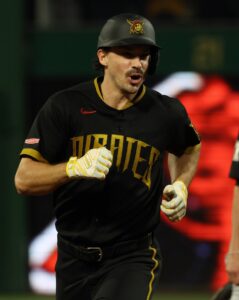
The team’s top producers have been a nice combination of homegrown heroes and shiny new toys. Bryan Reynolds, the longest-tenured Pirate, leads the team with a .403 on-base percentage; among qualified outfielders, only Mike Trout and James Wood have reached base at a higher rate. Acquired in the 2018 Andrew McCutchen trade, Reynolds broke out as a star in 2019 and ’21, his first two full seasons. However, his next few years were more good than great, and his 2025 campaign was genuinely disappointing; he saw his wRC+ dip below league average, while his .157 isolated power (ISO) was the lowest of his career. He hardly resembled the middle-of-the-order bat who convinced a famously stingy organization to open the purse strings and sign him to the largest contract in franchise history (at the time) a few years back. Through the first two months of 2026, Reynolds looks like that kind of player again. His power numbers are still down, but he’s compensating with discipline. He walked 57 times in 2025, 57 times in 2024, 53 times in 2023, and 56 times in 2022. This year, the switch-hitter has already drawn 44 free passes, and Pittsburgh has 101 games left to play. Add in his four hit-by-pitches, and he’s on pace to stroll to first base nearly 130 times in 2026; his previous career-high is 83. All told, the offensive production is right up there with that of his best years: an .835 OPS and a 138 wRC+.
While Reynolds is bringing the walks, another resurgent veteran is bringing the power. Brandon Lowe, acquired in a three-team trade this winter, leads the club in home runs, extra-base hits, and wRC+. His 15 long balls are tied for fourth in the National League. If he keeps hitting them at this rate, he’ll be the Pirates’ first 40-homer hitter since Willie Stargell in 1973, and it isn’t unrealistic to think he can pull that off. Lowe has always had big power, but frequent injuries have held him back; he hit 31 home runs in 134 games last year and 39 in 149 games in 2021. The fact that PNC Park isn’t very homer-friendly hasn’t hurt him either. Instead, it’s helped him hit 12 doubles, putting him on pace for a new career-high in total bases and extra-base hits.
There’s no one Reynolds or Lowe has driven in more often than Oneil Cruz, who leads the Pirates in runs scored and RBI. Cruz is a flawed player. He’s struck out in more than one-third of his trips to the plate, and he drives too many balls straight into the ground. The thing is, those flaws are almost trivial when the 6-foot-7 Cruz is making the most of his ridiculous strength and speed. His 119-mph double from April 16 remains the hardest batted ball any player has hit this year – and that’s still nearly 4 mph slower than Cruz’s personal best (which is also the Statcast-era record). In 2026, Cruz has taken advantage of having the third-fastest average swing speed and the highest hard-hit rate in baseball to smack 14 home runs, just seven back of his career high. He is also tied for third in MLB with 19 stolen bases in 22 attempts. That makes him the only player on pace for a 30-30 season.
In many ways, Spencer Horwitz is the anti-Cruz. The 5-foot-10 first baseman doesn’t run well, swing fast, or hit the ball hard. Yet, only 10 qualified hitters have a lower swing-and-miss rate, and only four have a higher walk-to-strikeout ratio. Thanks to his high-contact approach, Horwitz ranks third on the Pirates with an .843 OPS and a 137 wRC+. And while he doesn’t have as long a track record as many of his teammates, he owns a shockingly impressive 146 wRC+ since last year’s All-Star break. Only five qualified NL batters are ahead of him in that time: Shohei Ohtani, Juan Soto, Kyle Schwarber, Brice Turang, and Corbin Carroll. The catch is that the Pirates have done everything in their power to shield the lefty-batting Horwitz from same-handed pitching. Nearly 87% of his plate appearances over the last two years have come against right-handers, and he owns a career .561 OPS and 66 wRC+ without the platoon advantage. Nonetheless, he has proven incredibly valuable, even with his limitations. It seems like the Pirates knew exactly what they were doing when they acquired him in (essentially) another three-team trade two offseasons ago.
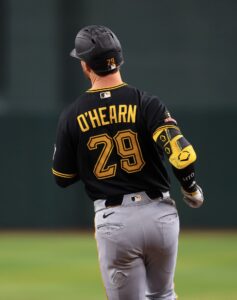
Speaking of righty mashers, Ryan O’Hearn returned from a brief stint on the injured list over the weekend, and he celebrated with a home run off a right-hander in his first at-bat back. The two-year, $29MM deal O’Hearn signed over the winter represented the largest guarantee the franchise has ever given to a free agent hitter. While a contract like that wouldn’t count as a big swing for most teams, it was for the Pirates. So far, it’s looking like they picked the right player to take that swing on. With eight home runs in 46 games, O’Hearn is tracking to surpass 20 for the first time. His .845 OPS and 136 wRC+ would also be his best marks in both categories since his 44-game rookie season in 2018. The Pirates haven’t protected O’Hearn from southpaws the same way they have for Horwitz, so they must be hoping he’ll improve on his .669 OPS and 84 wRC+ against lefty pitching. Even if he doesn’t, his numbers against righties make it easy to overlook his same-handed shortcomings.
The Pirates’ platoon issues go beyond any individual player. Their offense has been relentless against right-handed pitching, but unfortunately, they still have to face left-handers about 30% of the time. With lefties on the mound, the Pirates have a middling .690 OPS and 94 wRC+. Reynolds is doing just fine, and the lefty-batting Cruz has reverse platoon splits, but Lowe, Horwitz, and O’Hearn have struggled to do much damage. That’s compounded by the fact that none of the right-handed hitters in the lineup have stepped up to mash southpaws. Designated hitter Marcell Ozuna, another offseason signing, is showing his 35 years at the plate, while third baseman Nick Gonzales has had most of his success against righties. The good news for the Pirates is that they have at least one righty bat they can count on a whole lot more from.
Konnor Griffin was widely considered the top prospect in baseball entering the season. No one understood the hype better than the Pirates themselves, who agreed to a $140MM extension with their star rookie just a few days into his MLB career. Through 208 PA, Griffin has a modest .729 OPS and 104 wRC+, with roughly even platoon splits. However, he was still finding ways to be a major contributor to Pittsburgh’s offense before he hit the IL over the weekend. (He has a flexor tendon strain, and he isn’t expected to miss much time.) The lightning-fast 20-year-old is 14-for-15 in stolen bases, and he leads the majors in the FanGraphs baserunning metric, BsR. Thus, despite his pedestrian performance at the plate, he has already scored 30 runs in 51 games. If he taps into more of his potential, he can help protect against regression from some of his teammates, and Pittsburgh’s platoon splits should start to even out.
The Pirates haven’t had an offensive core like this in a long time. Lowe, Reynolds, Horwitz, and O’Hearn all rank among the top 20 qualified NL batters in wRC+. In the last decade, only one Pittsburgh hitter – Reynolds in 2021 – has finished a season with a wRC+ high enough to crack the NL’s top 20. Meanwhile, Cruz is on pace to score more runs than any Pirates hitter since Brian Giles in 2001, and he’s hoping to join Barry Bonds as just the second player to go 30-30 in franchise history. Then there’s Griffin, who has the tools to be the organization’s biggest position player star since McCutchen.
This team isn’t without its problems. The Pirates would make the playoffs if the season ended today, but it doesn’t. They have to show they can keep this up for another four months. To do that, they need their veterans to stay hot, their young guys to take the next step, and Endy Rodríguez to finally prove he can be the answer behind the plate. Yet, as early as it still is in the season, there’s something about this version of the Pirates that truly feels different. For the first time in a long time, the Pirates have an offense.
Images courtesy of Charles LeClaire and Mark J. Rebilas, Imagn Images.
Pirates Trade Justin Lawrence To Twins
The Twins announced they’ve acquired reliever Justin Lawrence from the Pirates for cash. Pittsburgh designated the right-hander for assignment last week. Minnesota already had an opening on the 40-man roster and doesn’t need to make a corresponding move tonight.
Lawrence is out of minor league options, so the Twins will need to add him to the MLB roster. They’ll need to demote a pitcher once he reports to the team. Taylor Rogers, Anthony Banda and Yoendrys Gómez are Minnesota’s three in-house relievers who can’t be optioned.
It’s the latest dart throw for a patchwork Minnesota bullpen. Twins relievers are 25th in ERA and 29th in strikeout rate (above only the Nationals). They also had one of the highest walk rates in May. That was expected given the personnel, as the Twins have done very little to replace the various relievers they shipped out at last year’s deadline.
Lawrence is a 31-year-old sinkerballer who carries a 5.32 earned run average across 22 innings this season. He has a league average 23.6% strikeout rate against an elevated 11.3% walk percentage. Lawrence sits in the mid-90s with his fastball and has a swing-and-miss breaking ball. He has been held back by below-average command and missed the bulk of the 2025 season due to elbow inflammation.
Minnesota assumes the approximate $800K remaining on Lawrence’s $1.225MM arbitration salary. He’d be under club control for another two seasons if he pitches well enough to hold his roster spot.
Pirates Reinstate Carmen Mlodzinski From Restricted List
June 1: Pittsburgh reinstated Mlodzinski from the restricted list during Monday’s off day, reports Jason Mackey of MLB.com. The right-hander tells Mackey he did not consider a trade request and will be available to pitch out of the bullpen for tomorrow’s series opener in Houston.
“I want to do what’s best to help us win baseball games,” Mlodzinski told MLB.com. “Being around these guys, this team, it’s a pretty cool group to be a part of. Of course I want to start and will always want that, but winning games takes precedence.”
May 31: In an unexpected move, the Pirates placed right-hander Carmen Mlodzinski on the team’s restricted list today. Righty Cam Sanders was called up from Triple-A Indianapolis to take Mlodzinski’s spot on the active roster, and Pittsburgh now has an open spot on its 40-man roster.
As a reminder, players aren’t paid for any time spent on the restricted list, nor do they receive any MLB service time. Clubs usually use the restricted list for players who are suspended, or are dealing with a personal issue that keeps them away from the team for an undetermined period of time. Colin Beazley of the Pittsburgh Post-Gazette reports that Mlodzinski is expected to be available on Tuesday, so it will be just a short absence for the righty.
The reasons for the placement were revealed today by Pirates GM Ben Cherington, who told Beazley and other reporters that Mlodzinski “wasn’t ready to” pitch on Sunday. “Going into the weekend, we understood and communicated with Carmen that at some point this weekend we were going to need him to be ready or we’d have to replace him on the team in fairness to the team, so that’s what happened today.”
The issue seems to stem from the Pirates’ decision to remove Mlodzinski from the rotation when Jared Jones made his return from the 60-day injured list on Friday. Jones joins Paul Skenes, Braxton Ashcraft, Mitch Keller, and Bubba Chandler in the starting five, leaving Mlodzinski as the odd man out. As Beazley noted, Mlodzinski was open about his disappointment while speaking with the media on Thursday, and Mlodzinski has been vocal in the past about preferring to work as a starting pitcher.
Mlodzinski said Thursday that he is “still communicating with the organization and the people in my corner, whether that’s my family or my agency, about what is next,” but Cherington said today that the right-hander hadn’t requested a trade. The Pirates control Mlodzinski through the 2029 season, as the right-hander won’t reach arbitration eligibility until the coming offseason.
Over 55 innings this season, Mlodzinski has posted a 3.76 ERA in 11 games — nine proper starts and two bulk-pitcher outings working behind an opener. Mlodzinski’s 8.4% walk rate is around league average but he isn’t missing many bats and he is allowing a ton of hard contact. The right-hander’s 50.9% hard-hit ball rate sits only in the second percentile of all pitchers. Still, Mlodzinski’s SIERA is only 4.21, as he has done a good job of limiting the damage of all that hard contact by allowing only three home runs.
A case can be made that Mlodzinski could’ve or should’ve retained a rotation spot over Bubba Chandler, as Chandler has struggled badly with his control while posting a 4.85 ERA across 52 innings. Since Mlodzinski has more experience as a swingman or long reliever, however, the Pirates opted to use that flexibility by moving him into a relief role, with the knowledge that Mlodzinski would likely have an easier time than Chandler in shifting back to a starting gig down the road.
It is understandable why Mlodzinski isn’t happy with the move, but his impending return on Tuesday probably means there aren’t too many hard feelings. Without much leverage in trade demands, Mlodzinski may simply have to move forward as a reliever for the time being, though obviously any number of circumstances (injuries, more struggles from Chandler, etc.) could open up a rotation spot in the future. Having a de facto sixth starter on the roster is also a good way for the Pirates to help keep the entire rotation fresh for what the team hopes will be a push towards a playoff spot.
Joe La Sorsa To Exercise Upward Mobility Clause In Pirates Contract
For the second time this year, Joe La Sorsa will trigger an upward mobility clause in his minor league deal with the Pirates. 7 News’ Ari Alexander reports that La Sorsa will exercise the clause tomorrow, and the Pirates will then have to offer the left-hander to the other 29 big league clubs.
If any other team is willing to give La Sorsa a roster spot, the Pirates are required to trade La Sorsa to an interested team, or add them to their own active roster. If none of the 29 teams are interested, La Sorsa will remain in Pittsburgh’s minor league system.
The two sides already went through this process at the end of Spring Training, when La Sorsa exercised his clause and went unclaimed. The Bucs haven’t felt compelled to select La Sorsa’s contract over the last two months, though he has a respectable 3.60 ERA, 5.9% walk rate, and 46.4% grounder rate rate over 25 innings with Triple-A Indianapolis.
La Sorsa has only a 20.8% strikeout rate, which about matches his moderate swing-and-miss ability over his pro career. After breaking into the majors with Tampa Bay in 2023, La Sorsa has a 5.21 ERA, 17.5K%, and 6.3BB% over 57 career innings with the Rays, Nationals, and Reds. The Mets inked La Sorsa to a minors deal last September that didn’t result in any big league playing time, and La Sorsa became a minor league free agent at season’s end before joining the Pirates.
Between closer Gregory Soto, Mason Montgomery, and Evan Sisk, Pittsburgh has been getting good results from the left-handed complement of its relief corps. Most teams generally don’t have more than three southpaws in the bullpen, so La Sorsa might not have a path to the Pirates’ roster. That said, the Bucs do have an open spot on the 40-man roster and even on their 26-man, as Cam Sanders was optioned back to Triple-A following a one-game cup of coffee in today’s 9-3 win over the Twins.
Another club with more of a pressing need for left-handed depth could have interest in La Sorsa. He has a minor league option remaining, so he has value for teams looking for bullpen arms that can be shuffled back and forth (up to five times) from Triple-A.